Mastering Greenhouse Ventilation Math: A Step-by-Step Guide to CFM Calculation

Understanding Greenhouse Volume and Air Exchange Rates (ACH)
To effectively size an exhaust fan, you must first determine the volume of air inside the greenhouse and the required rate at which that air should be replaced. While general winter ventilation or low-stress environments might only require 4 to 8 air changes per hour, the industry standard for active summer cooling is to provide approximately one air change per minute. This ensures the fan is capable of completely replacing the interior air volume every 60 seconds to prevent the structure from becoming a heat trap.
There are two primary mathematical approaches to establishing your baseline CFM (Cubic Feet per Minute) requirement: the volume method and the floor area method.
The Volume Method
The volume method calculates the total cubic space by multiplying the Length × Width × Height of the structure. To achieve the target of one air exchange per minute, the resulting total cubic footage directly equals your baseline CFM requirement. This approach is highly accurate for structures with unusual roof pitches or non-standard heights where the interior air mass may be larger than a typical build.
The Floor Area Method
Many engineers prefer calculating by floor area because the heat load generated by solar radiation is directly proportional to the floor area it strikes, rather than the total volume. The National Greenhouse Manufacturers Association (NGMA) establishes a baseline of 8 CFM per square foot for moderately shaded structures. This specific metric originated when greenhouse eaves and gutters were typically 8 feet high. Modern recommendations generally span a range of 7 to 10 CFM per square foot depending on the specific height and glazing of the setup.
Adjusting for Solar Gain
Finally, these baseline numbers must be adjusted for local environmental factors. A greenhouse utilizing a thermal screen or shade cloth can operate efficiently at the baseline CFM. However, if the structure is exposed to direct, unfiltered sunlight, the rapid heat buildup requires a "heat buffer." In these cases, you should multiply your final CFM calculation by 1.2. This 20% increase in power ensures the exhaust system can effectively manage the accelerated solar gain and maintain the desired air exchange rate.
The Core Formula: Converting Cubic Feet per Hour to CFM
How do you translate a theoretical ventilation target into a practical equipment purchase? While greenhouse ventilation goals are often discussed in terms of Air Changes per Hour (ACH), exhaust fans are universally sold based on their Cubic Feet per Minute (CFM) capacity. To bridge this gap and avoid buying a fan that is completely mismatched to your structure, you must use the standard conversion formula: CFM = (Room Volume × ACH) ÷ 60.
Step 1: Determine Hourly Airflow
First, establish your baseline volume by multiplying the structure's length, width, and height. Next, multiply this volume by your desired ACH. For instance, while active summer cooling may require higher rates, a standard environment might target 4 to 8 air changes per hour depending on the season and crop. If you have a greenhouse measuring 50 feet long, 20 feet wide, and 10 feet high, your volume is 10,000 cubic feet. To achieve 6 ACH, you must replace 60,000 cubic feet of air each hour.
Step 2: Convert to Minutes
Because exhaust fans are universally rated by the minute, you must divide the total air volume needed per hour by 60. In this scenario, 60,000 divided by 60 equals exactly 1,000 CFM.
By following this formula, you eliminate the guesswork and arrive at a precise, data-backed baseline. This ensures you select a fan with the exact capacity required to prevent your greenhouse from becoming a solar oven, ensuring you avoid undersized equipment that fails to cool the space or oversized units that waste energy.
Adjusting for Solar Gain and Structural Resistance
Once a baseline CFM is established, the calculation must be adjusted to account for the thermal and physical realities of the greenhouse environment. Why might a structure still overheat even when the baseline math is correct? The answer usually lies in unmitigated solar gain. Sunlight transmitted directly through the glazing represents a huge potential cooling load. Rigid plastic and glass materials are highly susceptible to the "greenhouse effect" because they allow less than 4% of the thermal radiation to pass back through to the outside.
To manage this, you must factor in the glazing's Solar Heat Gain Coefficient (SHGC). For example, clear glass with a high SHGC of 0.6 will result in massive solar heat gains, particularly through west-facing glass, which is the most critical factor for heat gain during summer months. In these high-exposure scenarios, the baseline CFM should be scaled up by 20% to 30% to remove the excess sensible heat before it damages the crop.
The second critical variable is structural resistance, commonly referred to as static pressure. Any physical barrier in the airflow path forces the fan to work harder, effectively reducing its output. While insect-proof screens are essential to reduce the incidence of pests, they severely restrict airflow. Studies indicate that screens with porosities from 25% to 53% reduce the ventilation rate between 16% and 77% compared to an unscreened structure.
Standard insect screens on either the intake or exhaust increase average airflow resistance by 17%. Even a simple birdscreen on an intake louver will increase a baseline pressure drop of 0.10 in. wg to an estimated 0.112 in. wg. To achieve your target air exchange rate, you must consult the fan's performance curve and ensure it can deliver the required CFM at the specific static pressure of your fully equipped greenhouse, rather than at "free air" (0.0 in. wg).
Implementing Farseen Solar Fans for Sustainable Off-Grid Cooling
Transitioning your calculated CFM requirements into an off-grid solution requires matching your baseline math with the precise output metrics of modern solar ventilation equipment. The capacity of solar exhaust fans varies significantly based on motor design and panel wattage. For smaller structures, an 8-inch solar fan paired with a 25W monocrystalline solar panel typically delivers around 380 CFM. Slightly larger 12-inch models can push 680 CFM, which is sufficient to effectively ventilate spaces up to 5,100 cubic feet. For commercial-scale off-grid cooling, industrial-grade units utilizing a Brushless Servo Motor can deliver up to 4,370 thrust CFM while remaining 30-70% more efficient than traditional alternating current (AC) competitors.
The primary challenge of off-grid greenhouse cooling is the natural intermittency of sunlight. To maintain your target Air Changes per Hour (ACH) during overcast conditions or after sunset, the system's energy storage must align with the fan's draw. Market benchmarks show that systems featuring a 66.6 Wh battery backup or integrated batteries ranging from 5000mAh to 21,600mAh can sustain continuous operation for 6 to 9 hours without active sunlight. To further boost reliability, bifacial solar panels can be employed to capture sunlight from both the front and rear ambient reflections, increasing energy efficiency by up to 130%. For critical operations, a hybrid option with an IP65 100-277 VAC input allows the fan to pull from a backup generator or AC source when solar levels are insufficient.
Effective climate control also requires automation to manage fluctuating heat loads without manual intervention. Modern solar exhaust systems often incorporate adjustable temperature controls and built-in thermostats that engage the fan only when the greenhouse exceeds a specific threshold. Additionally, timer functions (1, 3, 6 hours) allow for precise air exchange cycles. To protect the structure when the fan is inactive, it is essential to utilize an anti-backflow valve. This mechanical seal prevents insects and cold drafts from entering the exhaust port, ensuring the integrity of the internal environment while maintaining a quiet profile—often as low as 36dB even at high speeds of 2800 RPM.
Practical Next Steps
Translating your CFM calculations into a functional ventilation system requires balancing hardware selection, installation physics, and long-term operational efficiency. When selecting equipment, consider that two smaller fans are often better than one giant one. A dual-fan configuration provides critical redundancy if one motor fails and allows for "staged" cooling—running a single fan on mild days and both during peak summer heat to save energy.
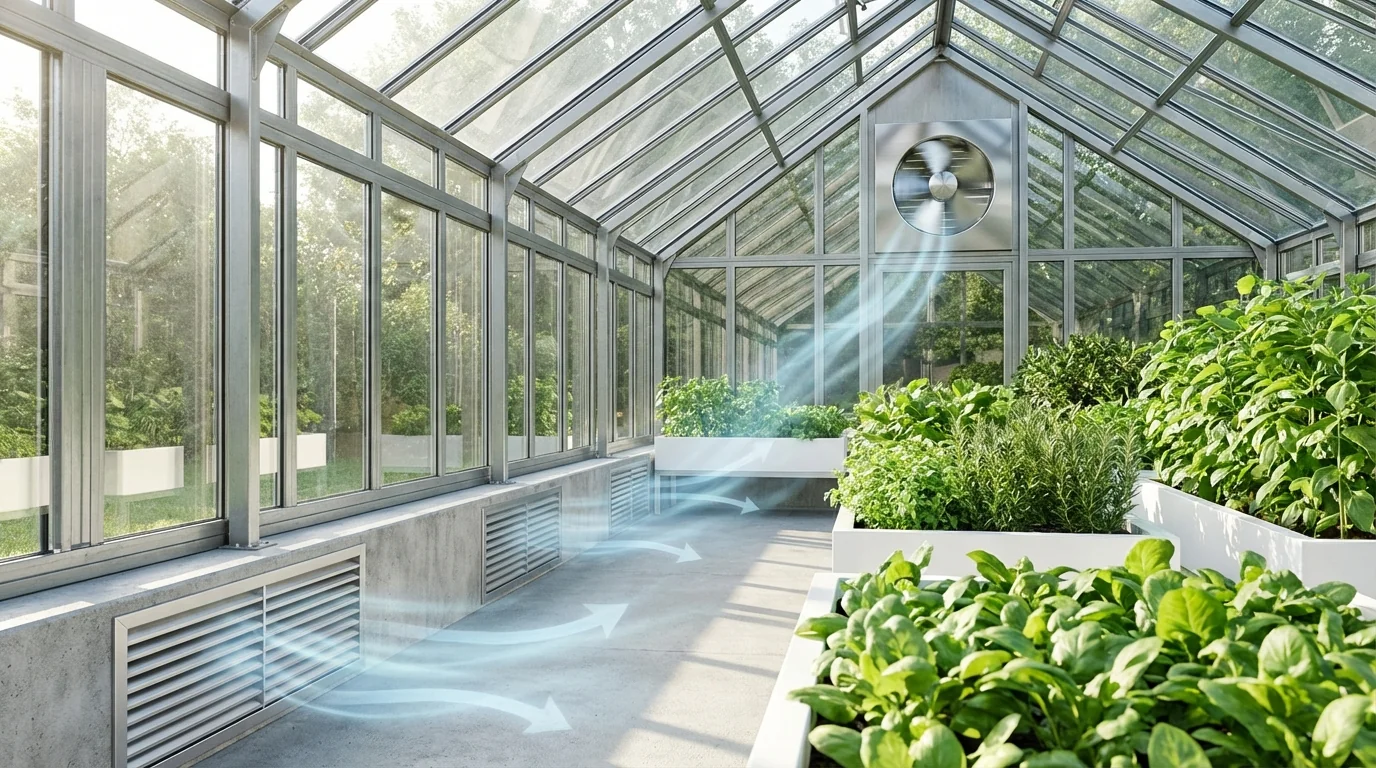
Proper installation is the next step in preventing the fan from "pulling against a vacuum," a common pitfall that leads to motor strain. To ensure unrestricted airflow, your intake vents should offer a total opening area roughly 1.5 times larger than the fan size. For example, a 12" exhaust fan requires a 16" intake or dual 12" intakes. To maximize thermal dynamics, you should mount your exhaust fan high up on the back wall near the peak and place intake vents low down on the opposite wall. This creates a diagonal cross-breeze that pulls cool air through the plant canopy; research confirms that running upper fans alone demonstrated the most effective cooling performance by efficiently dissipating trapped heat.
To optimize energy consumption, utilize automation and variable speed controls. While high-efficiency fans may carry a premium upfront cost, selecting a unit with a 35% higher efficiency rating can result in a payback period of 4.1 years through reduced utility bills. Furthermore, variable-speed fans operated at 85% capacity achieved higher efficiency than those pushed to 100%. Pairing these units with a thermostat plug set to turn on at 85°F ensures the system protects sensitive crops without wasting power on cooler days.
Finally, establish a strict maintenance schedule to protect your investment. You should maintain your ventilation equipment at least twice a year to clean guard screens and inspect motors. This routine is essential for both performance and legality, as over 70% of greenhouse operators must meet specific environmental compliance and legal standards regarding energy efficiency and emissions.

Ray Harlan
Ray Harlan is a seasoned American solar energy expert and Farseen's lead advocate for practical off-grid living. Born and raised in sunny California, with 14 years of hands-on experience in rooftop solar, microgrids, and real-world deployments across the U.S. and beyond, Ray has lived through everything from Texas blackouts and Florida hurricanes to Southeast Asian night markets and remote camping trips. He's not just theorizing-he has tested low-cost lighting and fan systems for street vendors, built emergency food preservation setups during multi-day power outages, and fine-tuned solar solutions for hot nights, kitchen ventilation, and disaster readiness. His mission is simple: turn sunlight into reliable, everyday power for families, small businesses, and outdoor enthusiasts. Every article he writes draws from field-tested insights, honest cost breakdowns, and straightforward step-by-step advice so you can confidently harness solar energy in your own life.