
The best portable solar fan for a market stall keeps air moving through your busiest hours without relying on perfect sunshine. Battery-backed runtime, efficient airflow, and a setup you can carry and recharge easily matter more than flashy solar claims.
Is your stall turning into a heat trap by noon, with the card reader, produce, or handmade stock all feeling warmer than they should? Newer fan motors can use up to 65% less electricity than older designs, which makes a real difference when every watt has to come from a panel or battery. The goal is to choose the right fan, size the power setup properly, and avoid the off-grid mistakes that make stall cooling unreliable.
Why Stall Cooling Is Different From Patio Cooling
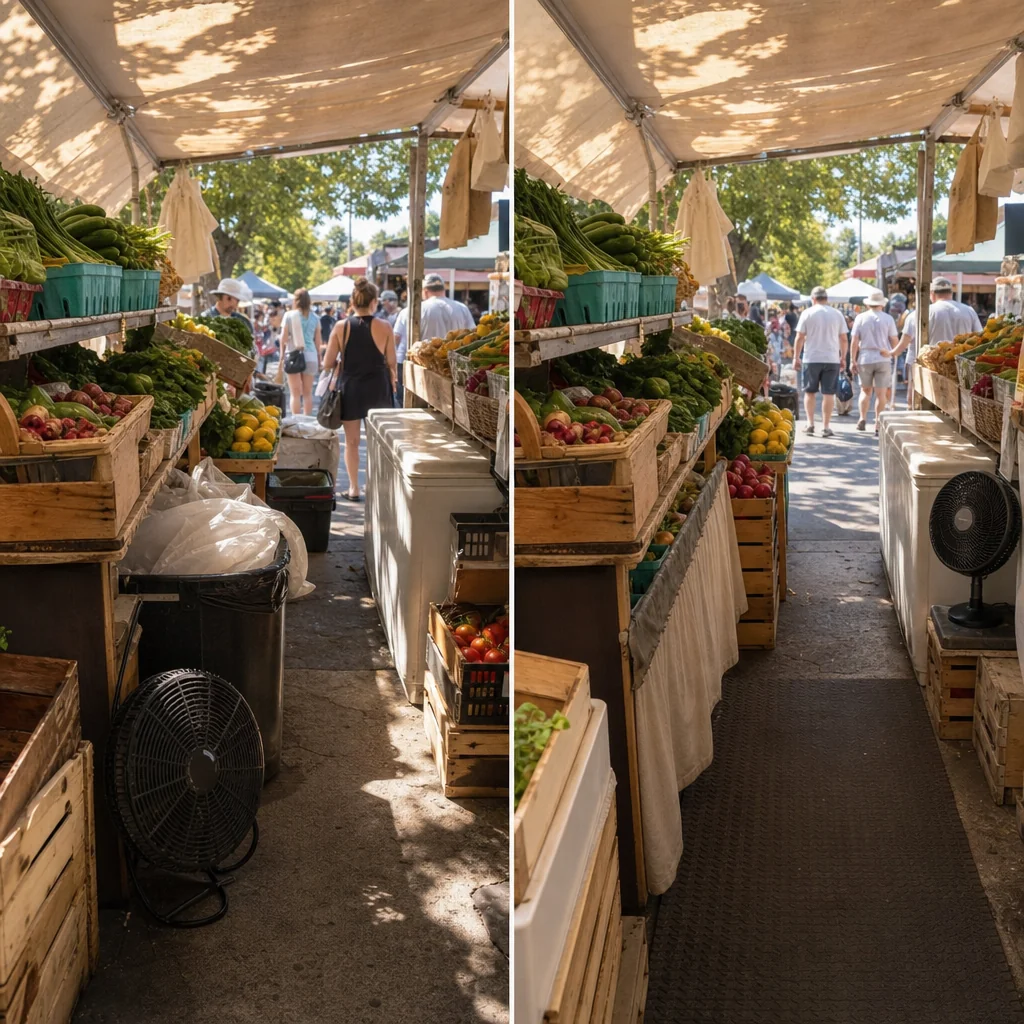
A market stall is a tougher environment than a porch or backyard table. You are usually working with moving shade, side gusts, foot traffic, limited floor space, and no tolerance for cable clutter near checkout. That is why the first question is not “Is this fan solar?” but “What problem is it solving at the stall?”
Portable solar products as an entry point to flexible clean energy make sense because they let you power small essentials without committing to a full fixed system. In practice, that means a stall fan should be treated like a small off-grid appliance: it needs enough airflow to cool a person across a table or keep air circulating around sensitive goods, but it does not need to act like a full-size room fan.
A useful definition helps here. A portable solar fan is simply a mobile fan that runs directly from a solar panel or, more reliably, from a battery that can be recharged by solar. For stall use, that second setup is usually better because clouds, building shadows, and tent canopies interrupt charging at exactly the time you still need airflow.
What Matters Most When You Buy
Airflow That Matches the Real Job
Oscillating fans dominate the stand-fan segment, which is a useful clue for stall buyers: wide airflow coverage usually beats a narrow blast aimed at one spot. If you sell across a 6 ft to 10 ft frontage, a fan that sweeps air across you and the customer side often feels better than a stronger fan locked in one direction.
The practical test is simple. If the fan only cools your face when it is pointed exactly at you, it is a personal fan. If it can move air across your working zone, it is doing stall duty. For baked goods, flowers, candles, soaps, and electronics, gentle circulation is often enough. For a food booth with radiant heat and long lines, you may need two smaller fans placed low and cross-angled rather than one larger fan in the back corner.
Motor Efficiency Matters More Than Many Sellers Admit
BLDC motor adoption can cut electricity use by up to 65% versus traditional induction designs, and that single spec can be more valuable than an extra speed setting. On a grid-powered patio, wasted electricity is mostly a bill issue. At a market stall, wasted electricity means shorter runtime, a larger battery, more panel weight, or all three.
This is one of the first things that shows up in real use. A cheap fan with mediocre efficiency may feel acceptable for the first hour, then force you to choose between lower speed and a dead battery by late afternoon. A more efficient fan often gives you the same usable comfort with a smaller off-grid kit.
Battery-Backed Operation Beats Direct-Sun-Only Claims
A direct-solar fan sounds appealing until a cloud passes, a neighboring canopy casts shade, or your best-selling period stretches into late afternoon. For stall work, stored energy is what turns a solar gadget into a dependable tool. The battery does not need to be huge, but it does need honest runtime.
Deep-cycle lithium options such as LiFePO4 last far longer than older lead-acid battery formats, which is why they are a better fit if you run markets weekly. The upfront cost is higher, but the cycle life, lower maintenance, and steadier performance usually make more sense than replacing cheaper batteries early.
How to Size a Fan and Solar Setup Without Overbuying
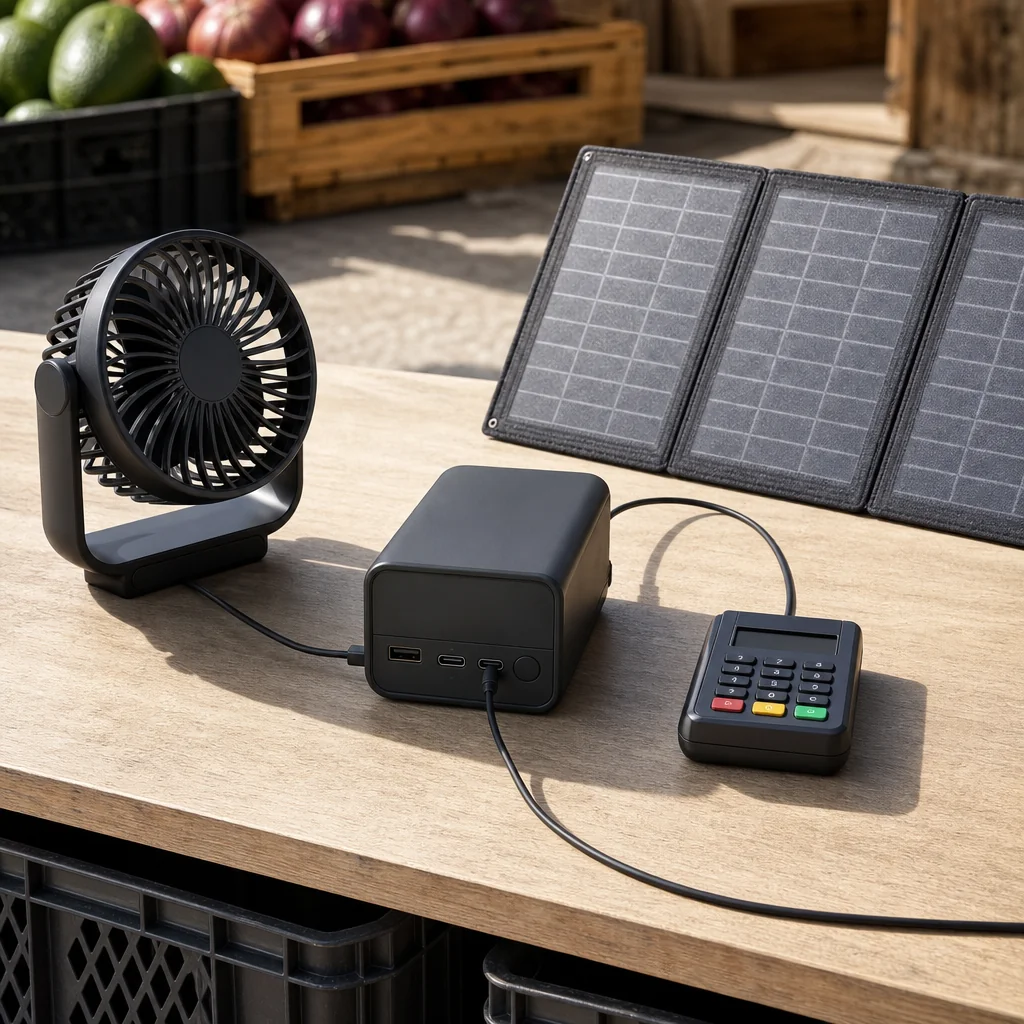
Start With Watt-Hours, Not Marketing Labels
Off-grid system planning works best when you separate watts from watt-hours. Watts tell you how hard the fan pulls at a moment in time. Watt-hours tell you how long your battery can keep that fan going.
Here is a realistic stall example. If your fan draws 12W and you want it to run for 8 hours, your base need is 96Wh. After allowing for speed changes, inverter or controller losses, and the fact that stalls never run in perfect conditions, a 150Wh to 200Wh usable battery is a much safer target. If you run two 12W fans for the same workday, you are now planning around roughly 200Wh before headroom, not counting a cell phone charger or card reader.
Match the Panel to Your Market Day, Not Just the Fan
Many U.S. locations average roughly 4 to 5 good sun hours a day, so panel sizing should assume a limited recharge window rather than all-day nameplate output. A 50W panel may look generous beside a 12W fan, but on a mixed-sun market day it may only just cover the fan and a partial battery refill once real losses and imperfect angle are considered.
That is why the most practical setup for many stalls is a modest battery with a panel large enough to recover midday, not a tiny panel trying to run everything live. If you sell from 8:00 AM to 3:00 PM, a larger foldable panel can top up during bright hours while the battery carries you through setup, lunch-rush shade, and pack-down. The panel is your refill source; the battery is your stability.
Durability, Noise, and Setup Details That Decide Whether You Actually Keep Using It
Portable cooling gear only earns its place if it is easy to live with. A fan that rattles, tips over in wind, or tangles into your payment cables will stay home after a few weekends. For stall use, the better build is usually a stable base or secure clamp, guarded blades, simple speed controls, and an enclosure that does not feel flimsy after repeated loading in and out of a vehicle.
Portable solar buyers are often pushed toward durability, and those traits matter even more in a temporary retail setup. Dust on the panel cuts charging. Loose stands become safety risks. Loud fan motors wear on both seller and customer conversation. Quiet airflow is not a luxury at a craft stall or produce table; it affects how comfortable people feel lingering.
There is also a useful tradeoff to accept early. A compact solar fan is excellent for personal comfort and small-zone airflow, but it is not a substitute for a large mains-powered floor fan. The right expectation is improved comfort, better circulation, and more resilience off-grid, not refrigerated air.
The Mistakes That Cost the Most
The most common buying mistake is treating “solar-powered” as proof of all-day performance. It is not. Some products only work well in direct sun, while others include such a small panel or battery that the solar feature is more of a backup trickle than a full operating strategy.
Another mistake is undersizing the power system. Off-grid planning repeatedly shows that too little battery capacity causes the fastest failures. For a stall, that usually means fading airflow during peak heat, dead payment devices late in the day, or a rushed switch to a noisy gas generator you were trying to avoid.
One final nuance is worth keeping in mind. Market-growth headlines about portable and personal fans often use broad categories that include everything from desk fans to wearable models. That is why those headlines are less useful than real specs such as watt draw, battery chemistry, and measured runtime. For stall buyers, product fit matters more than category hype.
A good portable solar fan setup should feel boring by week three. It should start easily, stay quiet, survive shifting weather, and keep you comfortable without drama. If you can run your fan through the hottest block of the day and still close out sales with battery left, you chose well.

Jordan Lee
Jordan Lee is part of the Farseen editorial team.