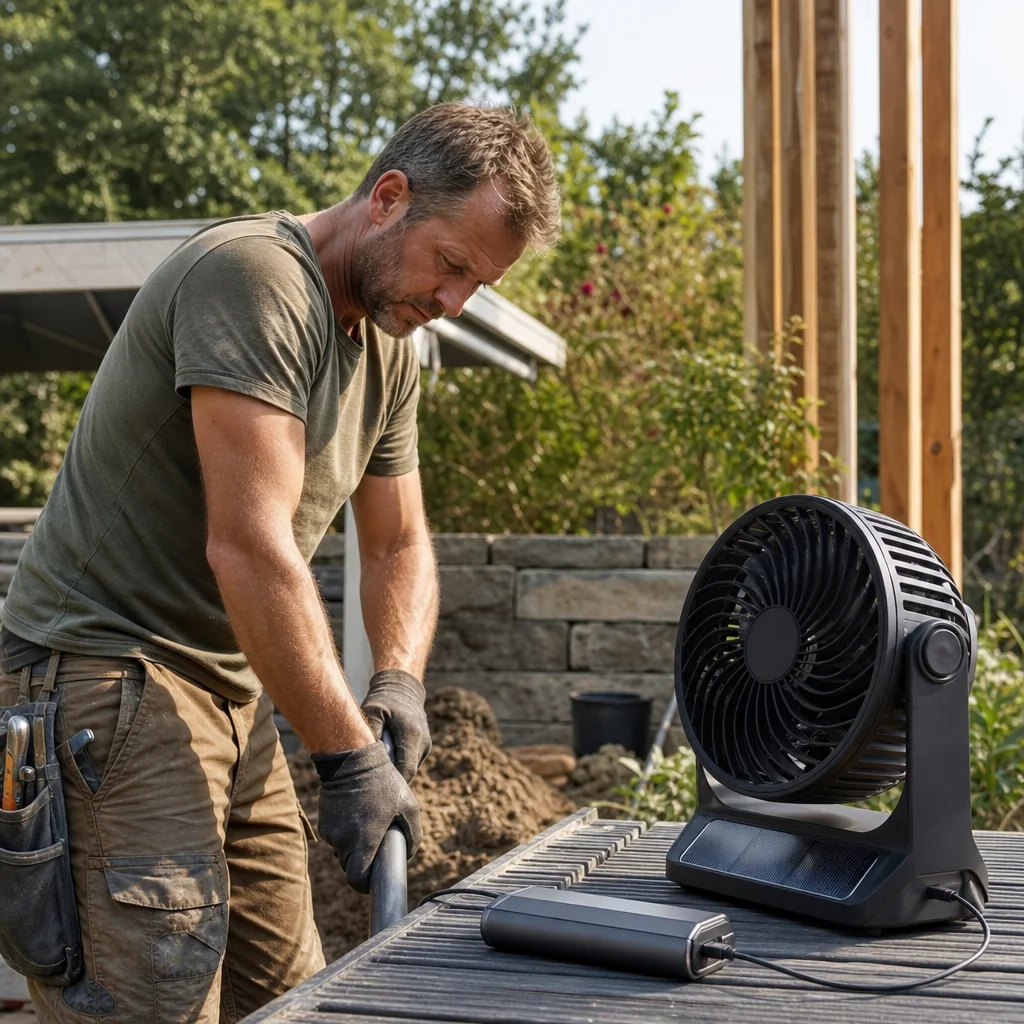
For outdoor workdays, the best solar fan is usually a rechargeable model with both solar support and USB charging. It keeps air moving when clouds roll in, when you move into shade, and when the day runs longer than the sun.
For outdoor workdays, the best solar fan is usually a rechargeable model that supports both solar topping-up and USB charging because it keeps airflow going when clouds roll in, when you move into shade, and when the workday runs past peak sun.
Are you halfway through a fence repair, a market shift, or a garden build when the air goes still and the heat starts draining your focus? The models that hold up best in practice are the ones that cool you in direct sun, recharge from USB when needed, and still make sense in a low-power off-grid setup. You need a clear way to judge whether one is worth packing, which specs actually matter, and how to use it without overestimating what “solar” can do.
Why This Category Makes Sense Off-Grid
A fan that runs from photovoltaic power is simply a fan powered either directly by a panel or indirectly through a charged battery. For outdoor work, that distinction matters more than the marketing label. A direct-solar fan may spin nicely at noon, but a battery-backed fan with USB charging is the more useful tool when you step under a canopy, move around a property, or keep working into late afternoon.
The pattern that shows up again and again in real outdoor use is that personal cooling works best when the device is built around flexibility rather than pure solar input. Rechargeable solar-supported fans are generally more practical in because they can keep running at night, during outages, or when sunlight is inconsistent. That fits outdoor workdays perfectly, since the hottest task area is not always the sunniest one.
What USB Charging Really Adds
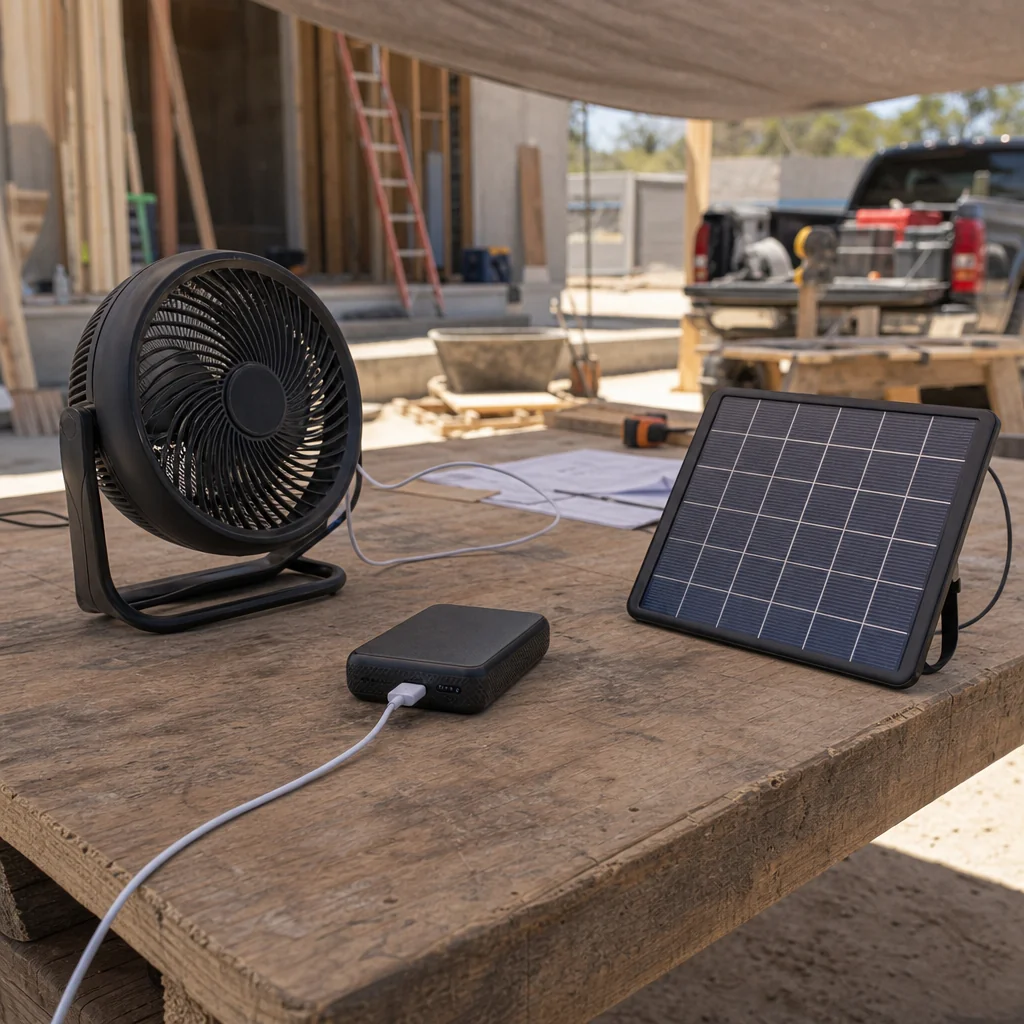
USB charging is not a minor convenience feature. In off-grid terms, it turns a solar fan from a weather-dependent gadget into a device that can plug into the rest of your energy system. Portable solar charging systems commonly combine PV panels with battery storage and USB outputs, and that same logic carries over to fans meant for mobile use.
For a workday, USB charging gives you three practical advantages. First, you can precharge from a power station before leaving home. Second, you can top up from a vehicle USB port or battery bank during lunch. Third, you can use a small folding panel as a supplement instead of asking a tiny built-in panel to do all the work. If you already carry a portable power station for lights, cell phones, or tools, a USB-chargeable fan fits naturally into that setup.
The Best Fit for Outdoor Workdays
Battery-Backed Beats Solar-Only
Small solar consumer products work best when they include storage rather than relying on live sunlight alone. For a landscaper trimming along a fence line, a seller under a pop-up tent, or a homesteader cleaning a shed, stored power is what keeps airflow consistent when the panel angle changes every few minutes.
There is also a technical reason for that advantage. The same solar umbrella research highlights a DC-centric design: solar panels produce DC, batteries store DC, and many portable fans and USB devices also use DC. That reduces conversion loss compared with routing everything through AC, which matters when every watt is small and precious.
A Built-In Panel Is Usually Backup, Not the Main Power Source
A retail listing such as a rechargeable fan with a 20,000 mAh battery and 3W solar panel shows the common formula in this category: a large internal battery, USB charging, multiple fan speeds, and a small solar panel added for emergency or supplemental charging. That listing mentions a 20,000 mAh battery, USB charging support, six speed settings, and a 3W solar panel, which is useful context for how these products are typically designed.
That matters because a tiny panel can help maintain charge in good sun, but it is rarely enough to guarantee strong all-day cooling at higher speeds. If your work happens in direct exposure for hours, treat built-in solar as a slow refill path and USB as the dependable recovery method. That expectation keeps you from buying the right idea for the wrong reason.
How to Choose One Without Guessing
Match the Fan to the Job, Not the Hype
Portable and rechargeable solar fans are best for personal cooling, not for cooling a whole barn, full workshop, or large enclosed room. That sounds obvious, but it is one of the most common buying mistakes. If you are standing at a workbench, driving a mower, sorting produce, or repairing irrigation lines, personal airflow can be enough to lower heat stress and improve focus. If you expect one small fan to ventilate an entire detached garage in August, you will be disappointed.
| Use case | Best fan style | Why it works |
|---|---|---|
| Walking jobs, market stalls, campsite chores | Compact rechargeable fan with handle or hook | Easy to reposition and recharge by USB |
| Bench work, shed tasks, canopy setups | Larger battery-backed fan with oscillation | Better comfort in one fixed zone |
| Greenhouse, attic, or fixed ventilation | Dedicated solar ventilation fan | Better for moving stale air than personal cooling |
That split is consistent with solar fan guidance that separates portable fans from fixed ventilation products. The right tool depends on whether you need a breeze on your body or air exchange in a space.
Check Charging Options Before Extras
For outdoor work, the order of importance is usually charging method, runtime, speed control, and portability. Futurelight’s buying advice emphasizes runtime, battery capacity, and speed control. That is a better filter than vague phrases such as “high-efficiency solar fan” or “all-day battery.”
A good scenario test is simple. If you work six to eight hours and expect part of that time in shade, ask whether the fan can start the day fully charged over USB, run acceptably on a medium setting, and accept some solar input while idle or clipped near your station. If the product description leans heavily on sunlight but says little about USB performance or battery size, that is a warning sign.
Where Solar Actually Helps During the Day
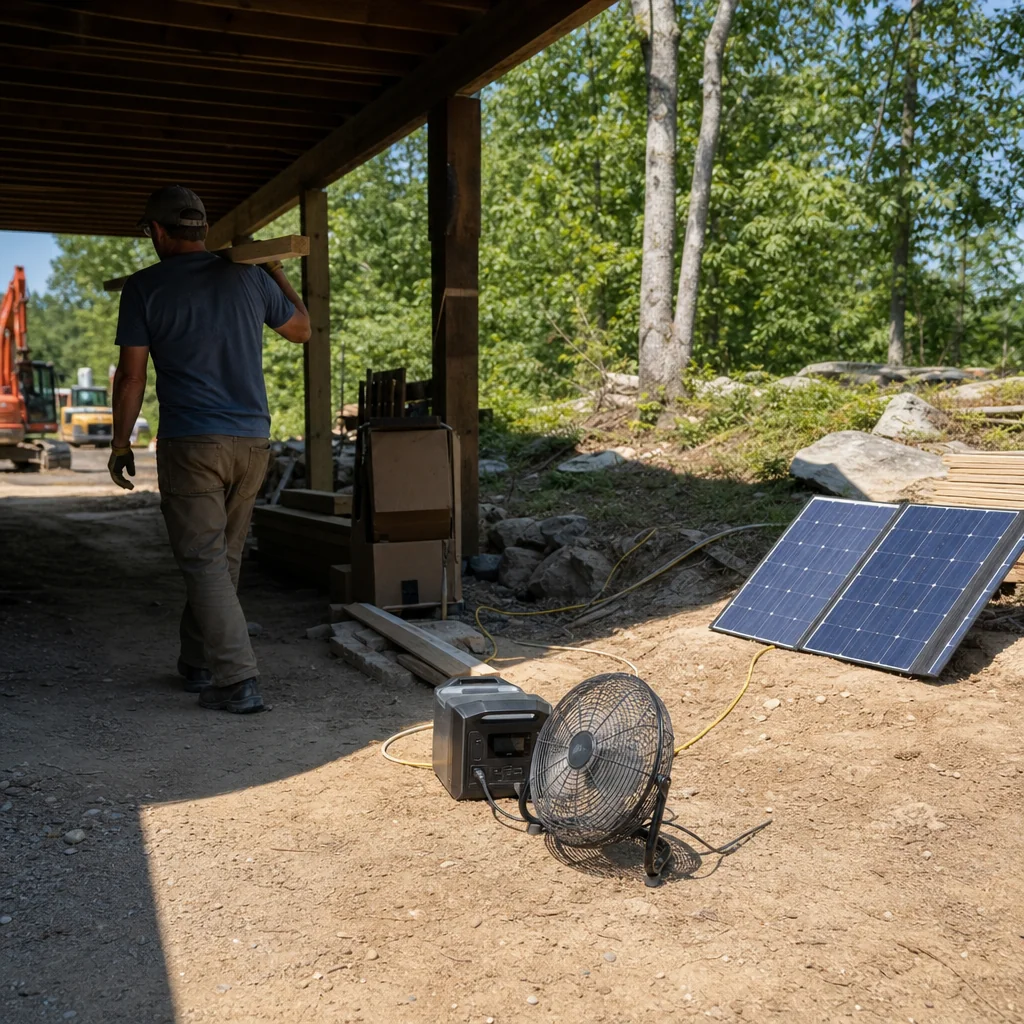
Portable power systems paired with solar panels work. A fan is a small load compared with a fridge or power tool, but the principle still applies. If you set the panel in clear sun from late morning through midafternoon and use the fan hardest during that window, you reduce how much stored battery you need later.
This is where small-system discipline helps. Off-grid gear planning starts with load analysis, and even a simple fan setup benefits from that mindset. If your fan also doubles as a light or backup cell phone charger, those extra functions draw from the same battery. The more multiuse the device becomes, the less realistic it is to assume the tiny included panel will keep up on its own.
Pros, Cons, and the Honest Tradeoff
The strongest case for a solar fan with USB charging is that it is silent, fume-free, portable, and easy to fold into a small off-grid routine. Portable solar-powered devices are especially useful where grid access is limited, and that includes fieldwork, rural properties, event setups, and emergency backup.
The tradeoff is that sunlight is variable, and solar performance drops in cloudy, foggy, or rainy conditions. That is why the most trustworthy version of this product is not a fan powered only by sunshine, but a rechargeable fan that can accept solar input when available and USB power when reality intrudes. For most buyers, that balance is the difference between a useful heat-management tool and a novelty.
Care and Setup That Improve Real Performance
Panel placement in strong direct sunlight and regular cleaning make a noticeable difference with small solar devices because there is so little spare charging capacity to begin with. Dust on a panel, a shaded corner of a work trailer, or leaving the fan stored for months without recharging can all quietly reduce usefulness on the day you actually need it.
That same maintenance logic carries into broader off-grid systems. Cleaning panels regularly and avoiding overload are standard practices, and while a fan is a small device, it benefits from the same habits. Charge it before the trip, give the panel unobstructed sun, and do not assume the highest speed is the right setting all day.
A solar fan with USB charging earns its place when it is treated as a practical comfort tool inside a wider low-power setup, not as a miracle cooler. If your workdays happen in heat, dust, and shifting light, choose battery-backed airflow first and solar assist second, and you will end up with something you actually keep using.

Jordan Lee
Jordan Lee is part of the Farseen editorial team.