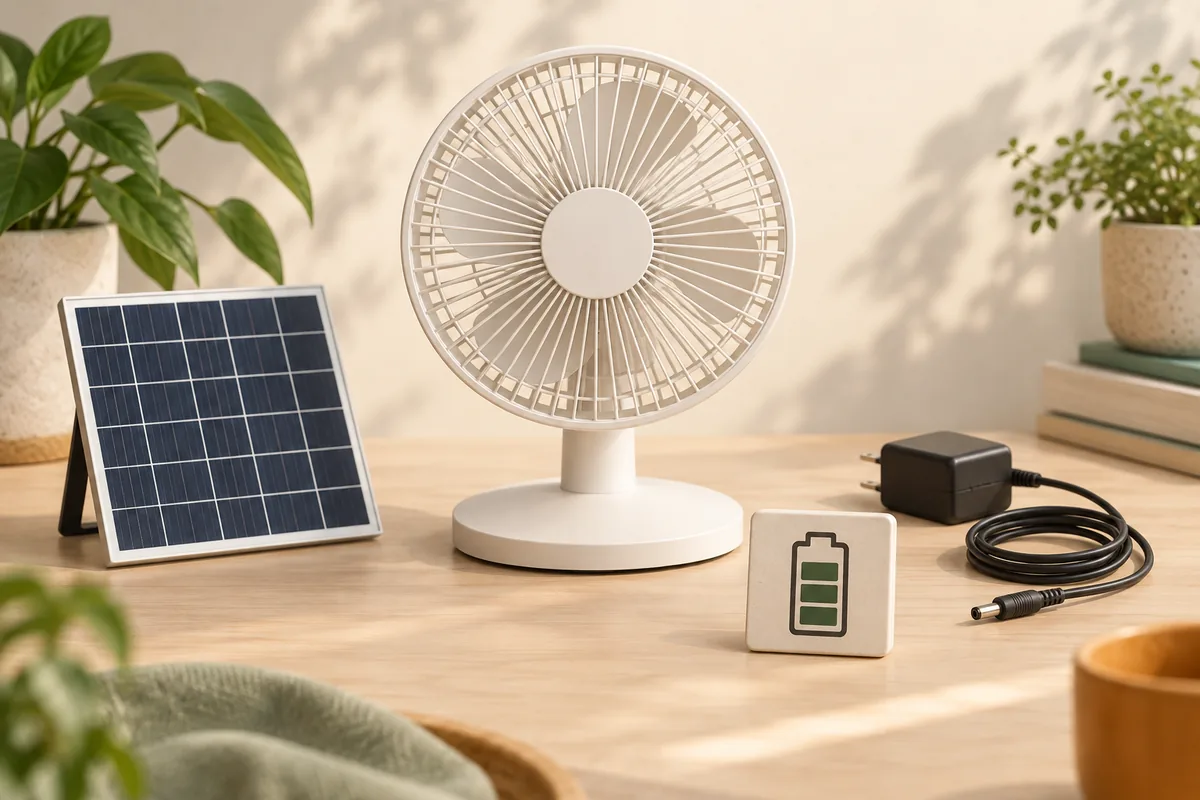
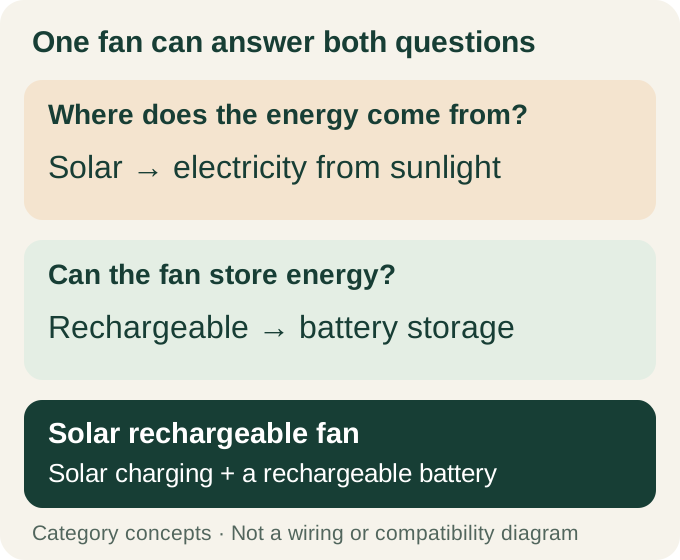
A solar fan and a rechargeable fan are not necessarily two different products. “Solar” describes an energy source. “Rechargeable” describes a battery that can store energy and be charged again. A fan can be both: its battery may charge from a solar panel and, if the design allows, from electricity through a suitable charger.
The useful comparison is therefore how the fan gets energy, whether it stores that energy, and when you need it to run. The label alone does not answer all three questions.
What does “solar fan” mean?
A solar fan uses electricity supplied by a solar panel, either directly through a suitable system or by charging a battery for later use. Photovoltaic cells convert light into electricity, as explained in the US Department of Energy's introduction to solar photovoltaic technology.
A panel is an energy source, not a battery. Its presence does not establish that the fan can run after sunset. You need to know whether the product also has storage or another supported power source.
The term also does not tell you whether the fan can operate directly from its panel. Some designs are built around battery charging and particular control electronics. Treat direct solar operation as a product feature to check, not an automatic consequence of having a panel connector.
What does “rechargeable fan” mean?
A rechargeable fan contains or uses a rechargeable battery. After charging, stored energy can power the fan without a live wall socket for a limited period, within the product's operating design.
“Rechargeable” alone does not specify the charging source. A model may use a mains-powered charger, a supported USB input, solar charging or a combination. A USB port that charges a phone is an output, so its presence does not prove that it can recharge the fan.
The overlap is visible in real products. For example, Solarway's SW101 product page lists a solar panel, a rechargeable battery and electrical charging for the same fan. That establishes an example of the combined category; its specifications should not be transferred to other products.
Compare three possible designs
The following are general configurations. They do not claim that every product offers all three operating arrangements.
| Design | Where energy comes from | Can it run after sunset? | Main planning question |
|---|---|---|---|
| Rechargeable fan charged from mains electricity | Approved charger and rechargeable battery | From a sufficiently charged battery, within its runtime | Can you recharge between the outages or uses you expect? |
| Solar rechargeable fan, with a supported mains charger | Solar panel or approved mains charger charges storage | From stored energy, subject to the model's controls and runtime | Can your available charging time replace the energy you use? |
| Direct solar fan without a battery | Supported panel and control system, without energy storage | Not from solar alone once useful sunlight is unavailable | Do you only need operation while enough sunlight is available? |
No battery lasts indefinitely. For either rechargeable category, usable stored energy and average electrical demand determine how long the fan can operate. Speed and permitted accessory use can change that demand. See how to calculate fan runtime for the calculation and its limits.
Which type makes sense during power cuts?
Start with the outage and your intended use, then choose the charging arrangement.
Short interruptions with reliable charging between them: a rechargeable fan may provide the stored energy you need, provided its tested runtime covers your chosen setting and schedule. Solar charging is an additional option, not a requirement created by the word “rechargeable.”
Repeated interruptions or limited access to grid charging: solar charging can provide another way to replenish the battery. Its usefulness depends on actual access to sunlight and a practical place for the matched panel. A shaded indoor corner does not become a dependable charging location just because the fan is described as solar.
Evening or overnight use: storage matters. Compare the runtime at the mode you intend to use and how you will recharge the next day. A panel-only system does not provide stored nighttime energy.
A desk, bedroom or small shop: also check where the fan will stand or mount. Charging flexibility cannot compensate for a format that does not fit the available space or deliver a comfortable breeze at the occupied position.
Can a solar fan also charge with electricity?
Yes, when the particular product supports an appropriate mains-powered charger. This is a feature of its charging system, not a rule for all solar fans. Use the specified charger and supported input; a plug that physically fits does not establish electrical compatibility.
For a concrete Farseen example, the current product specifications list solar charging and a DC charger for all four families: 198F, W01, S600 and T02. They belong in the combined solar rechargeable category. Their formats and packages differ, so compare the current solar fan range when choosing a physical model.
Those listed charging options do not, by themselves, confirm operation while charging, automatic switching during a power cut, or compatibility with an arbitrary replacement panel. Check those behaviors separately when they matter to your use. The charging-time guide explains why charging duration also needs defined conditions.
Does “solar” mean free or unlimited operation?
Sunlight can supply charging energy without purchasing that portion from the electricity grid. The fan, panel and battery still have purchase and ownership costs, and the battery holds a finite amount of usable energy.
For mixed solar and mains charging, electricity cost depends on how much energy you actually draw from the socket. The fan electricity guide and calculator explains measurement points and why panel watts, charger ratings and fan consumption are different quantities.
A practical checklist before choosing
- Charging sources: which inputs are supported, and which panel or charger is included?
- Storage: is a rechargeable battery included, and what capacity information and operating limits are documented?
- Your schedule: what runtime is established at the speed and accessory combination you need?
- Recharging opportunity: can your available sunlight or grid access replenish that use?
- Physical fit: does the desk, standing or wall format suit the occupied position and available space?
- Special operating behavior: if you need use while charging or automatic changeover, is it explicitly supported?
Compare those answers across actual models. The best description may be “a solar rechargeable fan,” because the two terms answer different parts of the same decision.

Farseen Editorial Team
The Farseen Editorial Team publishes practical guides and company updates about solar rechargeable fans, off-grid appliances, and product sourcing. Where an article discusses product-specific details, refer to its cited sources or contact Farseen for current information.