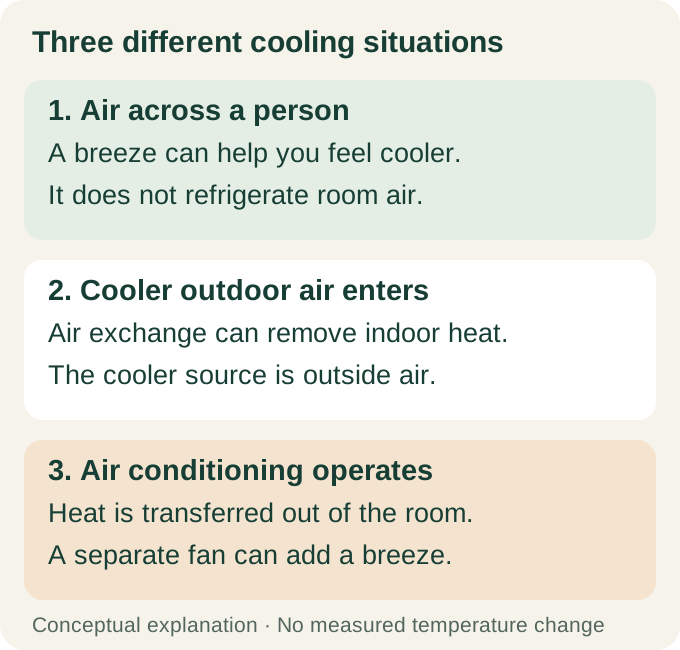
An ordinary circulating fan moves room air; it does not refrigerate it. The breeze can help a person feel cooler even when a room thermometer shows little change. That is why sitting in front of a fan can feel helpful, while running the same fan in an empty, closed room does not pre-cool the room for your return.
There is a separate case: a fan used to bring in cooler outdoor air can help remove indoor heat through ventilation. The temperature change comes from exchanging air with a cooler source, not from the fan creating cold air.

Why does a fan feel cool if the air is not colder?
Your skin and the surrounding air exchange heat and moisture. Airflow can carry away the warm, moist air close to your skin. When conditions allow heat to flow from your skin to the air, moving that air helps heat transfer. Airflow also helps sweat evaporate; evaporation takes energy from the skin.
The US Department of Energy describes how fans assist sweat evaporation and personal comfort. That benefit depends on conditions, including air temperature, humidity and the airflow reaching you. Humid air limits evaporation compared with drier air under otherwise similar conditions. A fan itself does not remove water from the room air like a dehumidifier.
This explains the apparent contradiction: your body's experience can change without the room's air temperature falling. A thermometer measures air temperature, not the complete experience of someone sitting in a breeze.
What happens to the room temperature?
A circulating fan does not provide a process for transferring indoor heat outdoors. Its motor also uses electricity and contributes some heat indoors; the exact effect on room temperature depends on the room, ventilation and other heat gains. There is no useful universal number of degrees to attach to that effect.
Air mixing can still change a thermometer's reading at a particular spot. For example, mixing warmer and cooler parts of a room changes the local air reaching the sensor. That is different from establishing that the fan has removed heat from the whole room.
If you compare readings before and after switching on a fan, keep the thermometer in the same position, away from direct sun and other heat sources. Record open windows, air conditioning and changes in outdoor conditions. Otherwise, a changing reading can be incorrectly credited to the fan alone.
| Situation | What the air movement does | What to expect |
|---|---|---|
| Fan circulating air around a person | Moves air across the skin | Can improve personal comfort without lowering room air temperature |
| Fan running in an empty, closed room | Mixes indoor air | Does not pre-cool the room through refrigeration |
| Ventilation with cooler outdoor air | Replaces some warmer indoor air | Can remove heat when conditions and the airflow path allow |
| Fan used alongside air conditioning | Moves air while the AC removes heat | Combines personal airflow with actual room cooling |
Should you leave a fan on in an empty room?
If its only job is to provide a breeze for people, switch it off when nobody needs that breeze. Leaving it on does not store a supply of cool air for later. It continues using electricity while running.
There can be other deliberate reasons to circulate air, such as distributing conditioned air between occupied parts of a space. Judge those uses by the intended result. An exhaust or ventilation system also has a different job from a standing fan aimed at an empty chair.
Use the fan electricity and running-cost calculator to compare schedules with your own watts and electricity rate. Saving an hour of unnecessary operation has a straightforward energy effect; it does not require a claim about how many degrees the room changes.
Will opening a window make a fan more effective?
It depends on the air outside. When outdoor air is cooler than indoor air, and weather and outdoor air quality permit opening windows, ventilation can help carry indoor heat away. A useful airflow path matters; a fan cannot make hotter outside air cold simply by bringing it indoors.
The Minnesota Department of Commerce's guide to fans and cooling distinguishes ventilation from circulating air for personal comfort. Its building guidance is regional, but the underlying distinction is useful: moving cooler air into a space and recirculating the air already there are different processes.
Keep a household fan dry and use it in the location and manner allowed by its manual. A solar charging feature does not by itself establish that the fan body is suitable for rain or placement in an exposed window.
Can you use a fan with air conditioning?
Yes. The air conditioner removes heat; the fan adds air movement where people are sitting or working. If the breeze makes you comfortable, you may be able to use a less demanding AC setting. The suitable setting varies by person and conditions, so a fixed temperature adjustment or percentage saving should not be assumed.
For a fair comparison, judge comfort at the occupied position. A fan aimed behind furniture or far from the person may circulate air without delivering the breeze they want. More appliances running is not automatically more efficient; the value depends on whether the combination changes AC use while meeting the room's needs.
How should you place a fan for personal comfort?
Start with where people spend time: a desk, sofa, counter or bedside. Choose a stable position and a clear airflow path, then adjust direction and speed for comfort. Keep grilles clear and cords away from walkways. Clean and maintain the fan according to its instructions.
A desk fan and a standing fan put the fan head at different positions, so compare the available surface or floor space as well as the nominal size. Our desk versus standing fan guide illustrates that placement decision with the T02 and 198F.
Solar charging and a rechargeable battery change how a fan receives and stores energy. They do not change this basic cooling distinction. Choose a fan for useful airflow where you need it; if your goal is to lower room air temperature, consider the process that will actually remove indoor heat.

Farseen Editorial Team
The Farseen Editorial Team publishes practical guides and company updates about solar rechargeable fans, off-grid appliances, and product sourcing. Where an article discusses product-specific details, refer to its cited sources or contact Farseen for current information.