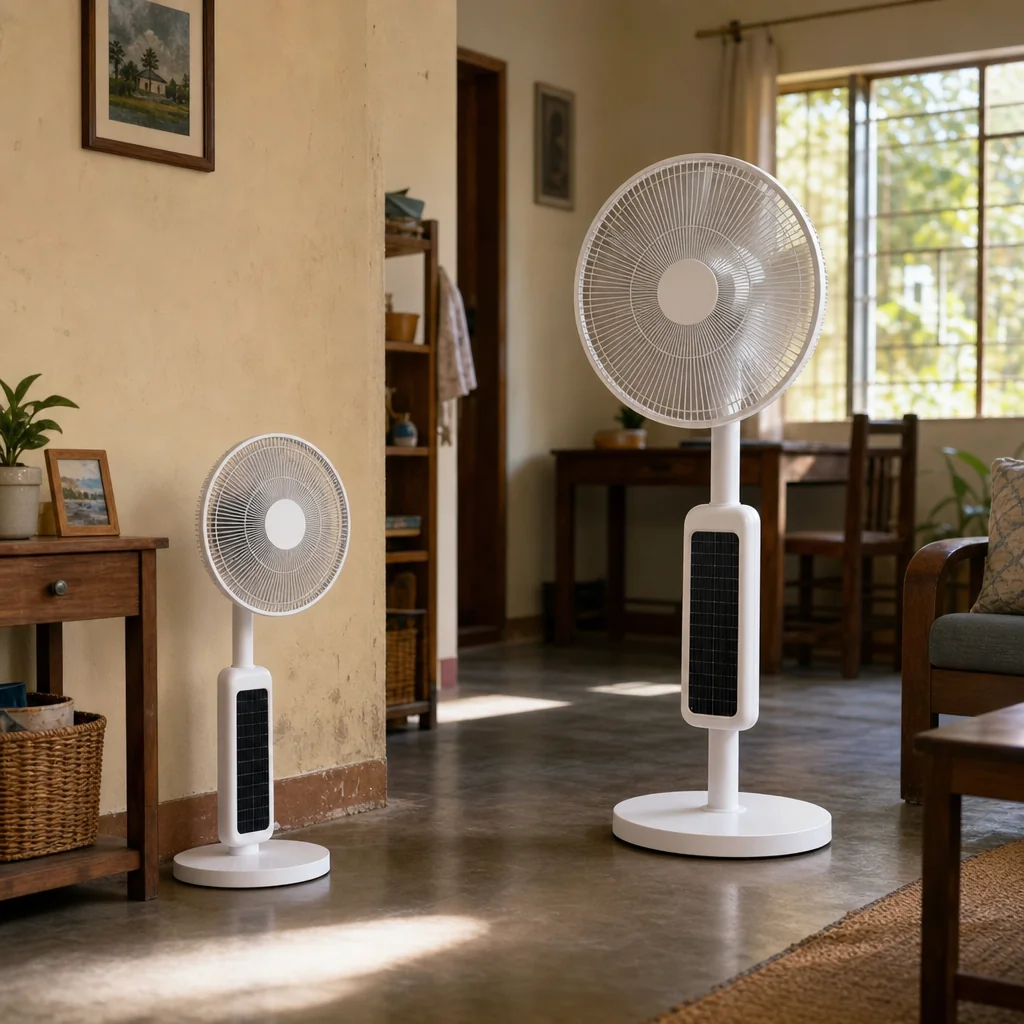
A 12-inch solar stand fan usually works best for personal cooling in small off-grid spaces, while a 16-inch model is better for shared areas that need broader airflow.
If your room still feels stuffy by bedtime even though the fan looks big enough on paper, the problem is usually one of two things: weak airflow for the space or a battery that runs out too early. Both are avoidable with a quick check of room use, runtime, and solar capacity.
What Really Changes Between a 12-Inch and 16-Inch Fan
The diameter affects how a fan behaves in a room, but it is not a shortcut for performance. In practice, a 12-inch stand fan is usually the better choice for personal cooling, tight sleeping quarters, and portable use, while a 16-inch model makes more sense when you want airflow to reach more than one person or move across a wider open area. That does not mean every 16-inch fan is automatically stronger. Actual airflow, motor type, speed settings, noise, and watt draw matter more than blade span alone.
That distinction matters even more off-grid because a fan is not just an appliance; it is part of a small energy system. Many solar-powered appliances with fans are built around very small panels and batteries, often in the 5W to 20W range, which is fine for light personal airflow. A full stand fan usually asks more from your battery and charging setup, so room fit and energy fit need to be judged together.
| Fan size | Best real-world fit | Main advantage | Main tradeoff |
|---|---|---|---|
| 12-inch | Bedside use, compact bedrooms, RV corners, desks, single-person cooling | Easier to power, easier to move, usually better for targeted airflow | Can feel underpowered in broad shared spaces |
| 16-inch | Living rooms, screened porches, workshops, daytime common areas | Better for wider air throw and multi-person comfort | Typically needs more space and a stronger solar-battery plan |
Choose the Size by Room Use, Not by Marketing
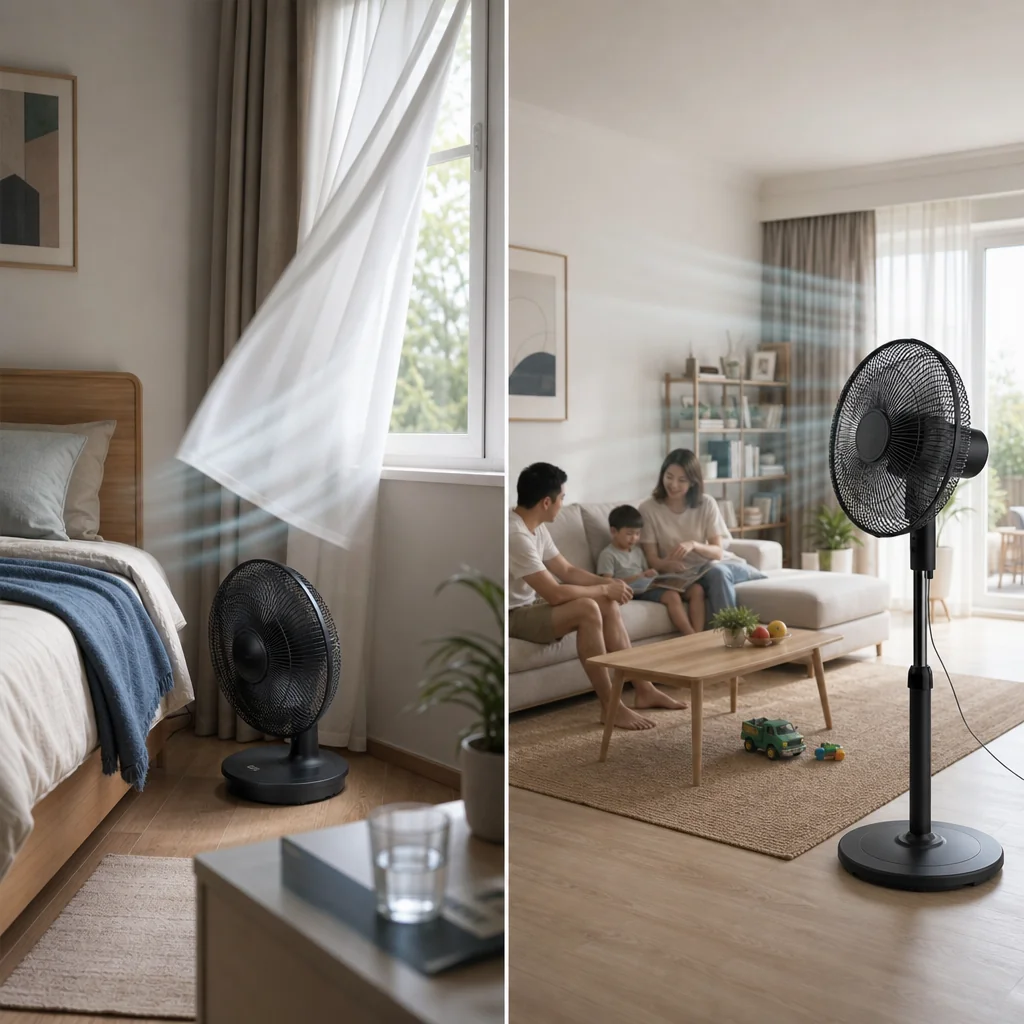
When a 12-inch fan is the smarter pick
A 12-inch fan fits best when you are cooling a person, not trying to cool the whole room. That includes a bunk room in a cabin, a compact tiny-home bedroom, a workbench corner, or the chair you actually sit in during a summer outage. In those situations, targeted airflow is often more valuable than broad coverage because fans help people feel cooler by moving air rather than lowering room temperature. In off-grid living, that usually means more comfort with a smaller electrical load and less nighttime battery drain.
There is also a portability advantage. Smaller stand fans are easier to move from the bed to the table to the porch, which matches the broader appeal of the benefits of solar-powered fans for flexible, outlet-free use. If your cooling needs shift during the day, a lighter, smaller fan often solves more problems than a larger unit parked in one place.
When a 16-inch fan earns its space
A 16-inch solar stand fan is the better choice when the room is open enough that a small personal fan leaves dead zones. Think of a main cabin room where two people are reading, a shaded patio where air stalls in the afternoon, or a workshop where you want the breeze to reach beyond a single chair. In those cases, the larger fan is more practical because you are paying for coverage, not just proximity.
This is also where many buyers make the wrong comparison. Some product roundups talk about solar fans as if they all perform alike, but the category includes everything from mini portable units to ventilation fans and attic systems. The range of solar fan types includes portable, wall-mounted, attic, and hybrid products, so a compact camping fan is not a fair performance benchmark for a 16-inch stand model in a living room.
Solar Sizing Matters More Than Blade Diameter
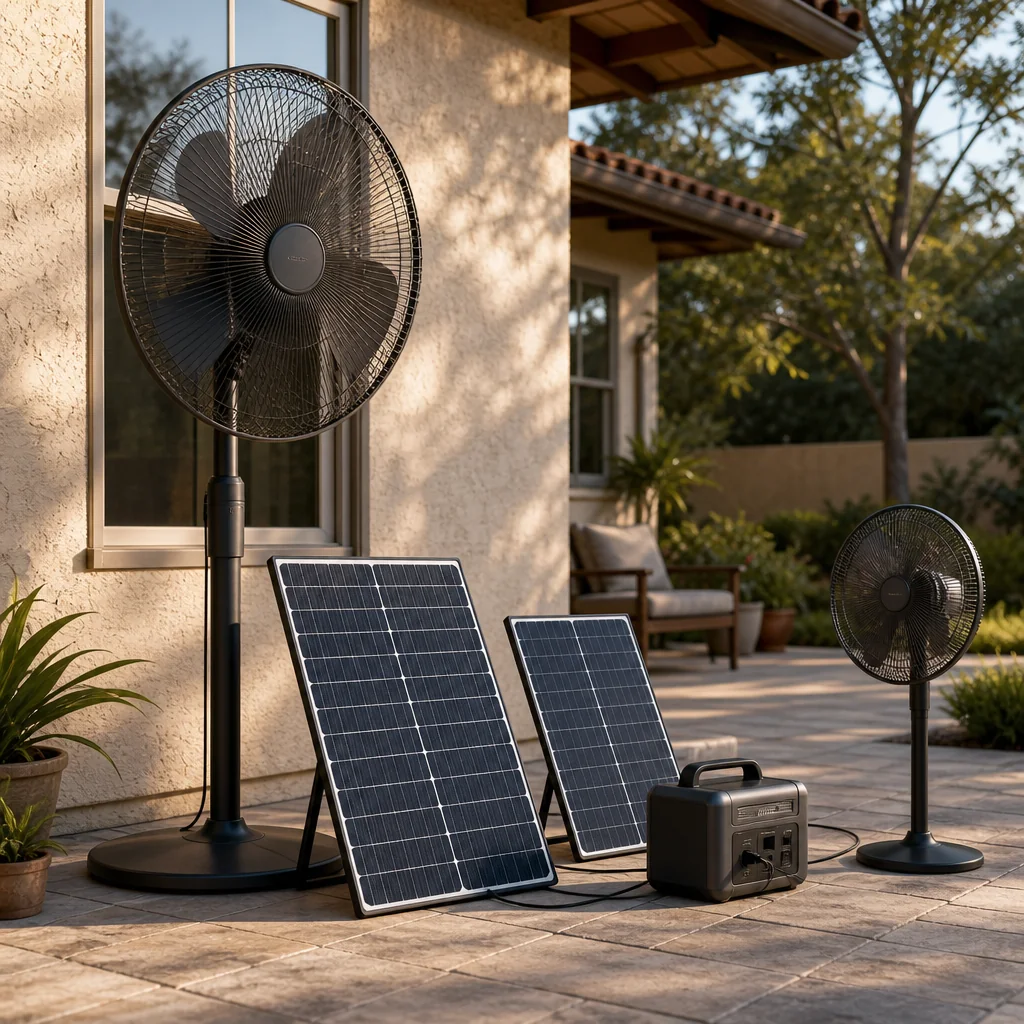
Once you move from casual daytime use to overnight or cloudy-day use, the battery becomes the real decision point. Battery guidance for 12V fans points to the same rule: match battery voltage and current to the fan, and protect the system with a charge controller so you do not overcharge or over-discharge the battery. If you want reliable evening cooling, battery chemistry matters as much as fan size. Lithium iron phosphate usually handles repeated cycling better than lead-acid and wastes less stored energy.
A simple planning example makes this easier. If a stand fan draws 60W and you want to run it for 8 hours overnight, that is about 480Wh of demand before system losses. A 100W solar panel can produce roughly 400Wh to 600Wh per day in decent sun, which means one panel may cover that fan load on a good day, but not with much margin for clouds, conversion losses, or any other devices. That is why a 16-inch fan can be perfectly reasonable in a small solar setup during sunny afternoons yet frustrating at night if the battery bank is undersized.
Calculator tools help, but they need honest inputs. Solar calculator battery sizing guidance notes that small input errors can distort the result, especially when inverter losses or backup days are ignored. For off-grid fans, the cleanest approach is to start with the fan’s actual DC watt draw, your realistic daily runtime, and how many cloudy evenings you want to ride through.
Pros and Cons in Real Rooms
The case for 12 inches
The strongest argument for a 12-inch fan is efficient use. It is usually the right answer when you sleep alone, work in one spot, or need a backup fan you can carry between zones. In a tiny house or cabin, that often means better comfort per watt because you are aiming airflow where your body is instead of trying to move the full air mass of the room. It also pairs better with smaller portable solar systems and all-in-one power stations that off-grid users often prefer for simplicity and modular growth.
The downside becomes obvious on a hot evening when you have guests or place the fan farther away than usual. A small fan that feels perfect at 4 ft can feel weak when asked to cover a sofa, a dining nook, and a doorway at the same time.
The case for 16 inches
The value of a 16-inch fan is reach. If your daily living happens in one shared room, the larger size often feels more useful because you do not need to sit right next to it to feel the breeze. It also works better as part of a wider airflow plan, especially when you combine it with open windows and cross-ventilation.
That said, the larger fan only pays off if the home itself helps the air move. The passive solar home airflow guidance emphasizes how convection and airflow patterns distribute heat and comfort through a home. In plain terms, a bigger fan performs better when it has a path to push or pull air through the space. In a cramped room with poor ventilation, it may simply use more stored energy without delivering a meaningful comfort gain.
The Practical Bottom Line
If your solar setup is modest, your room is compact, or your main goal is sleeping comfort through the night, choose the 12-inch fan first. If you spend most of your time in a shared room and want broader daytime airflow, a 16-inch fan is worth it, but only if your panel and battery sizing support the runtime you expect.
The best off-grid fan is not the largest one you can buy. It is the one that fits the room you actually use, the hours you actually need, and the battery you can recharge again tomorrow.

Ethan Parker
Ethan Parker is part of the Farseen editorial team.