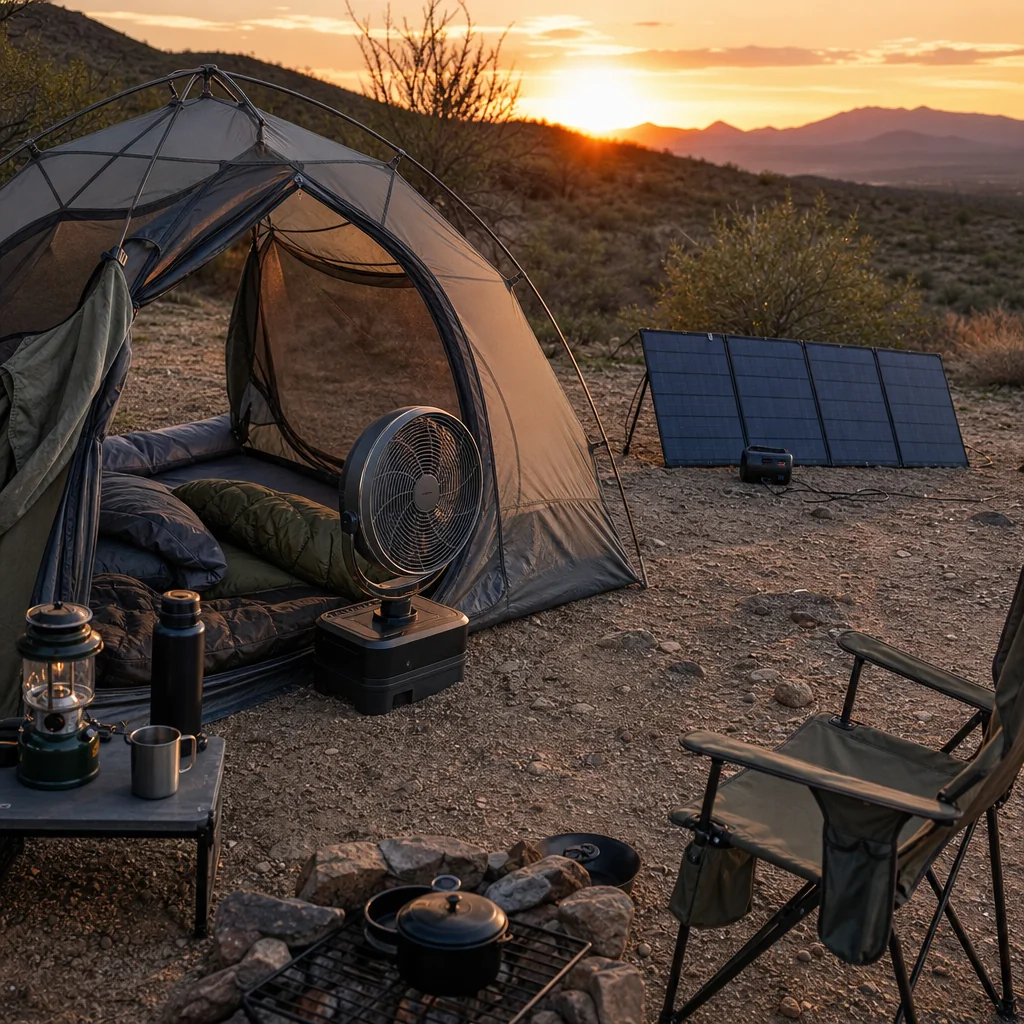
A solar camping fan works best as part of a small, well-sized power system. The right setup keeps air moving overnight without draining your battery before sunrise.
A solar camping fan works best when you size it as part of a small power system, not as a stand-alone gadget. In hot weather, the right setup keeps air moving overnight without draining your battery before sunrise.
Does your tent or SUV turn into an oven by late afternoon, then stay sticky and still long after sunset? In real off-grid camping, small cooling loads like fans are manageable, but only when battery size, panel size, and charging habits match the heat and your actual runtime. This checklist will help you choose the fan, battery, and solar setup that can hold up through a hot trip.
Why a solar camping fan needs a system, not just a panel
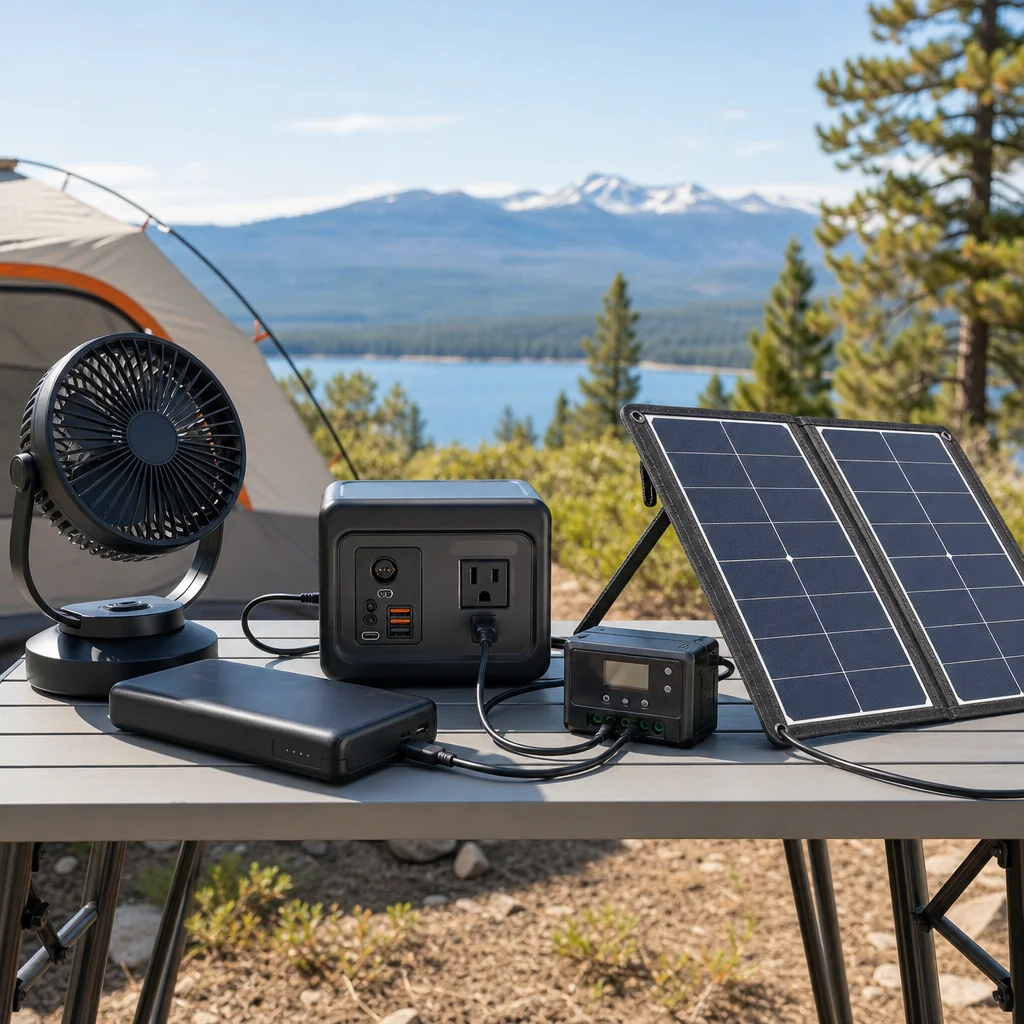
A panel, battery, and load working together is what makes a portable solar setup work well. That matters for a fan because cooling is usually needed most at night, exactly when the panel stops producing and the battery has to do all the work.
In practical camp use, a fan is usually a comfort load, but in extreme heat it can feel much closer to a safety tool, especially in stuffy tents, rooftop tents, vans, and small trailers. The common mistake is assuming a small panel can run the fan directly all evening. In reality, you usually need stored energy from a power station or battery bank, plus enough solar input the next day to replace what you used.
A useful definition here is simple: watts measure how much power the fan draws right now, while watt-hours measure how much energy it uses over time. If a fan draws 40 watts for 8 hours, it needs about 320 watt-hours. That number, not the marketing label on the fan, should drive your buying decision.
The hot-weather checklist that actually matters
Start with overnight runtime, not fan size
A daily energy budget for camping solar is the safest first step for any camping solar setup. For a fan, that means writing down the speed you realistically use, how many hours you need it after dark, and whether you also plan to run lights, a cell phone charger, or a 12V fridge from the same battery.
Hot-weather trips often push fans toward the high end of normal camping loads. One source puts a fan at about 30 to 70 watts, which aligns with what many portable camping and 12V circulation fans use on medium to high speed. If your fan averages 45 watts and runs for 9 hours overnight, you are already at roughly 405 watt-hours before charging a phone or turning on a lantern.
That is why a small emergency battery often disappoints in summer. A battery may look large on paper, but usable capacity is always lower once you account for inverter losses, reserve, and the fact that you should not plan to drain it to zero every night.
Favor DC fans when possible
A 12V off-grid appliance setup is usually the smarter choice for off-grid comfort gear. DC fans tend to waste less power than running an AC household fan through an inverter, and they fit the low-draw, battery-friendly logic that makes camping solar work.
This is one of the biggest practical tradeoffs. An AC fan may move more air and be easier to replace, but it often pulls more power and forces your battery to keep the inverter active. A purpose-built 12V fan or USB fan usually gives you longer runtime, quieter operation, and less system overhead. The downside is that these fans can feel underpowered in very large tents or poorly ventilated vehicles, so placement matters as much as wattage.
If you camp in a vehicle, aim airflow across your sleeping area instead of pointing the fan only at your face. Cross-flow from one cracked window to another usually feels better and can let you run a lower speed setting.
Size the battery for the night you expect, not the afternoon you hope for
A battery reserve matters because off-grid systems need a cushion for losses, surprise loads, and cloudy recovery days. For hot-weather camping, a good rule is to size for one full night of fan use plus your smaller essentials, then add margin rather than planning around a perfect sunny recharge the next morning.
Here is a simple way to think about it in real camp terms.
| Scenario | Typical fan use | Other small loads | Better minimum battery target |
|---|---|---|---|
| Solo tent camper | 30W for 8 hours = 240Wh | Phone + light = 40Wh | About 400Wh to 500Wh |
| Two-person tent or SUV | 45W for 9 hours = 405Wh | Phones + light = 60Wh | About 700Wh to 1,000Wh |
| Fan plus 12V fridge | 45W for 9 hours = 405Wh | Fridge can add 150Wh to 480Wh/day in heat | About 1,000Wh to 1,500Wh+ |
That last row is where many setups fail. A summer fridge test showed how sharply heat can raise compressor runtime, with daily fridge use climbing from about 150 watt-hours in mild conditions to roughly 480 watt-hours in hot weather. If your battery has to support both the fan and the fridge, “just enough” capacity stops being enough very quickly.
How much solar panel do you need?
A 100W panel often produces only 300 to 500Wh per day in good sun, which is why hot-weather reliability usually improves when campers step up to more panel capacity than they first expected. If your overnight fan use is around 400Wh and you also need to top up phones or offset fridge use, one small panel can become marginal once clouds, shade, poor angle, or late setup enter the picture.
In practice, a 200W portable panel or folding blanket is a much more forgiving starting point for summer camping than a 60W or 100W trickle solution. That aligns with field advice that a 200W folding panel can produce roughly 110W to 130W in real use and recover more than 700Wh across a strong day, enough to better support serious warm-weather loads.
Portable panels also have a real advantage over fixed ones at camp. A portable panel can be tilted and moved into the sun, while your tent or vehicle may need to stay parked in shade. If you can combine a shaded sleeping area with a panel placed in open sun, your comfort goes up and your charging reliability improves.
Fan features worth paying for
A controller, battery, inverter, and wiring sized together is easier to live with because the controller, battery, inverter, and wiring are designed to work together. Even if you are only buying a fan now, think in terms of system compatibility so you do not end up replacing half your setup later.
For the fan itself, variable speed is more valuable than maximum advertised airflow. A fan with only one strong setting may feel impressive for 20 minutes and waste battery all night. A good camping fan should also have a stable base or hanging hook, guarded blades, and a low-noise mode you can tolerate at 2:00 AM.
Battery chemistry matters too. Long-cycle lithium iron phosphate storage is widely favored in portable power stations because it offers better cycle life and safety than older chemistries, which makes sense for repeated camping use through a long summer. It usually costs more upfront, but it is the better fit if you expect frequent charging and discharging.
The eco-friendly angle that is actually practical
A quiet backup power option without fuel or fumes has practical advantages over gas-powered backup. For campers, that is not just a green talking point. It means no gasoline smell in the vehicle, no noise carrying through camp after dark, and no need to manage a machine that is poorly matched to a tiny overnight cooling load.
Solar fans and small power stations also fit the broader reality that portable solar uses for camping are already practical. The cleanest setup is rarely the one with the fewest parts. It is the one that uses the least power necessary, charges efficiently during the day, and avoids waste at night.
A realistic buying path for most campers
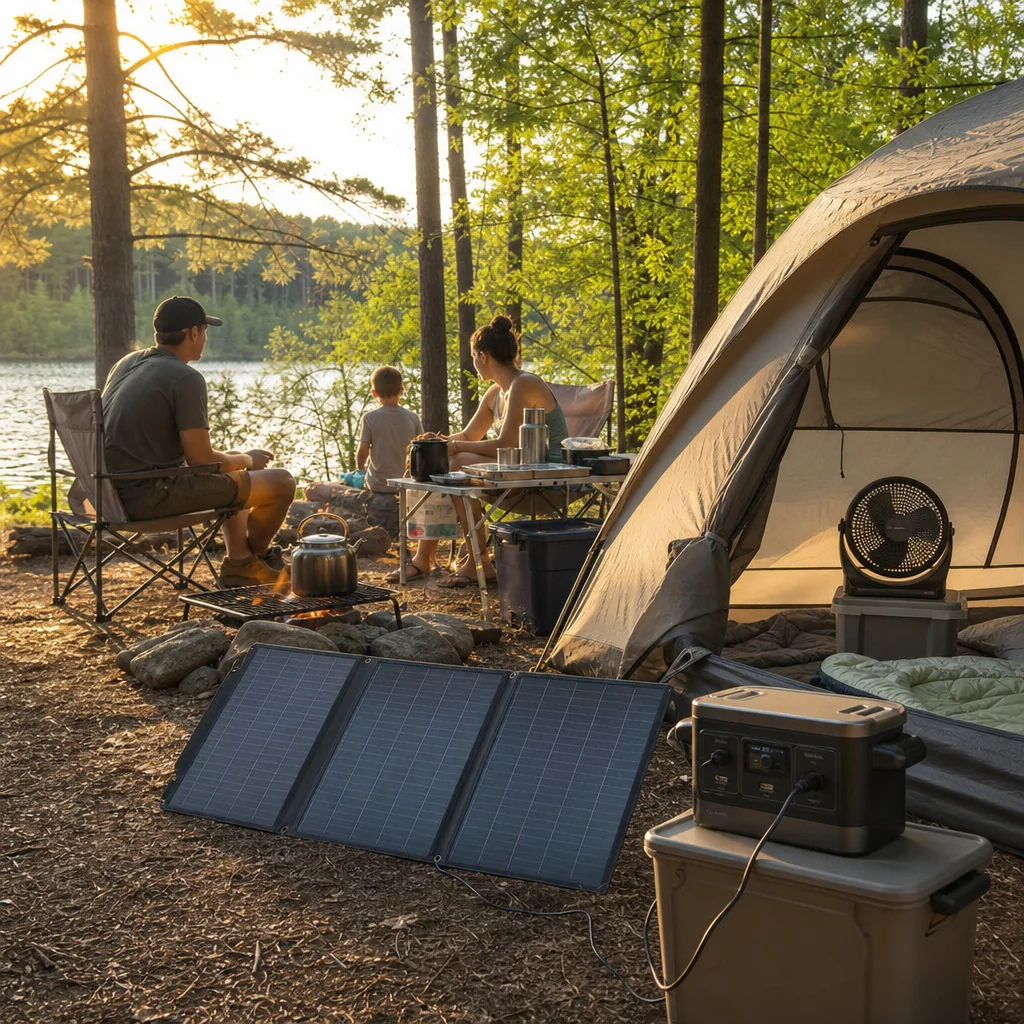
If you camp a few weekends each summer, start with a quality 12V or USB fan, a battery in the 500Wh to 1,000Wh range, and a 200W portable panel. If you already run a 12V fridge or camp in sustained heat above 90°F, move closer to 1,000Wh to 1,500Wh of battery capacity and do not count on a single small panel to save you.
By the second night, the setup should feel uneventful. Your fan should still be running before dawn, your battery should not be flirting with shutdown, and your panel should be refilling the system without forcing you to ration every watt. That is the real checklist: honest load math, extra solar capacity for heat, and enough battery to sleep through the night instead of watching the percentage drop.

Jordan Lee
Jordan Lee is part of the Farseen editorial team.