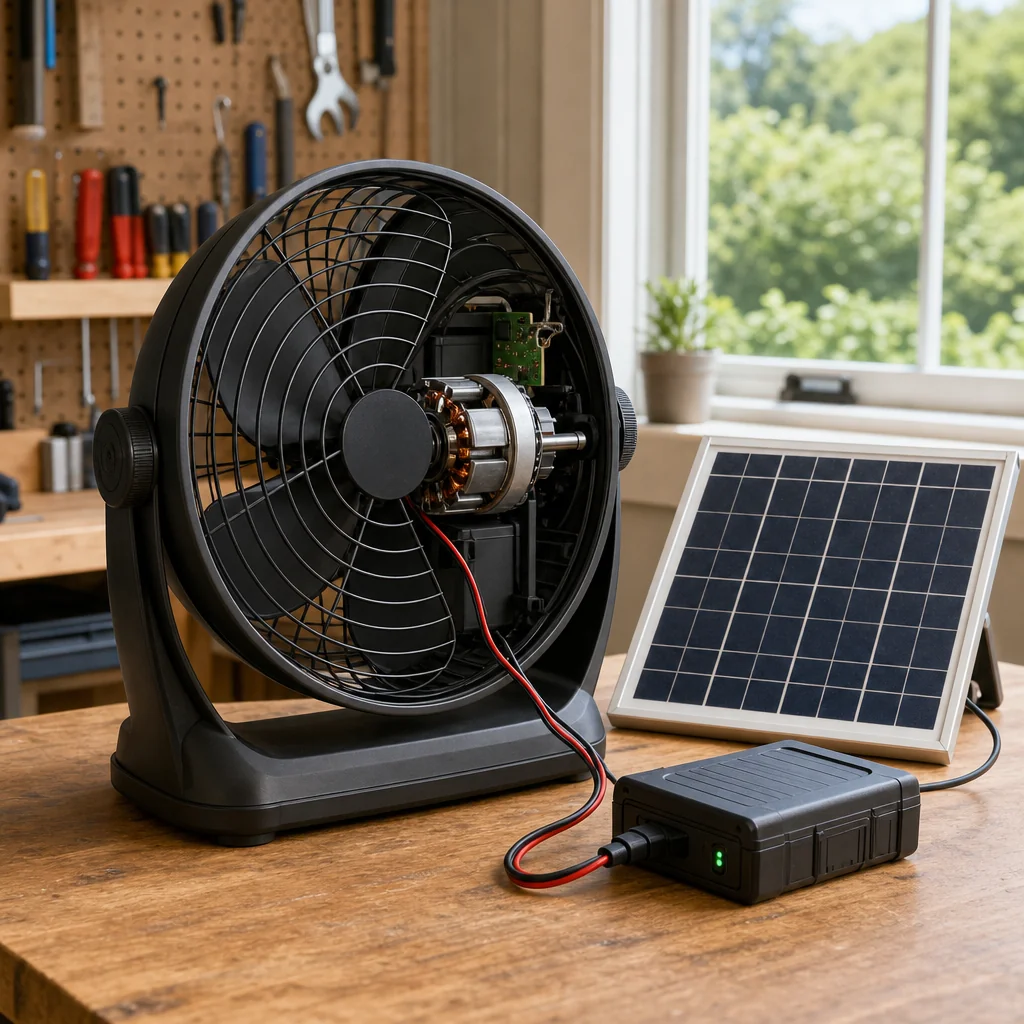
Brushless solar fan motors are often the better choice for off-grid cooling because they use less power, need less maintenance, and make better use of small solar panels and battery storage.
Does your fan slow down right when the room gets hottest, or do you want airflow in a cabin, attic, shed, or RV without raising your electric bill? Brushless DC product trends in solar fans show why this design matters in real off-grid setups: longer runtime, simpler wiring, and fewer maintenance issues. You can use that difference to decide whether a brushless solar fan motor is worth the extra cost and how to choose one that fits your space.
What a Brushless Solar Fan Motor Actually Is
A brushless solar fan motor is a DC motor that spins without the carbon brushes used in older brushed motors. In practice, that means the motor uses electronic control instead of internal parts rubbing together. For everyday users, the result is straightforward: less friction, less wear, and less wasted energy.
That matters even more in solar equipment than it does in a standard plug-in fan. Solar fans are commonly designed for direct solar power or battery-backed hybrid use, so every watt matters. When your panel is small, your battery is limited, or sunlight is inconsistent, a more efficient motor can be the difference between useful airflow and barely moving air.
That is why brushless motors appear so often in modern solar attic fans and off-grid ventilation products. Long-term attic ventilation needs help explain the appeal: most homeowners want a system they can install once and maintain as little as possible.
Why Brushless Matters More in Solar Than in a Regular Fan
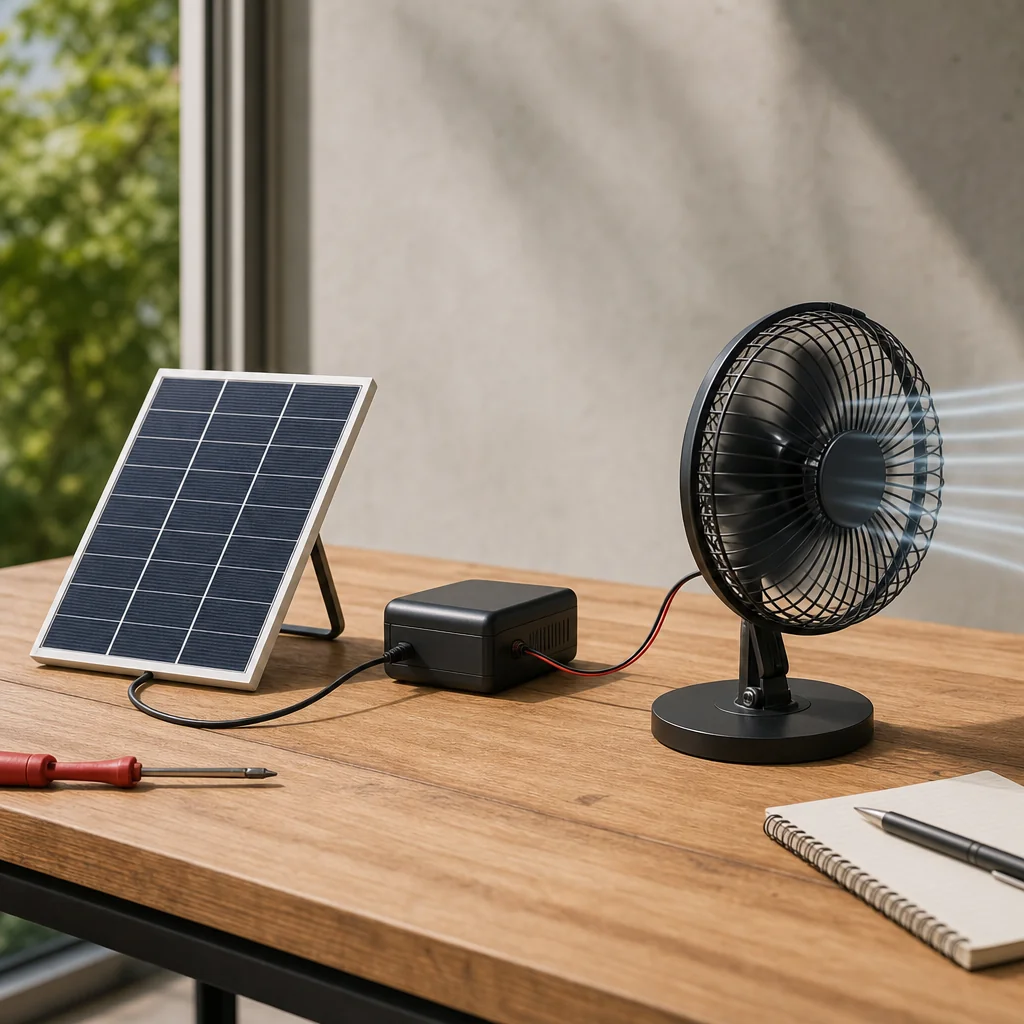
The main advantage is efficiency under limited power. Much of the solar fan market centers on the 10 to 20 W range, which shows that these products are expected to do meaningful work on modest energy input. A brushless motor helps turn more of that limited solar energy into airflow instead of heat and internal friction.
That efficiency also fits the way real off-grid systems are built. Off-grid system sizing responsibility changes buying decisions because the user has to account for every watt. In a grid-connected home, an inefficient fan is mostly a small monthly annoyance. In an off-grid shed, van, workshop, or cabin, an inefficient fan can force you into a larger panel, a larger battery, or shorter runtime.
There is also a reliability advantage. Brushless motors have fewer wear parts than brushed alternatives, so they are usually a better fit for spaces that are hot, dusty, or hard to reach. Attic ventilation is a good example. A fan mounted under a roof deck in summer heat is not something most people want to service often.
Where You’ll Notice the Difference Day to Day

The first difference most people notice is startup and low-light behavior. A well-designed brushless solar fan often starts more smoothly in partial sun and holds a steadier speed as conditions change, especially when paired with solid electronics and battery management. That does not mean every brushless model performs well at dawn, dusk, or under heavy clouds, but the motor type gives manufacturers a better foundation.
The second difference is runtime for a given panel size. If you are trying to ventilate a greenhouse, chicken coop, attic, or small cabin with a compact panel, motor efficiency directly affects how much useful air movement you get from the same hardware. Compact-panel demand and BLDC growth reflect that exact need.
The third difference is noise and upkeep. Build quality still matters, but brushless fans are generally chosen because they can run for long periods with less mechanical wear. That is especially useful in dusty off-grid environments where regular disassembly is unrealistic.
The Main Tradeoff: Better Motor, Higher Expectations
Brushless does not automatically mean best. It means the motor is a stronger starting point. A weak panel, poor controller, undersized fan blade, or bad installation can still make a brushless solar fan disappointing.
This is where many buyers get tripped up. A motor may be efficient, but the full system still has to match the job. Attic airflow and vent-path limits show why performance depends on more than the motor alone. If an attic has poor soffit venting, the fan may struggle no matter how good the motor is. The same logic applies to a shed or cabin: without an intake path, the fan cannot move much air through the space.
Cost is the other tradeoff. Brushless models often cost more upfront than simpler fans, but in solar applications that premium can make sense because it may let you stay with a smaller panel or battery. When you price the full system instead of the fan alone, the math often looks better.
How to Choose the Right One for Your Setup
Start with the use case, not the motor label. If you need daytime ventilation for an attic or greenhouse, a brushless solar exhaust fan may be enough on its own. If you need evening airflow in a cabin or RV, a hybrid or battery-backed setup is the better fit. Battery-backed and hybrid solar fan options matter because they change actual comfort, not just the feature list.
Then think about the rest of your power system. Reducing demand before upsizing solar is smart advice here. Choosing a brushless fan is one form of demand reduction: you meet the ventilation need with fewer watts. In a small off-grid build, that can matter more than people expect.
Finally, consider installation conditions. System-wide cost of every extra watt is a useful lesson even in projects much larger than a fan setup. For a fan that may run daily through a hot season, efficiency is not just a spec-sheet detail. It affects the panel, controller, battery, and total budget.
A Simple Way to Decide
If your fan will run often, if your solar panel is modest, or if your battery capacity is limited, brushless is usually the right choice. If the fan is only occasional, plug-in, and not part of a tight energy budget, the advantage matters less.
A common example is an off-grid shed that gets stuffy by late afternoon. A brushless solar exhaust fan paired with proper intake vents can solve the problem without requiring a larger solar setup. A poor fan choice might still work, but it can push you toward more panel wattage and more battery storage just to get the same comfort.
What the Label Still Won’t Tell You
Motor type matters, but airflow, solar input, and installation quality still determine whether the product feels effective. Residential demand in the solar fan market suggests that more buyers now expect real household performance rather than emergency-only use. That makes it even more important to treat brushless as one positive sign, not the only one.
If you are shopping for attic ventilation, pay close attention to space size and vent path. If you are shopping for a cabin, van, or workshop, think carefully about whether you need airflow only during sunlight hours or after dark as well. That one question often matters more than marketing.
Brushless solar fan motors matter because they solve a real off-grid problem: stretching limited solar power into dependable everyday comfort. When the motor, panel, and airflow path match the job, you get quieter ventilation, lower maintenance, and less strain on the rest of your system.

Maya Chen
Maya Chen is part of the Farseen editorial team.