A solar rechargeable fan can be a useful purchase when its airflow, charging options and runtime fit your daily needs. Whether it saves money depends on the alternative you would actually use, the complete purchase cost and how much grid charging remains necessary. Sunlight supplying some charging energy does not establish a zero-cost product or a fixed reduction in the household electricity bill.
For household desk, standing and wall fans, compare personal airflow and charging access first. Roof-mounted exhaust systems perform a different ventilation job and need their own building assessment; their advertised savings cannot be transferred to a rechargeable room fan.
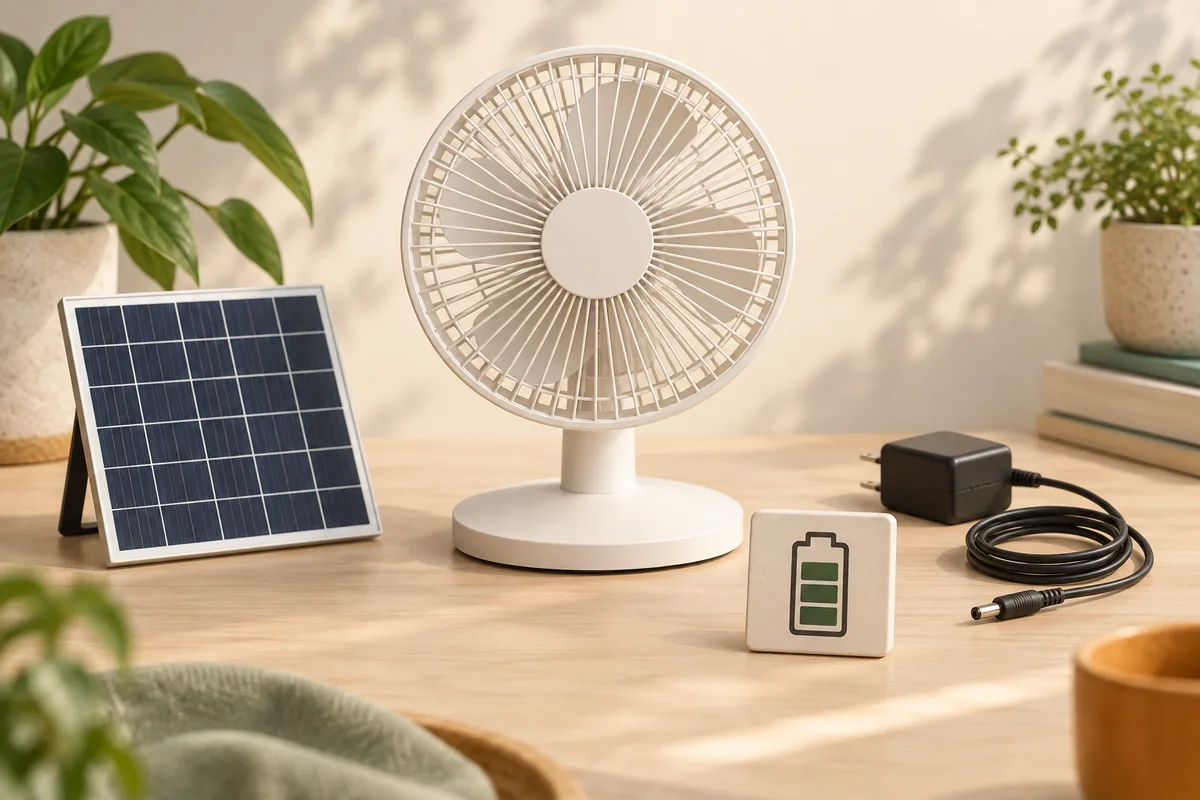
Compare products that meet the same need
A useful comparison begins with the occupied position and your schedule. A low-priced fan is poor value if it cannot provide comfortable airflow at your seat or lacks the charging method you need. A higher price is not justified merely by a “solar” label.
Write down the hours you need, where the fan will stand or mount, the setting you are likely to use and when charging is available. If the main benefit is airflow during power cuts, include that practical value separately from electricity savings. Outage usefulness and a lower energy bill are different reasons to buy.
Also distinguish a fan from air conditioning. A fan moves air; it does not provide the same room-temperature control as refrigeration. The fan, air cooler and air conditioner comparison helps define the job before comparing costs.
Count the complete package and ongoing costs
| Cost or requirement | What to include |
|---|---|
| Initial equipment | Fan, the specified panel and charger, and any required mounting or approved accessories |
| Grid charging | Energy drawn by the charger under your actual charging routine |
| Maintenance | Cleaning and care required by the instructions, plus any applicable servicing |
| Battery service | The approved replacement process, part availability and eventual cost when needed |
| Practical setup | Suitable panel placement, safe cable routing and space for the fan |
| Expected use | Whether the selected setting and battery condition support the hours you need |
Compare equivalent supplied packages. A fan-only price and a fan-plus-panel kit price do not describe the same purchase. Confirm what is standard, what is optional and what must be obtained separately.
Battery service should be a question, not an invented replacement interval. Battery condition changes with use and environment, and the exact product design determines whether replacement is a user task or a service task.
Estimate electricity use from the right measurement
The US Energy Information Administration distinguishes electrical power from energy consumed over time. To estimate an energy charge, you need kWh used and your actual rate per kWh.
For a mains-powered comparison fan, use its average input and running hours. For a rechargeable fan, measuring at the wall during a defined charging cycle captures grid input at the point relevant to the bill. Battery output energy and socket input are different measurement points; unmeasured losses should not be silently treated as zero.
Use our electricity-use guide and calculator for the arithmetic. Solar panel watts describe the panel's rated output, not the fan's electrical demand or the amount of grid energy you will avoid every day.
Check whether your sunlight can support the routine
A separate solar panel needs a practical location with useful sunlight. An awning, nearby building, changing shade or an inconvenient cable route can limit how useful solar charging is in daily life. The panel-placement guide explains these checks.
For evening use, the charging opportunity comes before the operating period. Battery runtime does not prove that each day provides enough charging to repeat the same schedule. A mains charging option can be useful when sunlight is insufficient, but that energy belongs in the cost comparison.
Do not assume a model can charge while running or accept a different panel. Follow its supported charging arrangement rather than modifying electrical connections to pursue a theoretical saving.
A useful decision record
Compare two actual packages over the same intended period of ownership. Record the purchase price, included equipment, expected grid charging and any known maintenance or service costs. Keep unknown costs visible instead of filling them with optimistic estimates.
Then ask two separate questions:
- Does the fan perform the required task? Check placement, useful airflow, controls and runtime at the chosen setting.
- Is the total cost acceptable for that result? Compare the complete package and operating routine with the alternative you would otherwise use.
Avoid an automatic payback claim if those inputs are missing. A percentage taken from a rooftop ventilation project, another fan or a different climate cannot establish your household's savings.
Where the Farseen range fits
The current Farseen range includes the 198F and S600 standing fans, W01 wall fan and T02 desk fan. Their documented charging options include solar charging and a DC charger. Compare the current model specifications and packages for the physical format and supplied equipment.
Those options establish ways to charge the product. They do not establish a universal daily saving, recharge time or uninterrupted operating schedule. For the distinction between the two charging labels, see solar fans versus rechargeable fans.
Choose on the basis of a complete, usable setup. Solar charging can be part of its value, alongside access to airflow when a wall-powered fan would not meet the same need.

Farseen Editorial Team
The Farseen Editorial Team publishes practical guides and company updates about solar rechargeable fans, off-grid appliances, and product sourcing. Where an article discusses product-specific details, refer to its cited sources or contact Farseen for current information.