Start with fixed direction for a steady breeze at one seat. Try oscillation when you want the fan to sweep across several occupied positions, or when you prefer breaks between passes. Then compare both settings where you actually sit. A wider sweep is useful only if the breeze reaches the people who need it.
There is no setting that everyone finds more comfortable. In a Reddit discussion about oscillating-fan settings, some people prefer a continuous breeze while others choose oscillation. Those comments describe preferences, not a performance test. The practical question is whether you want continuous or intermittent airflow at your position.
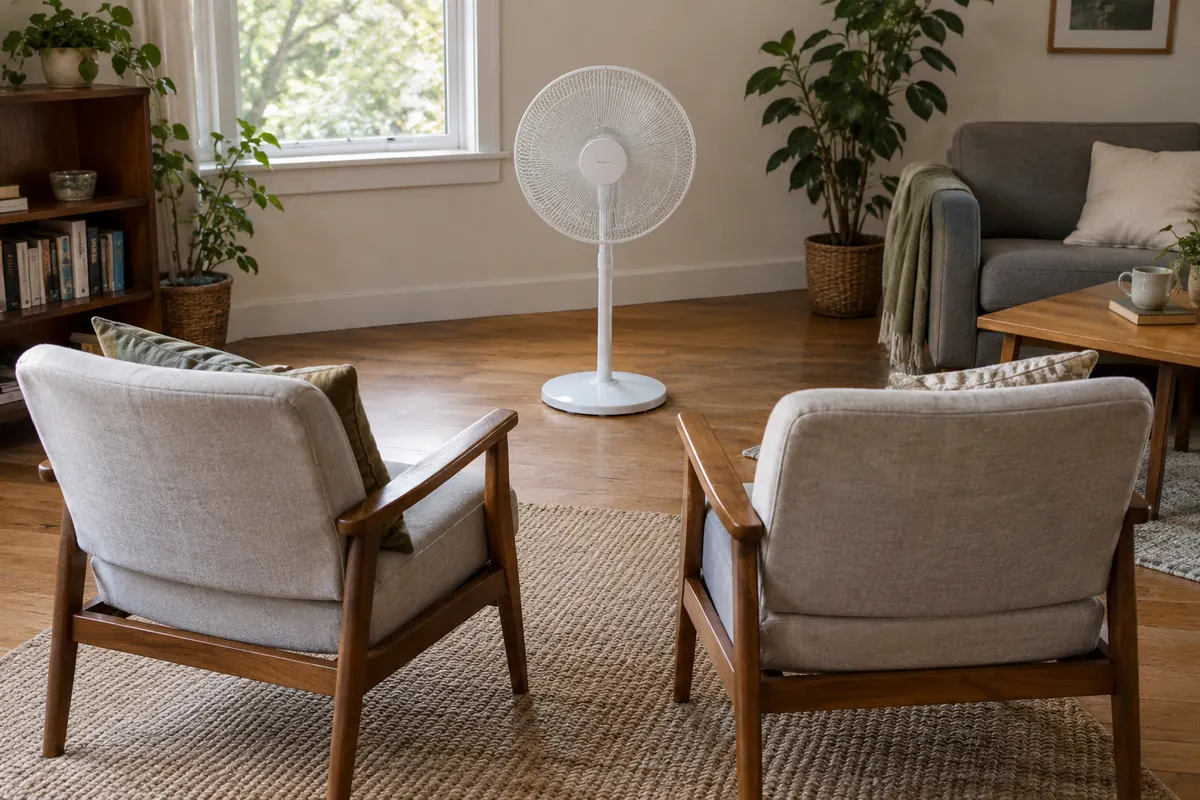
What changes when oscillation is on?
With fixed direction, the fan head stays pointed toward one area. With horizontal oscillation, the head or body repeatedly turns from side to side, changing where the outgoing stream is aimed. This is different from blade speed: a fan can keep the same speed while changing its direction.
The UC Berkeley Center for the Built Environment's fan guidebook describes how side-to-side movement lets pedestal fans deliver air across a broader area. That describes the function of oscillation; it does not mean every point in that area receives the same airflow all the time.
At one seat, the breeze can rise and fall as the fan passes. How noticeable that feels depends on the fan, sweep, distance and room layout. Fixed direction can feel more consistent when you stay inside the useful stream. It still needs a suitable height and clear path: a tabletop or sofa arm can block airflow even when the head appears to face you.
Oscillation also differs from a programmed “natural breeze” mode, which may vary motor speed. Check what each control actually does in your model's manual rather than treating every changing breeze as the same feature.
Choose around the occupied positions
Use these as starting points for a normal-use comparison, not promises about room coverage:
| Your situation | Setting to try and what to check |
|---|---|
| One person at a desk | Try fixed direction. Check comfort at the seat and whether loose papers move. |
| Two nearby chairs | Try oscillation. Check both seats receive a useful breeze and the gaps between passes are acceptable. |
| Dislike a constant direct breeze | Try oscillation or adjust the fixed direction. Compare the actual feeling at your seat. |
| One shop-counter position | Try fixed direction. Check displays do not block the airflow and the work area stays clear. |
| Seats spread around a room | Check each seat. A wide sweep does not guarantee useful airflow at distant or blocked positions. |
For a shared sofa, check both ends while seated. A fan placed to one side may give one person a direct pass and the other only a weak edge of the stream. Try another safe position or direction before raising the speed. If one setting cannot serve both people comfortably, acknowledge that limitation rather than calling the room “covered.”
For a single working position, start with direction and height. A bigger fan is not automatically the answer to an obstructed path. The desk versus standing fan comparison helps when the main constraint is a usable tabletop or floor position.
Compare the settings without changing everything at once
Keep the ordinary furniture in place and follow the manual's placement and clearance instructions. Then:
- Choose the position you want to serve. Sit where you normally work or relax, rather than judging only while standing beside the grille.
- Try fixed direction first. Select a comfortable speed and adjust the permitted direction controls. Note whether the airflow is steady, blocked or unpleasant.
- Keep the position and speed unchanged, then enable oscillation. Use the normal control; do not force the head by hand. Notice how the breeze changes through its travel and return.
- Check every intended seat. Record whether each person receives a useful pass and whether the gap between passes is acceptable.
- Change one thing and compare again. Try direction or safe placement before changing speed. Record the preferred setting and any limitation.

This comparison is about your experience in that layout. It does not produce a measured airspeed, noise rating or room-size specification. Importers comparing samples can add fixed and oscillating operation to the sample inspection checklist, with the same location and operating conditions recorded for each sample.
Does oscillation cool the whole room?
Turning the head spreads the direction of airflow; it does not turn an ordinary fan into an air conditioner. A breeze at a person and a reduction in room air temperature are separate outcomes. Our guide to why fans feel cool without refrigerating a room explains that distinction.
If your goal is air mixing rather than a breeze at occupied seats, compare the intended path through the room. The air circulator versus electric fan guide covers that task. An oscillation switch alone does not establish circulation around every obstacle or equal airflow in every corner.
Will switching oscillation off extend battery runtime?
Do not apply a universal extra-hours or percentage-saving claim. The effect depends on the fan's mechanism and electrical demand in that mode. For a rechargeable fan, compare actual operating duration with the same starting charge, speed and additional loads, changing only the oscillation setting. Use the runtime recording guide for the inputs and limitations.
If the fan rattles, clicks unusually or fails to turn normally, that is a separate troubleshooting task. Follow the oscillation-rattle checks rather than assuming abnormal movement is part of the intended breeze pattern. Do not open or force the mechanism.
What should you check on a Farseen sample?
Farseen's range includes standing, wall and desk formats. The 198F and S600 are standing fans, and their current product references list horizontal oscillation. That feature does not establish how comfortable the sweep will be at your seats. Check the normal on/off control, movement clearance and useful airflow at the intended positions on the actual sample.
Review the 198F product configuration or S600 product configuration when the standing format fits your space. For a bulk order, include the intended seating or counter arrangement and the controls you need in your configuration enquiry. Choose the setting from the result at those positions, then assess charging and outage runtime separately.

Farseen Editorial Team
The Farseen Editorial Team publishes practical guides and company updates about solar rechargeable fans, off-grid appliances, and product sourcing. Where an article discusses product-specific details, refer to its cited sources or contact Farseen for current information.