A useful private-label solar fan brief separates the product you want to buy from the branding you want to change. Start with a specific model and package, then describe the logo, box and manual as individually reviewable requests. That gives a supplier enough information to explain feasibility, sample work and quotation changes.
“Put our logo on a solar fan” leaves too much undecided. Does the logo go on the fan, retail box, manual or all three? Does the request include a different color, charger or battery? Will the sample show the final artwork? This checklist helps an importer or distributor turn those questions into a clear brief.
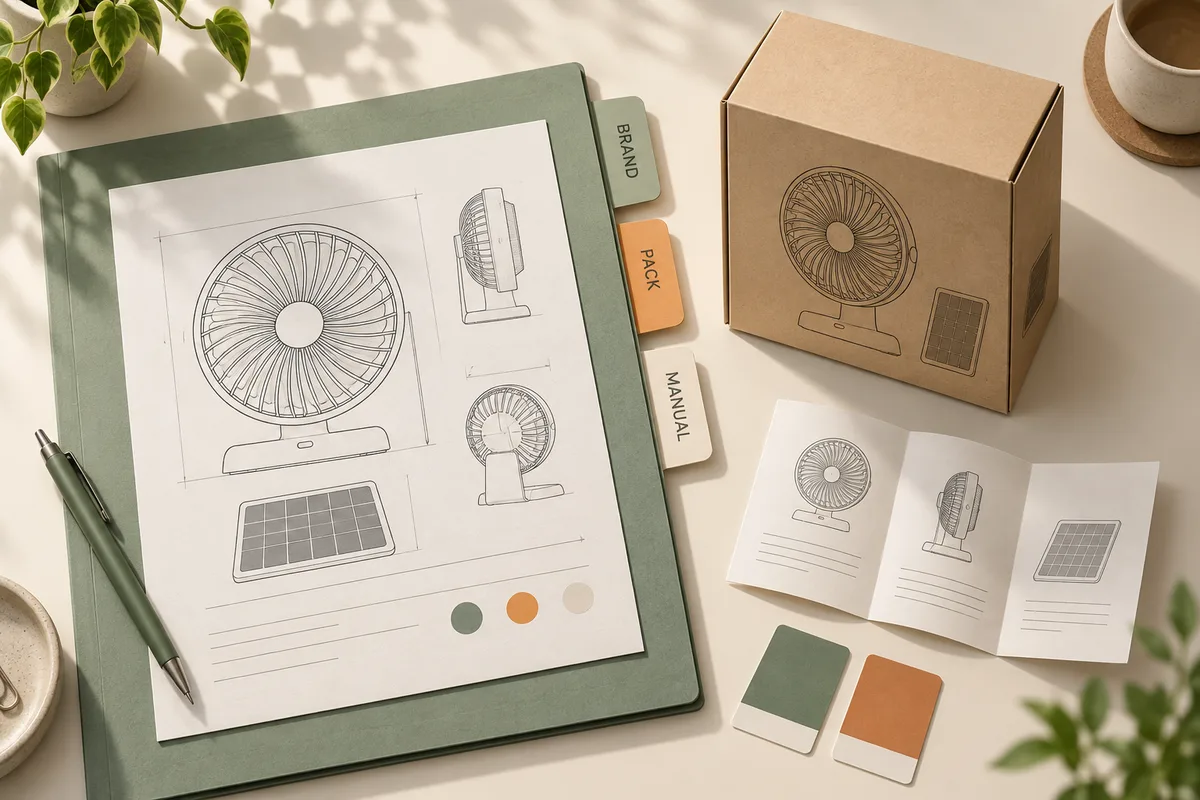
1. Name the base model and keep its package visible
Choose the format before requesting cosmetic changes. Farseen's current range includes the 198F 16-inch standing fan, W01 16-inch wall fan, S600 18-inch standing fan and T02 12-inch desk fan. A logo request does not resolve whether the product will sit on a counter, stand on the floor or require wall installation.
For each model in the brief, identify the standard package and any requested departures. For example, the current T02 package lists a solar panel, DC charger and two LED bulbs, with no remote. W01's standard package includes the fan, panel and DC charger, without bulbs or a remote. A buyer should not copy one shared accessory illustration across both boxes.
Record the destination, sales channel and requested quantity by model. Treat the quantity as your purchasing requirement; ask for the supplier's response on the applicable minimum order and commercial terms. A standard-product quantity or indicative price does not settle the terms of a customized order.
2. Describe each change in a separate row
Use a table like this for the initial request. “Pending supplier review” is a useful status when an option has not been confirmed.
| Area | What the buyer supplies | What needs a written response |
|---|---|---|
| Fan branding | Logo file, proposed location and approximate visual size | Available application method, placement limits and sample proof |
| Product color | Color reference and parts to change | Feasibility, approved color sample and effect on quotation |
| Retail box | Artwork, language and required product information | Dieline, print proof and package revision |
| Manual | Required languages and customer support details | Model-specific instructions and reviewed translation |
| Accessories | Desired package contents and charger requirements | Confirmed compatible components and exact included quantities |
| Shipping package | Units per outer carton and handling requirements | Measured dimensions, weight and packing arrangement |
These are fields to agree, not a promise that every requested change is available. Farseen's OEM service page is the place to submit the proposed scope. Changes to the battery, panel or electrical system require a separate technical response; they should not be hidden inside an artwork request.
3. Keep labels, illustrations and instructions consistent
Review the fan label, carton and manual against the same model and configuration. Pay particular attention to information that can survive unnoticed when an old packaging file is reused:
- The model name and product format match the sample.
- Accessory pictures show the agreed package, including the correct number of bulbs and whether a remote is included.
- Charging instructions identify the approved charger and panel for that configuration.
- Electrical ratings and battery information come from confirmed specifications.
- Runtime claims state the conditions behind them; artwork does not introduce an unsupported overnight promise.
- Support details, languages and revision identifiers are consistent across the files.
If battery capacity appears in more than one place, resolve ambiguous units before approving print. The Wh and mAh guide explains why a large mAh number alone is not enough to compare complete battery packs. Do not use a requested label to override unresolved technical information.
For any market-specific mark or claim, ask for documentation covering the actual model and configuration before including it. This checklist does not establish certification status or provide a destination-market compliance approval.
4. Define what the sample is meant to approve
A plain functional sample and a fully branded sample answer different questions. Record which version is being supplied and which parts of the brief remain open.
| Approval item | Useful evidence to retain |
|---|---|
| Appearance | Photos of the actual approved sample and the agreed artwork revision |
| Controls and accessories | Model identification, control check and counted packing list |
| Charging configuration | Panel and charger labels matching the agreed configuration |
| Packaging | The approved box proof and measurements of the packed sample |
| Instructions | The reviewed language version for that model |
| Open points | Each unresolved request, responsible contact and required decision |
Do not approve unseen packaging merely because the fan sample operates correctly. Equally, an attractive box proof does not establish charging compatibility or performance. The solar fan sample inspection checklist provides a fuller inspection framework.
A simple approval note can say: “The sample appearance matches artwork revision B. The manual translation and final carton dimensions remain pending.” That keeps a limited approval from being mistaken for acceptance of the complete order.
5. Ask for a revised quotation tied to the brief
When the scope is understood, ask the supplier to quote the named model, package and artwork revision. Separate any sample or setup charges from the unit quotation, and clarify packing, delivery terms and what triggers the agreed schedule. These are requested quotation fields, not assumed Farseen fees or lead times.
Packaging changes may affect shipping volume. If the box or carton changes, use the packaging and CBM guide to compare the revised outer shipping packages. Then use the supplier quotation checklist to compare complete offers on the same basis.
A brief you can copy into an inquiry
Base model and standard package:
Destination, sales channel and requested quantity by model:
Requested changes: logo / color / retail box / manual / accessories
Attached artwork and revision:
Items that must remain standard:
Required sample scope and acceptance checks:
Technical or packaging questions still open:
Quotation basis and requested delivery window:
Keep the first brief short enough to review, but specific enough to price. Once the supplier responds, carry the agreed revision into the sample record and quotation. For Farseen model and customization review, send the brief through the OEM inquiry page.

Farseen Editorial Team
The Farseen Editorial Team publishes practical guides and company updates about solar rechargeable fans, off-grid appliances, and product sourcing. Where an article discusses product-specific details, refer to its cited sources or contact Farseen for current information.