Calculate solar fan shipping volume from the outer packages that will actually be shipped. A retail box, a packaged set and a master carton can have different dimensions. If you multiply the wrong one by the order quantity, a correct formula can still produce a misleading freight comparison.
This guide explains the calculation, works through Farseen's current T02 packing record and shows what to confirm before comparing the four models or a customized package.
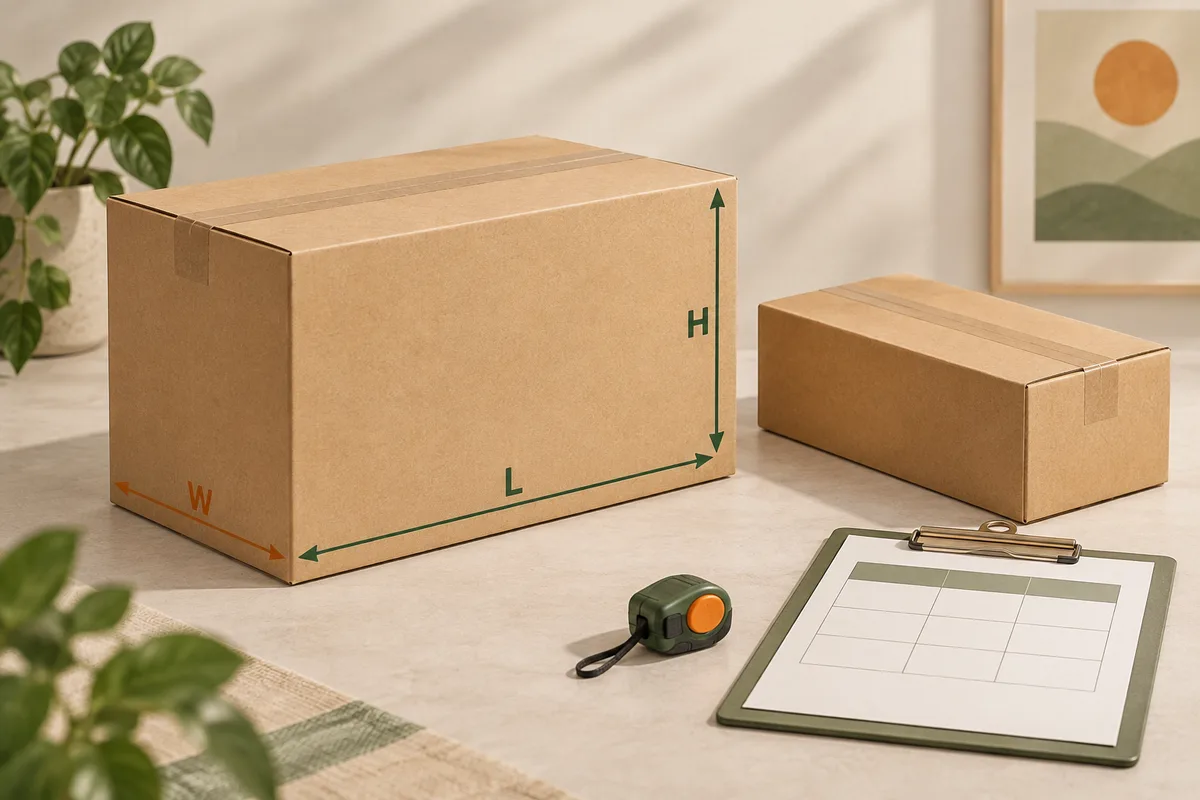
What CBM measures
CBM means cubic metres: the volume occupied by a package. For a rectangular carton measured in centimetres:
Carton CBM = length × width × height ÷ 1,000,000
If the dimensions are already in metres, multiply them directly. Use the outside dimensions of the closed shipping carton, including any protrusion that changes the measured package. Record which packing revision was measured.
For multiple identical cartons:
Total CBM = one carton CBM × number of cartons
The multiplier is the carton count, not necessarily the fan count. Calculate different carton sizes separately and add their volumes. If the goods will be shipped on pallets or with an additional outer package, obtain the dimensions of that final shipping arrangement.
Worked example: T02 unit box versus master carton
The current T02 record lists a 33.8 × 34.5 × 16 cm unit box, a 70 × 51.5 × 36.8 cm master carton, and six units per master carton.
| Calculation | Result |
|---|---|
| One unit box: 33.8 × 34.5 × 16 ÷ 1,000,000 | 0.0186576 m³ |
| Six unit-box volumes added together | 0.1119456 m³ |
| One master carton: 70 × 51.5 × 36.8 ÷ 1,000,000 | 0.132664 m³ |
| Master-carton volume allocated across six units | About 0.022111 m³ per unit |
When six units ship in that master carton, use 0.132664 m³ per carton as the carton-volume starting point. Adding six unit-box volumes leaves out the difference between those boxes and the outside dimensions of the master carton.
For an illustrative order of 60 T02 units in ten of these six-unit cartons, the calculation is:
10 × 0.132664 = 1.32664 m³
This is a worked packing example, not a stock, minimum-order or freight quotation. For an order that does not divide evenly into six, confirm whether the remainder uses a full-size carton or a different package. Do not calculate a fractional carton and treat it as the shipment.
Compare the four Farseen records on the right basis
The table below uses current product-profile dimensions. The calculated volumes describe the listed package basis; they do not establish the final shipping arrangement for every model.
| Model | Listed package dimensions | Calculated volume | Packing basis to confirm |
|---|---|---|---|
| 198F | 43 × 47 × 19 cm | 0.038399 m³ | Listed packed set; confirm the outer shipment arrangement |
| W01 | 44 × 20 × 43.5 cm | 0.038280 m³ | One set per carton in the current record |
| S600 | 56 × 14.5 × 59 cm | 0.047908 m³ | Listed per-set package; carton quantity is not established |
| T02 | 70 × 51.5 × 36.8 cm | 0.132664 m³ | Master carton containing six units |
A T02 master carton contains multiple units, so comparing its CBM directly with one S600 packaged set does not compare the same quantity. Likewise, do not silently turn S600's per-set dimensions into a confirmed one-set shipping carton. Ask for the final carton count and outer dimensions first.
For a private-label order, a new retail box, insert or carton arrangement may change these values. Keep the standard record as a reference and request measurements for the approved customized package.
Keep weight separate from volume
Record both CBM and weight. The current T02 record lists 19 kg for its six-unit master carton and 2.5 kg with the unit-box entry. Those are different packing levels. Use the confirmed weight of the actual shipping package; do not replace the master-carton record with six times the unit-box figure.
Freight charges are not determined by CBM alone. Depending on the transport mode and service, a carrier may compare actual gross weight with a calculated volume-based weight, or apply other pricing arrangements. Conversion factors and charging rules vary. Confirm the basis with the forwarder rather than applying a universal divisor. DHL's chargeable-weight guide explains the distinction.
A lower calculated carton volume therefore does not, on its own, prove a lower delivered cost. It also does not prove how many cartons will load into a particular container: orientation, stacking, clearances and the final packing plan still matter.
Send a complete packing request with the quotation
Use one row for each distinct shipping package. This makes missing information visible before the freight comparison begins.
| Field | What to request |
|---|---|
| Model and revision | Exact fan configuration and approved packing version |
| Package level | Unit box, master carton, pallet or another outer package |
| Contents | Sets per outer package and included accessories |
| Dimensions | Outside length, width and height, with units |
| Weight | Gross weight per shipping package and the basis of any net-weight figure |
| Quantity | Full-package count and treatment of remaining units |
| Shipment arrangement | Any pallets, overpacking or stacking restrictions |
| Quote basis | Transport mode, service, destination and chargeable-weight method |
For a sample order, compare the supplied packing list with the actual packed sample. For a bulk order, request confirmation that the same approved arrangement will be used. Recalculate if the carton dimensions or units per carton change.
Use the OEM brief checklist when packaging is part of a branding project, and the supplier quotation guide when comparing complete offers. The Farseen product range provides the model starting points; the confirmed packing revision should determine the shipping calculation.

Farseen Editorial Team
The Farseen Editorial Team publishes practical guides and company updates about solar rechargeable fans, off-grid appliances, and product sourcing. Where an article discusses product-specific details, refer to its cited sources or contact Farseen for current information.