Before a bulk order, ask for a model-specific spare-parts list and a written claim process. A statement such as “one-year warranty” does not by itself tell a distributor which configuration is covered, how a fault is documented, who decides the remedy or how a compatible replacement reaches the buyer.
The supplier quotation checklist already has a line for spares and warranty. This guide turns that single line into a decision record that can be attached to the final quote, sample approval and purchase documents. It is a buyer's request template, not a published Farseen warranty policy.
The same purchasing question appears outside the fan industry: an importer researching machinery asks whether to negotiate spare parts and warranty alongside price. For solar fans, the useful response is to make compatibility and service responsibilities explicit before ordering.
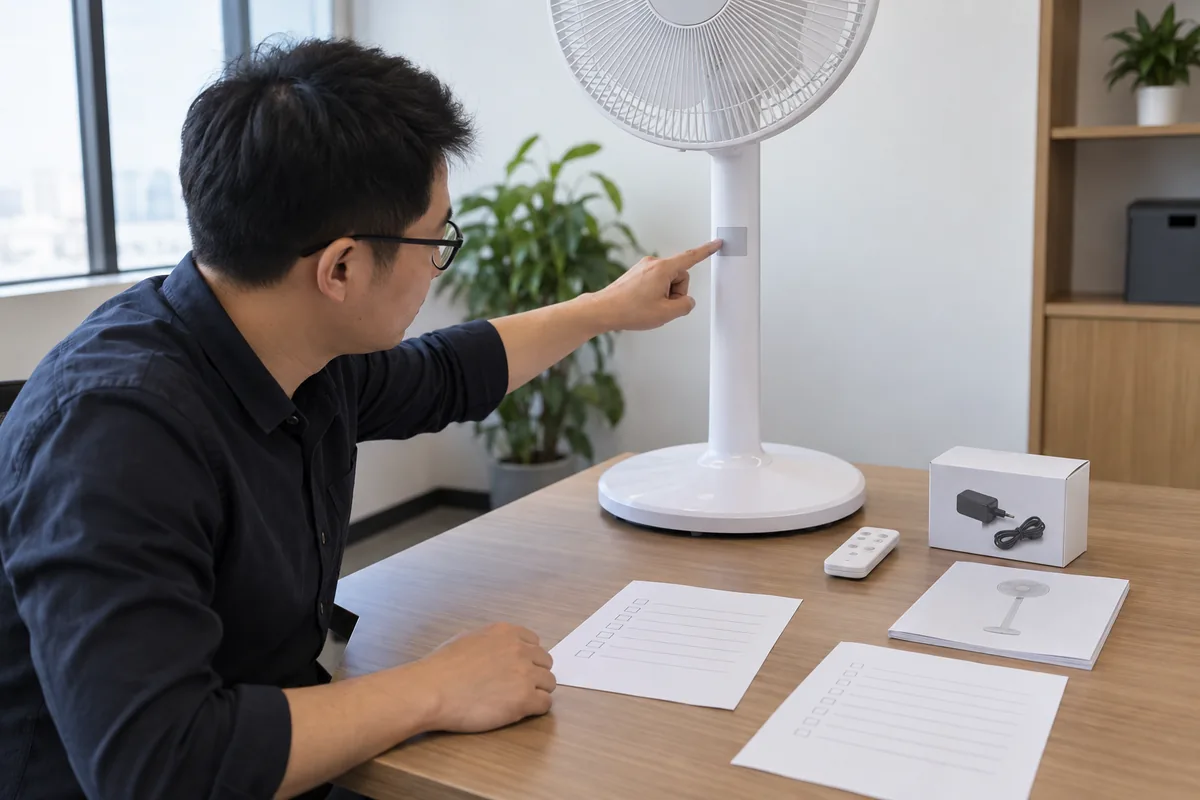
Fix the model and configuration first
Write the original model reference, quotation revision and approved sample identifier on the same page as the proposed service terms. A spare that fits one production version may not fit a later control board, remote or connector. Ask the supplier to identify the compatible revision and provide a part number or other unambiguous identifier for each offered item.
Farseen's public range comprises T02 desk, W01 wall, 198F standing and S600 standing fan families. The current standard listings include a remote for 198F and S600, but not for T02 or W01. That difference is a reason to build a service list by model rather than order the same “fan remote” for all four. The four-model range provides the current product-family starting point; confirm the exact order configuration in writing.
Even within one brand, appearance is not proof of interchangeability. For example, Dreo's replacement-remote listing names supported and excluded fan models. Its list is evidence about Dreo parts only; it illustrates the compatibility question that a Farseen buyer should ask.
| Spare or service item | What to request and record |
|---|---|
| Remote, if included | Compatible model and revision, functions and replacement part reference. |
| DC charger | Approved input/output, connector, fan revision and charger reference. |
| Solar panel | Approved panel reference and connector for the ordered configuration. |
| Grille, base or external part | Whether a replacement is offered, its reference and who may fit it. |
| Battery assembly | Written confirmation of an approved assembly and qualified service route. |
| Bulbs or included accessories | Whether separate replacements are offered; exact part and quantity. |
Mark an unanswered field as pending rather than treating it as a confirmed spare-parts offer.
This is a list of questions, not a claim that every part is stocked, interchangeable or user-replaceable. Never ask a customer to fit a loose lithium cell, bypass protection or open a sealed motor or battery housing to make a generic part fit. The battery replacement discussion explains why the complete assembly and service route matter.
Make the written warranty operational
Ask both parties to resolve these fields before they treat a warranty statement as part of the order:
- Covered configuration: exact model, approved revision, included accessories and any separately purchased parts.
- Start event and duration: the event from which the agreed period starts, and how purchase, shipment or retail sale records are used. Do not assume these dates are identical.
- Covered fault and exclusions: what kind of failure qualifies, what is excluded and who makes that determination.
- Evidence for a claim: model label, serial or batch identification if available, invoice reference, symptom record, photos and safe normal-use observations.
- Decision and remedy: who reviews a claim, whether the proposed response is a part, repair, replacement or another agreed solution, and who is authorised to perform work.
- Cost and logistics: who pays for diagnosis, replacement parts, transport and returns, and where the claim is handled.
- Timing and escalation: how a case is acknowledged, what information is needed next and whom the distributor contacts if it remains unresolved.
Do not invent a warranty period, defect rate, free-spares allowance, stock commitment or service turnaround when the written offer does not provide one. Keep any destination-market customer obligations and the supplier-to-distributor agreement distinct, and obtain advice appropriate to the market where products will be sold.

Use one claim record across the channel
A distributor should be able to connect a reported symptom back to the delivered configuration without asking a retailer to guess at a component fault. A simple case record can contain:
| Field | Entry |
|---|---|
| Fan model and approved order revision | ____________________ |
| Purchase or delivery reference | ____________________ |
| Identifying label or batch detail, if present | ____________________ |
| Customer-reported symptom and when it appeared | ____________________ |
| Charging source and accessories involved | ____________________ |
| Photos or safe normal-use observations available | ____________________ |
| Stop-use sign such as damage, heat or smell | ____________________ |
| Supplier response, owner and next step | ____________________ |
The record is a communication tool, not a remote diagnosis. If the fan still responds to its built-in buttons but ignores the handset, the remote-check guide shows safe observations to make before ordering a replacement. If it will not charge or spin, use the separate charging and no-spin checks. Stop testing a damaged or overheating unit and seek qualified support.
Close the loop before repeating an order
After sample review, compare the approved accessory list and service terms with the quotation. The sample inspection checklist records the physical set and its normal-use behavior; this article records the promised after-sales handling. If the supplier changes a charger, remote, battery assembly or packaging revision, ask whether the compatible parts list and warranty wording need to change as well.
For a private-label program, put the service contact and claim-record responsibilities beside the OEM brief. Then send Farseen the intended models, destination, order scope and requested service terms for a written response. The answers must be confirmed for that order; this template does not claim that an unlisted part or term is already available.

Farseen Editorial Team
The Farseen Editorial Team publishes practical guides and company updates about solar rechargeable fans, off-grid appliances, and product sourcing. Where an article discusses product-specific details, refer to its cited sources or contact Farseen for current information.