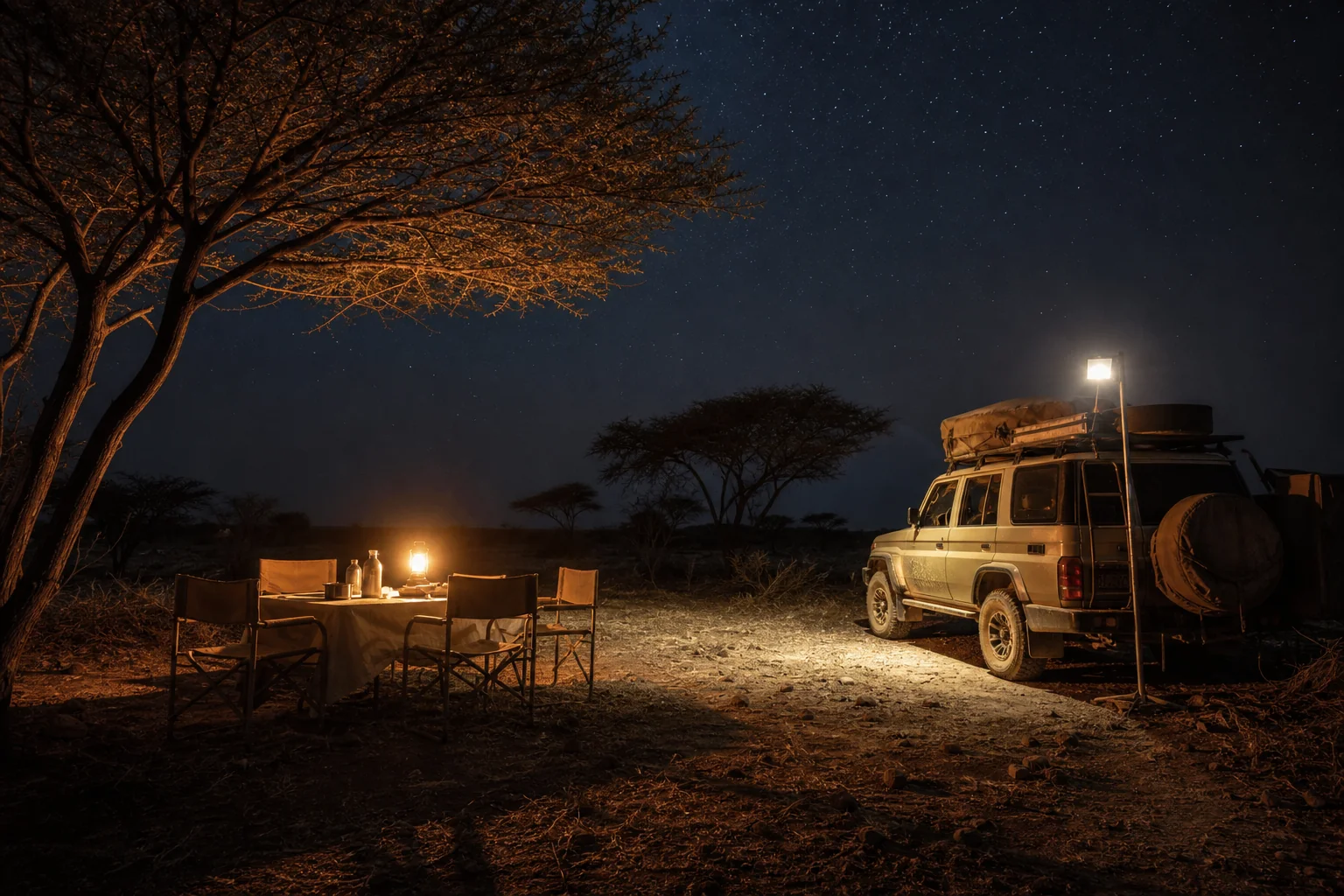
Choose a solar lantern for inside-the-tent comfort, cooking, reading, and shared campsite light; choose a solar flood light when you need wide, bright, directional coverage for a vehicle area, group basecamp, trail edge, or security zone.
Trying to cook after sunset while one person holds a flashlight and another searches for stakes in the dark gets old fast. Field-tested camping guidance shows that modest lanterns around 360 to 650 lumens can handle most camp-table jobs, while flood lights serve broader, higher-output visibility needs. Here is how to pick the right light without overbuying, draining batteries, or washing out the whole campsite.
Solar Lantern vs Solar Flood Light: The Practical Difference
A solar lantern is a portable area light. It spreads softer light in multiple directions, usually from a table, tent loop, branch, or picnic shelter. That makes it the better tool for shared, close-range tasks such as eating, reading maps, changing clothes, sorting gear, or keeping a tent softly lit.
A solar flood light is a brighter, directional fixture. It throws light across a wider outdoor zone and is often used for driveways, entrances, yards, work areas, or security lighting. Modern solar lights use photovoltaic panels to collect daylight, store energy in rechargeable batteries, and power LEDs after dark, but the beam pattern and intended job are very different.
For a campsite, the simplest rule is this: lanterns make a space livable; flood lights make an area visible. If you are car camping with a large kitchen tarp 20 feet from the tent, one lantern over the table and one motion-sensitive flood light aimed low near the vehicle can be a strong setup. If you are backpacking, the flood light usually stays home.
Quick Comparison
| Camping need | Solar lantern | Solar flood light |
|---|---|---|
| Tent lighting | Best fit | Too harsh for most tents |
| Cooking table | Good to excellent | Useful if mounted high and aimed down |
| Group basecamp | Good with multiple units | Strong for wide coverage |
| Backpacking | Usually better | Usually too bulky |
| Security near vehicle | Limited | Better fit |
| Wildlife-friendly low light | Easier to manage | Requires careful aiming and dimming |
| Solar-only reliability | Good with low modes | More demanding because output is higher |
When a Solar Lantern Is the Better Camping Light
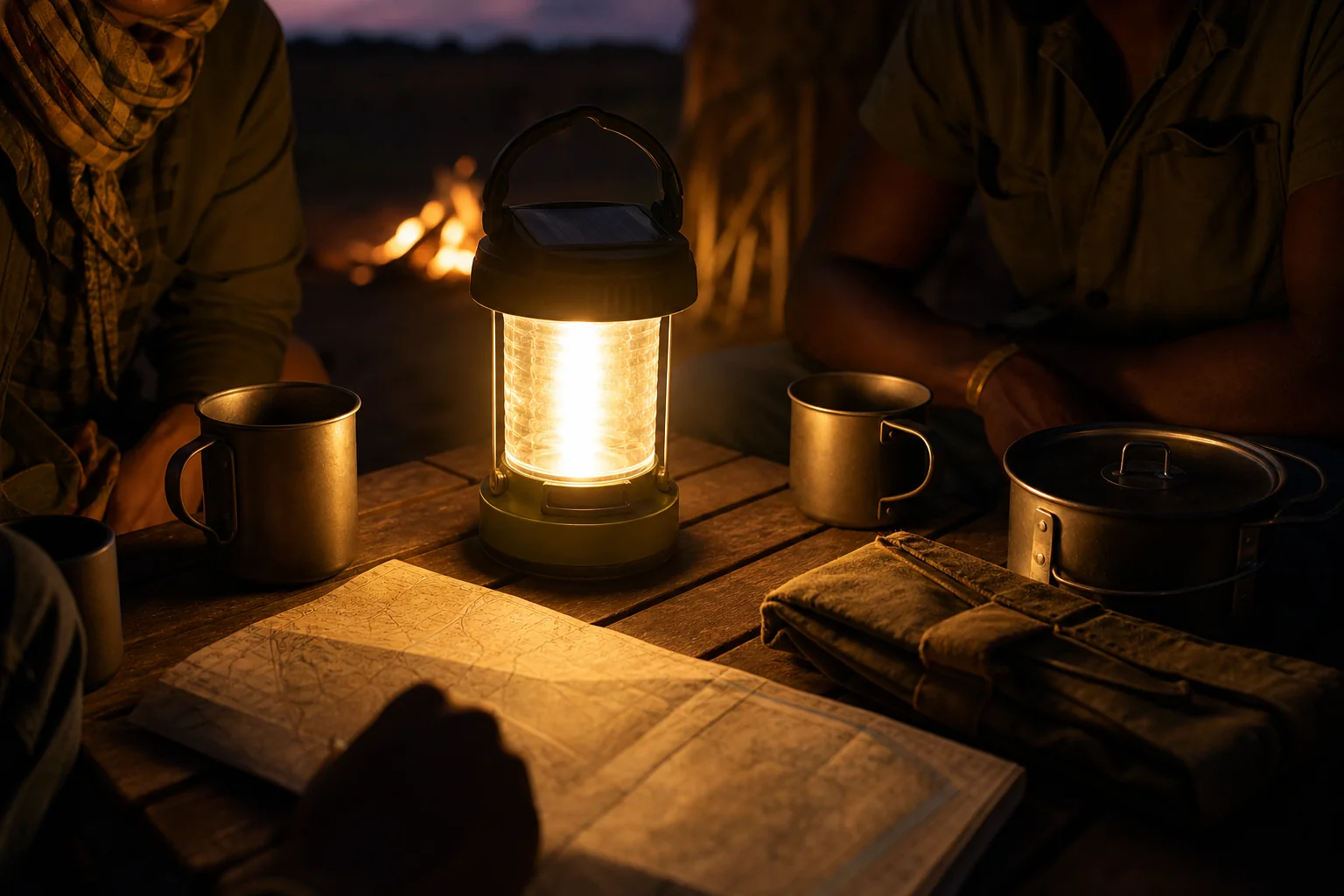
A solar lantern is the better first purchase for most campers because it solves the most common nighttime problems with less glare and less power draw. Long-running lantern testing has found solar-friendly camping options around 360 lumens and rechargeable lanterns around 500 to 650 lumens, which is a useful range for most camp chores rather than excessive brightness for its own sake.
The big advantage is usable light quality. A lantern on a picnic table can illuminate faces, food, cards, and gear without creating the hard shadows you get from a single bright beam. In a two-person tent, even 50 to 150 lumens can be enough. Around a kitchen area, roughly 300 lumens or more becomes more comfortable when chopping food, checking a stove, or cleaning up.
The downside is coverage. A lantern will not light a 40-foot parking pullout well, and it will not provide the same deterrent effect as a motion flood light near a vehicle or trail entrance. It also depends heavily on mode selection. Runtime changes dramatically between low and high settings, so a lantern that looks average on paper may last several evenings if it has a practical low mode.
A real-world example is a three-night car-camping trip. If you run a 500-lumen lantern on high for five hours every night, you may need USB backup charging. If you run it at a medium setting for dinner and low inside the tent, the same lantern can stretch much further and feel better to sit around.
When a Solar Flood Light Makes Sense at Camp
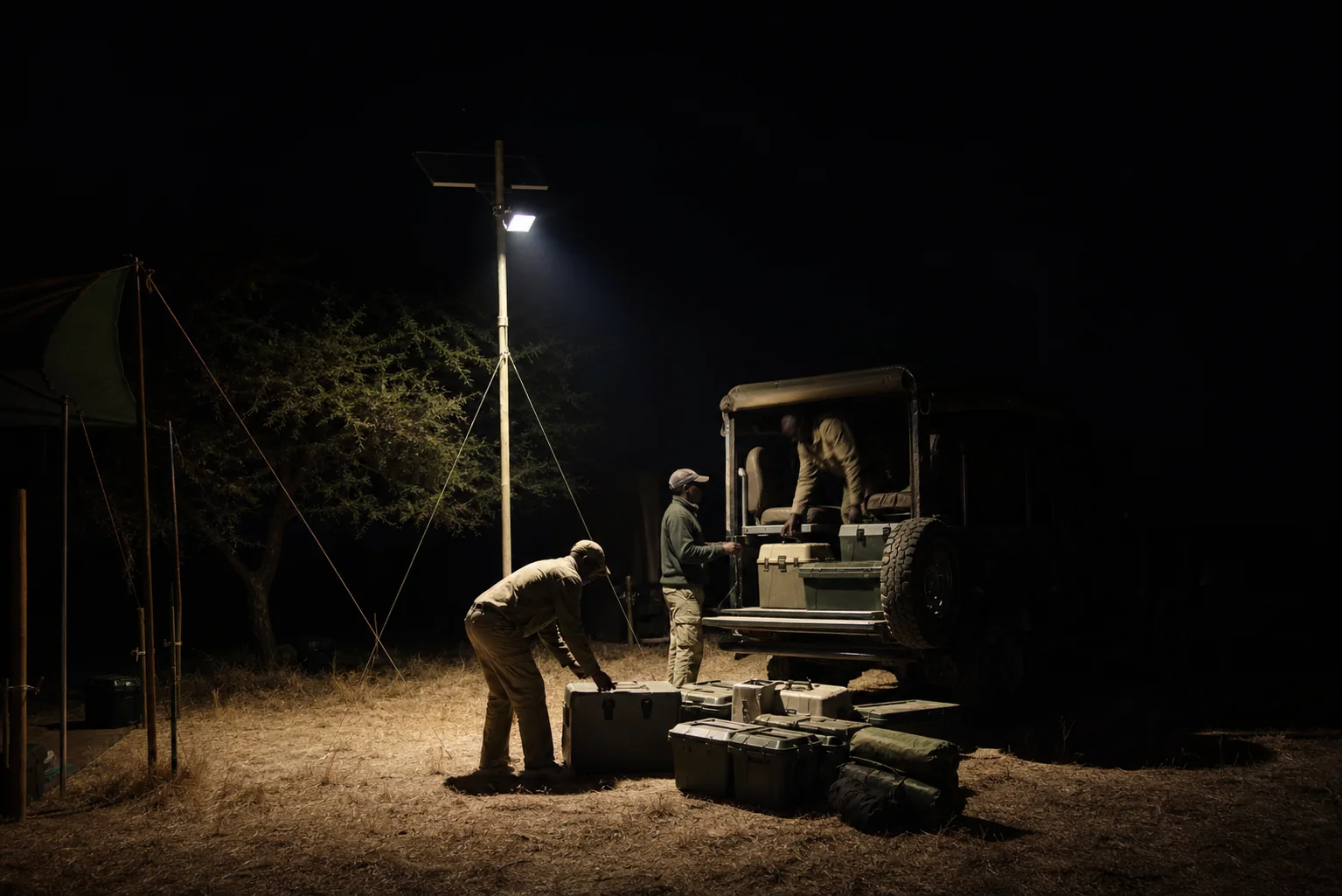
A solar flood light is useful when the campsite has a fixed area that needs clear visibility. Think of a desert basecamp, a hunting camp staging area, a boat ramp camp, a group kitchen, or a dark driveway at a cabin site. Flood lights are also useful when you arrive late and need to unload a vehicle, set up a canopy, or check the perimeter without carrying a light in your hand.
Solar flood lights are built around the same core parts as other solar LED systems: a panel, battery, LED fixture, charge controller, sensor, and mounting structure. Selection should account for solar panel wattage, battery capacity, brightness in lumens, weather resistance, and whether the panel gets enough direct sun.
The tradeoff is energy demand. Notes on flood light power consumption put small flood lights around 10 to 30 watts, medium units around 40 to 60 watts, and large units around 100 to 400 watts. Over four hours, that means a small unit may use about 0.04 to 0.12 kWh, while a large one may use 0.4 to 1.6 kWh. That is a very different load than a small lantern running on low.
For camping, that math matters. A compact solar flood light may be reasonable for lighting a vehicle area for one or two hours. A high-output flood light running all evening may require a separate solar generator or power station, especially if the weather is cloudy or the campsite is shaded.
Brightness, Runtime, and Solar Charging Reality
Lumens tell you how much light a product produces, but they do not tell you whether the light will last through dinner, cleanup, and a midnight walk. A 2,000-lumen light sounds impressive, but high output drains batteries fast and can be unpleasant around camp. Lower settings are often the real value.
Solar charging claims also deserve skepticism. Solar lights perform best with clean panels, strong direct sun, and good orientation. Outdoor solar guidance commonly recommends several hours of direct sunlight, and a 100 W panel typically generates about 400 to 600 Wh per day under good conditions. Small built-in panels on lanterns and compact flood lights collect far less, so USB backup is practical redundancy on longer trips.
A simple camp calculation helps. If a small flood light draws 20 watts for three hours, it uses about 60 Wh. If a lantern uses only a few watts on a medium or low setting, it may give you several evenings from a much smaller battery. This is why lanterns feel more forgiving and flood lights need more planning.
Pros and Cons for Camping
Solar Lantern Pros and Cons
Solar lanterns are portable, packable, and easier on the eyes. They are the better fit for tents, tables, shelters, and family camps where people sit close to the light. They also support lower-impact camping because they reduce disposable battery use and can be recharged from sunlight or USB.
Their weaknesses are limited reach and slower solar recovery. A compact lantern may not collect enough solar energy in one partly cloudy day to replace a full night of high-output use. It is also not the right tool for lighting a broad parking area or a work zone.
Solar Flood Light Pros and Cons
Solar flood lights provide stronger, wider, more directional visibility. Motion sensors, dusk-to-dawn controls, and dimmable settings can make them useful for security and energy savings, especially at a fixed basecamp or cabin-adjacent campsite. Outdoor solar testing shows that motion-sensor solar lights can combine brightness, durability, and automatic operation for outdoor visibility.
Their drawbacks are glare, bulk, and higher energy demand. A flood light aimed across camp can ruin night vision, bother nearby campers, and disturb wildlife. Wildlife-focused outdoor lighting testing notes that softer, downward-facing lighting and leaving some areas dark can reduce disruption to insects, bats, and other nocturnal wildlife; that same principle applies at camp.
Which Should You Pack?
For backpacking, pack a compact solar lantern only if it is light, collapsible, and has USB backup; otherwise, a headlamp plus a tiny rechargeable lantern is usually more efficient. A flood light is rarely worth the weight unless the trip has a specific basecamp or safety requirement.
For car camping, a solar lantern should be your main light. Add a solar flood light only if you need to illuminate a larger kitchen, parking spot, boat tie-down area, or group gathering zone. Aim it down, use the lowest workable brightness, and switch it off before bed.
For RV camping, overlanding, and remote cabins, the combination makes more sense. Use lanterns for living spaces and a flood light for the exterior task zone. If you already carry a power station, a flood light becomes much more practical because you are not relying only on a small built-in panel.
Buying Advice That Matters
Prioritize runtime on low and medium settings before maximum brightness. A light that lasts all evening at a comfortable level is more useful than one that looks powerful for an hour. For lanterns, look for hanging options, stable table placement, simple controls, and water resistance. For flood lights, look for adjustable mounting, motion sensing, weather resistance around IP65 or better, and a panel that can be placed in sun even when the light is aimed somewhere else.
Hybrid charging is the most dependable choice. Off-grid lighting systems with solar, USB, and sometimes manual backup are better suited to storms, shaded campsites, and emergency use because hybrid systems combine solar with other charging paths when sunlight is limited.
The cleanest setup for most campers is not either-or. Use a solar lantern as your primary camp light, then add a solar flood light only when you have a defined area that needs stronger visibility. Keep the lantern warm and low, keep the flood light aimed down and brief, and your campsite will be safer, calmer, and easier to live in after dark.

Jordan Lee
Jordan Lee is part of the Farseen editorial team.