An air circulator is a type of electric fan. The comparison usually concerns the intended airflow pattern: many circulators are designed to project a directed stream for air mixing, while many desk and pedestal fans are used to deliver a breeze to people nearby. Those uses overlap, and the label alone does not prove that one appliance is stronger, quieter or more efficient.
Choose according to the job: airflow at your seat, a breeze shared between seats, or mixing air through a useful path in the room. Then compare the actual model's direction controls, placement, sound and electrical demand.
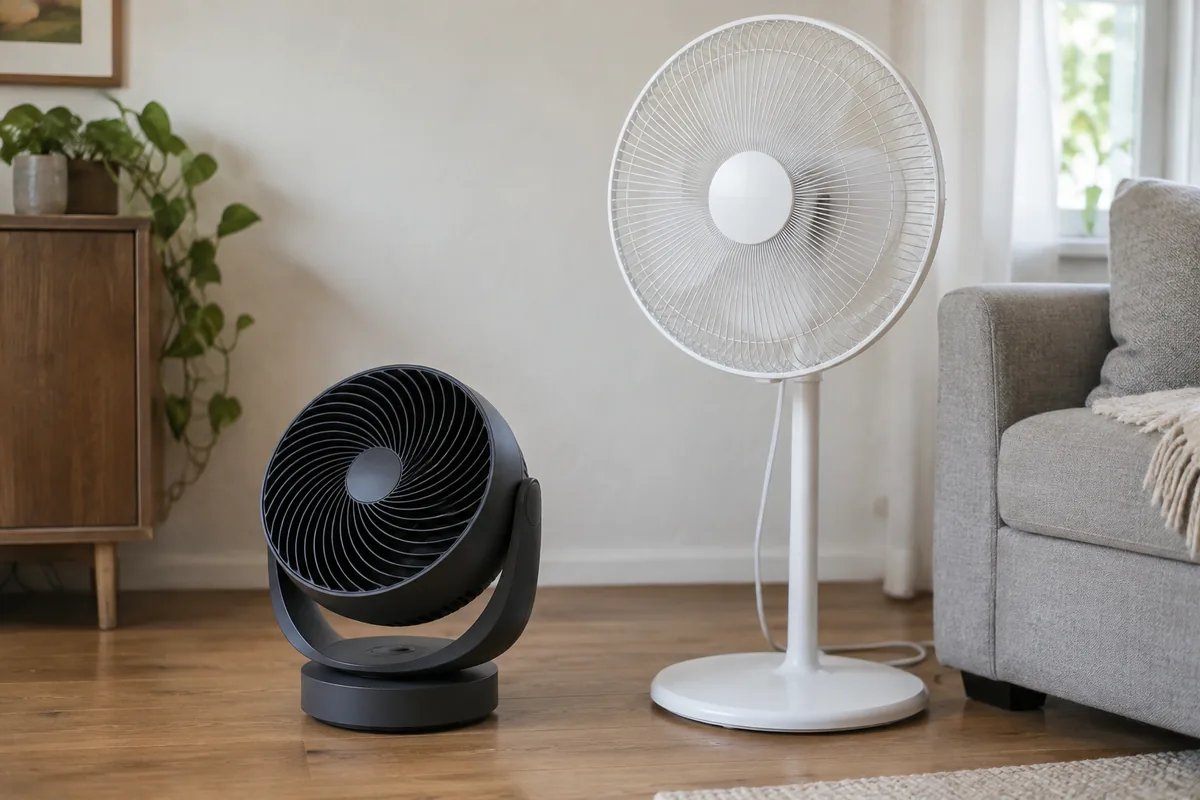
What does an air circulator do differently?
A circulator may use its blade, housing and grille design to shape and project airflow. For example, Vornado describes how these parts work together in its own circulators. That is a manufacturer's explanation of its designs, not evidence that every product sold as a circulator has the same range or performance.
Ordinary fans also move and mix air. Likewise, a circulator can provide direct personal airflow: Meaco describes its table circulator as an option for close-range comfort. The useful distinction is the result you want at the positions that matter, rather than treating the two labels as opposite technologies.
Oscillation is a separate feature. A fan can sweep its head to share a breeze across several positions; another can remain fixed on one direction. Check horizontal movement, vertical tilt and available controls on the model itself.
Compare the job before comparing specifications
| Your main need | What to look for | What the label cannot establish |
|---|---|---|
| A steady breeze at a desk or bedside | Comfortable airflow at your distance, suitable head height and reachable controls | That a circulator is too strong for close use, or that a desk fan is always quiet |
| Airflow shared by two nearby seats | A useful sweep angle and timing, or an adjustable fixed direction | That every pedestal fan oscillates or every circulator stays fixed |
| Mixing air in a room with uneven conditions | A clear airflow path and direction adjustment that suits the layout | A guaranteed coverage area or temperature difference |
| Helping distribute conditioned air | Placement that complements the existing supply and occupied positions | A fixed reduction in AC energy use |
| Operation during a power cut | Documented battery and charging behavior, plus runtime at the needed setting | That either airflow category automatically includes a battery |
A table fan, pedestal fan and wall fan describe physical formats. “Air circulator” describes a type or intended use of airflow design. “Rechargeable” describes energy storage. These features can appear in different combinations; they are not a single ranking from basic to advanced.

Will an air circulator lower room temperature?
Neither a normal fan nor a fan sold as an air circulator refrigerates room air. Air moving across a person can improve comfort, while air mixing can reduce differences between locations without removing the room's heat.
For the mechanisms, see why a fan can feel cool without cooling the room. If your main requirement is a lower indoor air temperature, compare fans, evaporative air coolers and air conditioners. A more forceful breeze and a lower room temperature are different outcomes.
Where should you put each type?
For personal airflow, start with the actual occupied position. Sit at the desk or on the sofa, use a comfortable setting and adjust the direction. A fan below a solid tabletop may have its useful airflow blocked, while a tall fan may need enough downward adjustment to reach a low seat.
For air mixing, first identify the path you want the air to follow. Furniture, partitions and closed doors can interrupt it. Follow the model's placement instructions, keep its inlet and outlet clear, and judge the result at more than one location. Moving a fan a short distance can matter more than selecting the highest speed.
Avoid assuming that pointing any circulator into any corner creates the same room-wide pattern. Room shape and the appliance's airflow design affect the result. A drawing of circulating air is a concept, not a promise that every corner receives equal airflow.
If your choice is mainly about where the fan can physically stand, use the desk versus standing fan comparison.

Which is quieter and cheaper to run?
Compare actual models at settings that meet the same practical need. A low setting on one fan and a high setting on another are not necessarily delivering comparable airflow to the person.
For sound, check whether a published measurement states the setting, distance and test conditions. If those details are absent, listening at the intended seat is more useful than assuming that “circulator,” “DC” or a larger diameter means quieter operation.
For electricity use, compare measured average input watts and running time. Use the fan electricity calculator with your own wattage and tariff. A product category does not supply a reliable cost estimate, and a solar panel's rated output is not the fan's input demand.
Battery runtime also depends on the stored energy and operating load. A rechargeable circulator and a rechargeable pedestal fan need the same kind of mode-specific endurance check.
A simple comparison you can make at home
- Choose the task. Write down whether you need a breeze at one seat, shared airflow or better air mixing.
- Use the real position. Compare at the intended desk, bed or sofa with the usual furniture in place.
- Find a comfortable setting. Adjust direction and speed before deciding that more power is needed.
- Check interruptions. Note whether oscillation gives each person enough airflow, or whether a steady direction works better.
- Check daily usability. Consider control access, sound, available space, cleaning instructions and the cable route.
- Check energy separately. If electricity cost or battery duration matters, measure or verify the selected mode instead of guessing from the fan's name.
Choose the model that performs the intended job in your layout. Either label can describe a useful household fan; the practical airflow, placement and operating conditions make the decision.

Farseen Editorial Team
The Farseen Editorial Team publishes practical guides and company updates about solar rechargeable fans, off-grid appliances, and product sourcing. Where an article discusses product-specific details, refer to its cited sources or contact Farseen for current information.