A fan moves air, an evaporative air cooler uses water evaporation to cool incoming air, and an air conditioner transfers indoor heat outside. The best fit depends on whether you need a personal breeze or lower air temperature, how humid the air is, and what ventilation, water and electrical supply your space can support.
Here, “air cooler” means a direct evaporative cooler, often called a desert or swamp cooler. A portable air conditioner with a compressor and exhaust arrangement belongs to the air-conditioning category, even if a seller also calls it an air cooler.
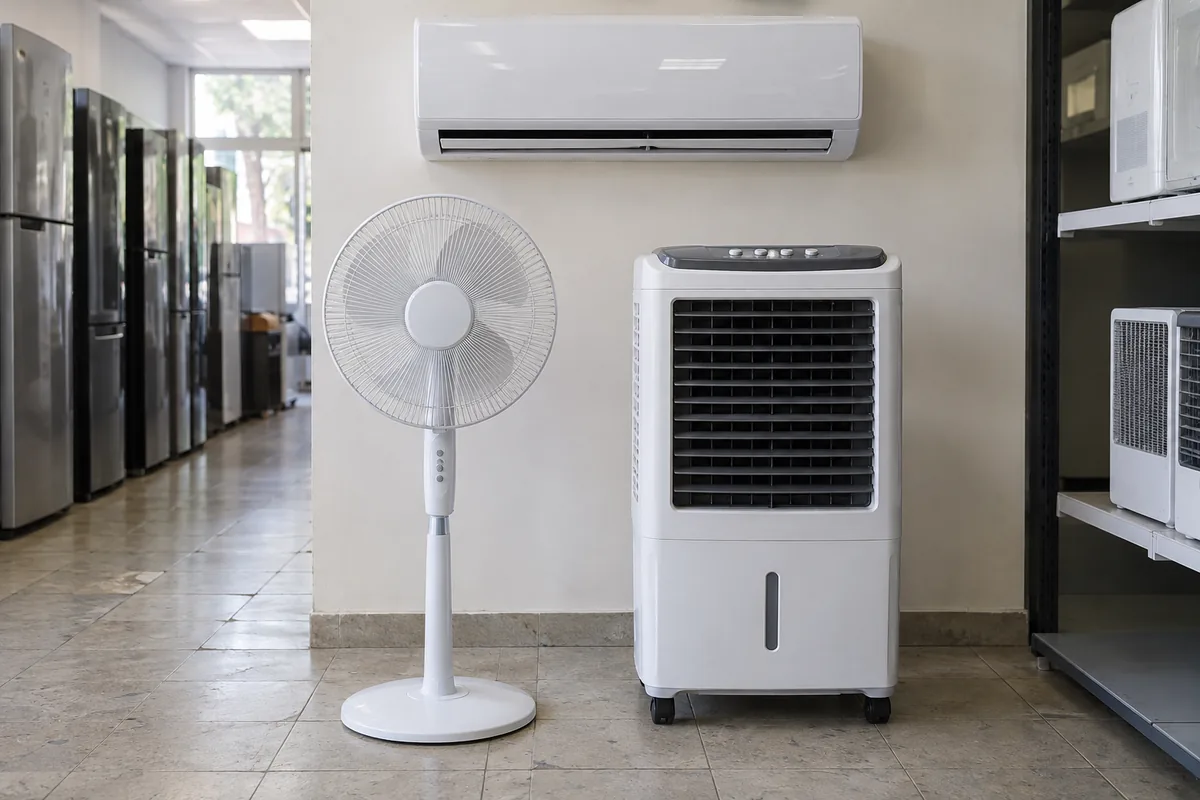
The main differences at a glance
| Question | Ordinary fan | Direct evaporative air cooler | Air conditioner |
|---|---|---|---|
| Main process | Moves existing air | Evaporates water into passing air | Uses refrigeration to transfer heat outdoors |
| Can it cool the air itself? | Does not refrigerate it | Can lower the temperature of passing air, depending on conditions | Can lower indoor temperature when properly selected and installed |
| Effect on humidity | Does not actively remove moisture | Adds moisture to the supplied air | Can remove moisture through condensation while cooling |
| Water requirement | None for an ordinary fan | Water supply or a refillable tank, with maintenance | Condensate management according to the system |
| Space requirements | Stable placement and a clear airflow path | Suitable fresh-air flow and a path for moist air to leave | An approved way to reject heat outside |
| Main selection question | Does the breeze reach people comfortably? | Are the air conditions and ventilation suitable for evaporation? | Does its cooling capacity and installation suit the room's heat load? |
These describe mechanisms, not a ranking of every appliance sold under each name. Fan size, a cooler's tank volume and AC cooling capacity are also different specifications; they cannot be compared as if they measure the same thing.
Choose a fan when useful airflow is the goal
At a desk, sofa or counter, a fan can supply a breeze without a water tank or refrigeration installation. Air movement can help personal comfort while leaving room air temperature largely unchanged. Our explanation of fans and room temperature covers that distinction.
A fan is useful when airflow meets the task. It cannot be assumed to solve a room that requires active temperature or humidity control. Moving a fan closer, changing its height or adjusting direction may improve the result at an occupied position without making it a room-cooling system.
An air circulator is also a fan. Read the circulator versus electric fan guide if your next decision concerns airflow pattern rather than refrigeration.
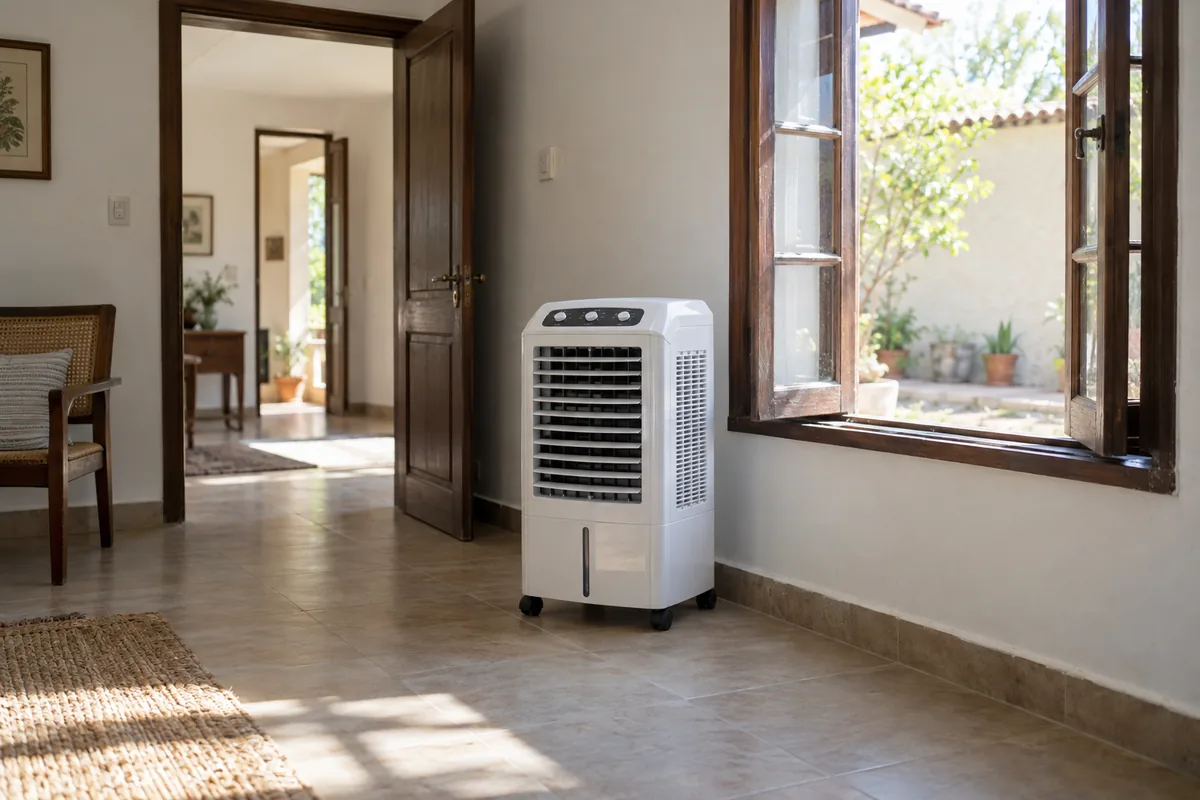
When does an evaporative air cooler make sense?
A direct evaporative cooler draws air through wet material. Some water evaporates, taking energy from the air, so the supplied air becomes cooler and more humid. The US Department of Energy explains this process and why it is more effective in dry conditions.
As incoming air becomes more humid, its ability to take up more water decreases. Cooling therefore depends on both temperature and humidity, the appliance and the airflow conditions. There is no single humidity percentage that guarantees the same result in every room.
The moisture needs somewhere to go. Honeywell's evaporative cooler guide describes the need for ventilation. Follow the model's instructions for fresh-air entry and air leaving the space. Repeatedly adding moisture to a closed room can make conditions less comfortable.
Before choosing one, check the refill routine, access for cleaning and drying the tank and pads, and whether water can be managed without spills near electrical equipment. Tank capacity tells you about water storage; it does not establish a room coverage area or a fixed temperature drop.
When is an air conditioner the better fit?
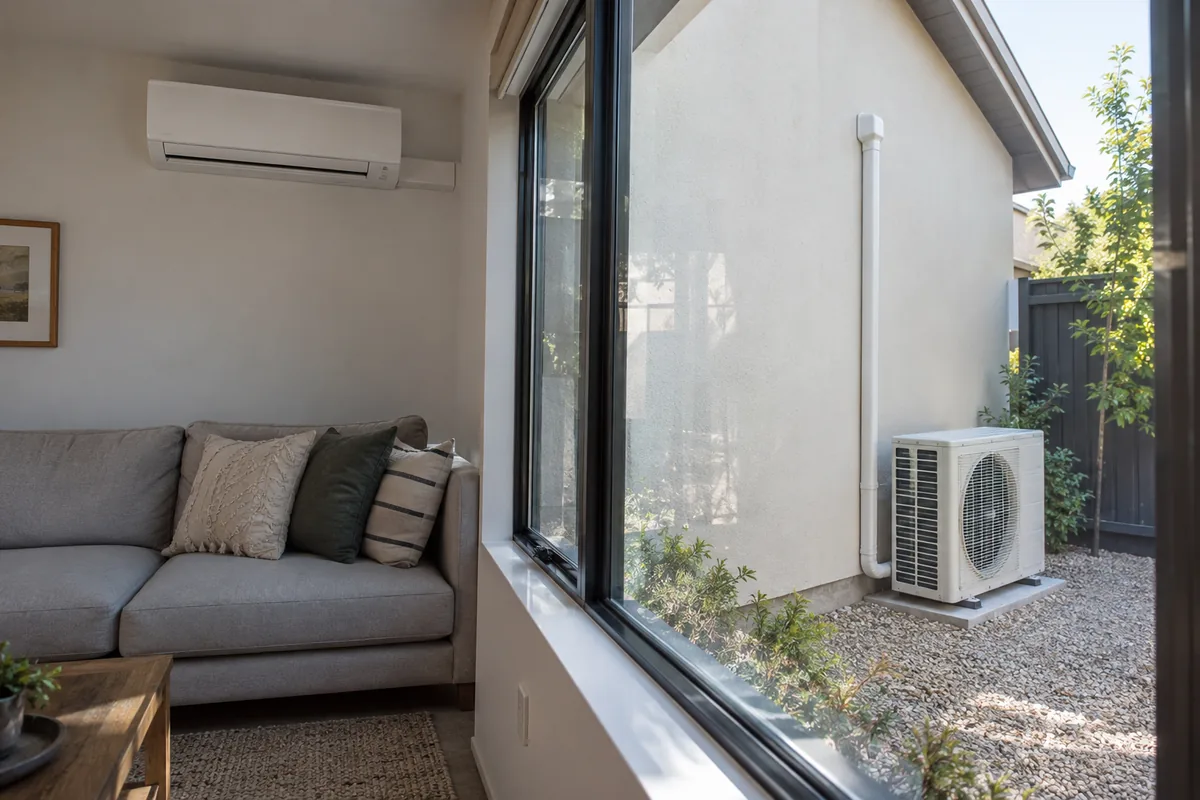
If the requirement is to lower room air temperature, an appropriately selected air conditioner supplies a process for removing indoor heat. Daikin explains how refrigerant carries heat from inside to outside, using a split system as its example.
Different designs reject that heat differently: a split system has an outdoor unit, while a portable room AC typically uses an approved exhaust arrangement. A portable unit cannot cool a closed room effectively if its rejected heat is simply discharged back into that same room.
Cooling coils can also collect moisture as water condenses on them. Daikin's cooling and dry-mode explanation describes this humidity-related function. It does not mean every AC will automatically maintain a particular humidity in every installation.
Check the room's size, heat gains, electrical requirements, drainage and installation constraints with the equipment supplier or installer. Closing exterior openings during normal AC cooling is a different strategy from the air exchange needed by a direct evaporative cooler.
Which uses less electricity?
Use the input power and operating time of the actual appliances. A small fan generally performs a less energy-demanding task than refrigeration, but comparing a breeze with a cooled room does not measure identical outcomes.
AC demand can change as the compressor cycles or adjusts output. An air cooler may use power for both its fan and pump. Compare measured energy over a useful period when possible, and include water and maintenance costs where relevant.
The fan electricity guide and calculator explains watts, hours and kWh. Do not insert a solar panel rating, a water tank size or an AC's cooling-capacity number into the electrical-input field.
What about solar charging and power cuts?
Solar and rechargeable describe energy supply and storage. They do not turn a circulating fan into an evaporative cooler or an air conditioner. A solar rechargeable fan can provide stored-energy airflow within its documented runtime; it does not establish whole-room refrigeration or an automatic backup supply for other appliances.
Farseen's current four-model range consists of solar rechargeable fans. Use the solar versus rechargeable comparison to understand charging options, then check the exact model's operating schedule and controls.
Make the choice in this order
First decide what must change: the breeze at your seat, the temperature of supplied air, or the temperature and moisture conditions in the room. Next check humidity, ventilation, water access and the route for heat to leave. Then compare the actual model's energy use, maintenance and installation.
For personal airflow, begin with a fan. For direct evaporative cooling, confirm that the incoming air and ventilation support the process. For controlled room cooling, plan an appropriate air-conditioning system. The appliance should match the job and the space, not just the word “cooling” on its label.

Farseen Editorial Team
The Farseen Editorial Team publishes practical guides and company updates about solar rechargeable fans, off-grid appliances, and product sourcing. Where an article discusses product-specific details, refer to its cited sources or contact Farseen for current information.