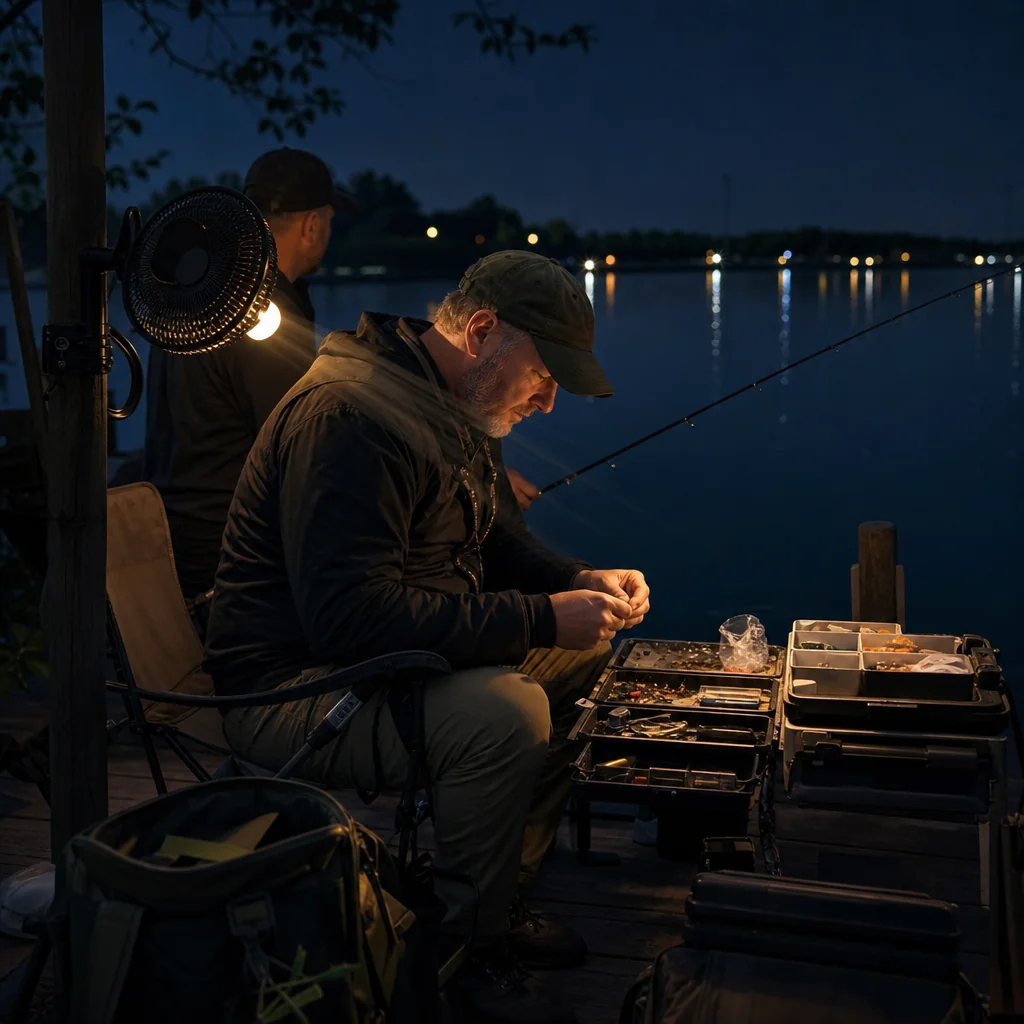
The best option for night fishing is usually a compact, battery-powered fan and light combo that lasts through a full evening. The right pick depends more on stored power, useful lighting, and dependable charging than on a big solar claim.
A calm, muggy night can turn uncomfortable fast once the sun drops behind the trees. A well-matched combo solves two problems at once by keeping air moving and providing usable task light, but the models worth carrying are the ones that still perform after midnight instead of fading after the first couple of hours. The key is knowing how to judge runtime, brightness, charging limits, and what makes sense on a dock, bank, or small boat.
Why Solar Fan and Light Combos Make Sense for Night Fishing
Night fishing is exactly the kind of situation where small off-grid gear proves useful. You need enough light to rebait, unhook fish, check line, and move safely, but without the noise, fumes, or glare of bulkier fuel-powered setups. At the same time, a little airflow matters more than many first-time buyers expect, especially in humid weather when still air brings mosquitoes, gnats, and plain discomfort.
A compact solar combo works on the same simple off-grid principle as larger standalone systems: the panel gathers energy, the battery stores it, and the load runs later when the sun is gone. That solar-plus-storage approach is why off-grid systems can still work after sunset. For fishing, that matters more than the panel size printed on the box.
There is also a practical safety angle. In off-grid communities, solar home systems are often adopted first for lighting, with clear benefits for safety and communication. That does not mean every portable fan-light is a good product, but it does reinforce that dependable stored lighting is a real need, not a gimmick.
What a Good Combo Actually Includes
A solar fan and light combo usually has three parts built around one battery. The LED light handles close-range visibility. The fan provides personal airflow, not room cooling. The solar input gives you a way to recharge away from an outlet, although in small portable products that solar charging is often supplemental rather than primary.
That last point trips up many buyers. One common portable camping fan, for example, combines built-in LED lighting, a 20,000 mAh battery, and a 3W solar panel. That sounds appealing, but a 3W panel is small. In real use, sunlight may help extend runtime or recover some charge during the day, yet USB charging is still usually the faster and more dependable way to refill the battery before a trip.
The Runtime Question That Matters Most
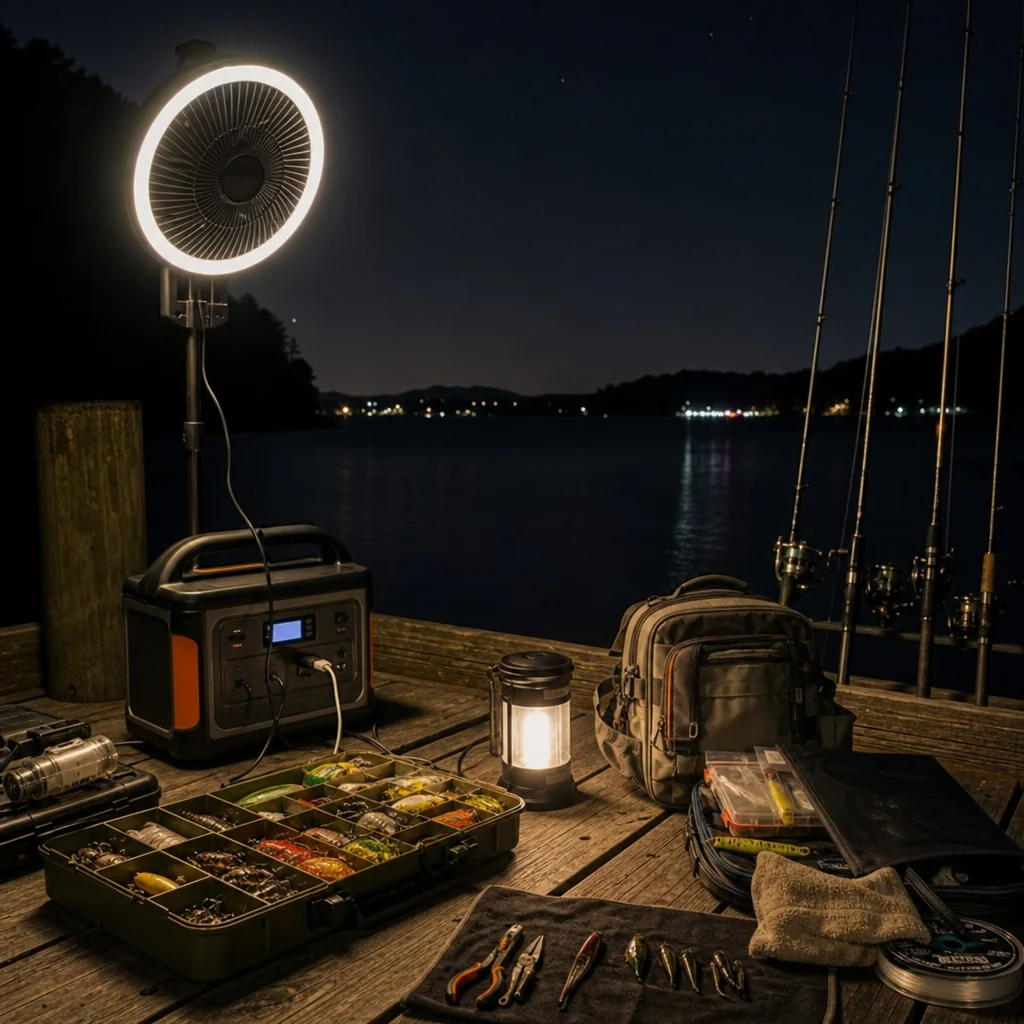
For night fishing, runtime matters more than maximum brightness or top fan speed. A combo is useful only if it can cover the session you actually fish. A short evening on a pond might last four hours. A summer catfish trip can run six to eight hours. An overnight dock session can stretch even longer.
The easiest way to shop is to assume you will not run both features at full blast all night. In practice, most anglers use the light in bursts for tying knots, landing fish, or sorting tackle, while the fan runs more continuously on a lower setting. That usage pattern is exactly why a medium-capacity battery often beats an ultra-bright, power-hungry unit.
Small off-grid design guidance supports this conservative approach. Battery-first planning is standard advice in standalone solar systems because storage, not the panel alone, determines whether power is there when you need it. The same lesson applies here: size for the load first, then decide how much solar support you need.
Solar Charging in the Real World
The phrase “solar rechargeable” can mislead buyers into thinking the product will fully recover on its own after one sunny afternoon. Sometimes it will not. Portable units with low-wattage panels simply do not harvest energy as fast as wall or USB charging, especially if the panel angle is poor, the sky is hazy, or the panel is partly shaded by trees, a canopy, or gear.
That matches broader solar-light behavior. Performance depends heavily on sun exposure, panel angle, battery capacity, and weather, and output drops when the panel is dirty, shaded, or stuck in cloudy conditions sunlight exposure. For anglers, the practical takeaway is simple: treat solar as a daytime top-up and USB as the main refill method unless the product has a meaningfully larger panel than a typical camping combo.
A good field rule is to start every trip with a full wall charge, then let the sun add a little extra while you travel, set up, or fish late afternoon into dusk.
Picking the Right Battery Type and Size
Battery chemistry affects both convenience and lifespan. In small portable gear, lithium-based batteries are generally the better fit because they store more energy for their weight and waste less power during charging and discharging. Lithium options, especially LFP-style chemistries, are also typically longer-lived and more efficient than lead-acid in solar-fan setups.
That aligns with broader small-system advice. Older lead-acid batteries can still work in fixed off-grid setups, but they are heavier, more maintenance-sensitive, and less convenient for mobile gear. For fishing, weight and portability matter. If you are carrying the combo from truck to bank or moving around a jon boat, lighter gear usually gets used more and regretted less.
A useful mental check is to match the battery to your fishing style. If you mostly fish two to four hours after dinner, a compact all-in-one unit is usually enough. If you regularly fish until 2:00 AM in still summer heat, move up in battery size before you move up in fan speed.
How Bright Is Bright Enough on the Water
For night fishing, useful light is controlled light. You do not need floodlight output bouncing off the water and ruining your night vision. You need enough illumination to work inside your own setup: tackle tray, rod holders, bait station, knot tying, and fish handling.
Warm or neutral LED light usually feels less harsh than a cold blue-white beam when you are sitting close to it for hours. A dimmable lantern-style light is often more versatile than a fixed spotlight because you can keep it low most of the time and raise it only when you need detail. If the combo includes multiple light levels, that is a real advantage, not just marketing filler.
Fan Performance: Comfort, Bugs, and Expectations
A portable solar fan will not cool open air the way a house fan cools a room. What it does well is move air across your face, neck, and hands. That small airflow helps sweat evaporate, keeps stagnant air off you, and makes bugs less comfortable hovering in your space.
Oscillation can help if two people are sharing a bench, dock chair, or covered platform. A six-speed fan sounds flexible, but high speed usually drains the battery faster. For fishing, low or medium settings tend to be the sweet spot because they stretch runtime and still provide enough airflow for personal comfort.
A Practical Setup for Different Fishing Scenarios
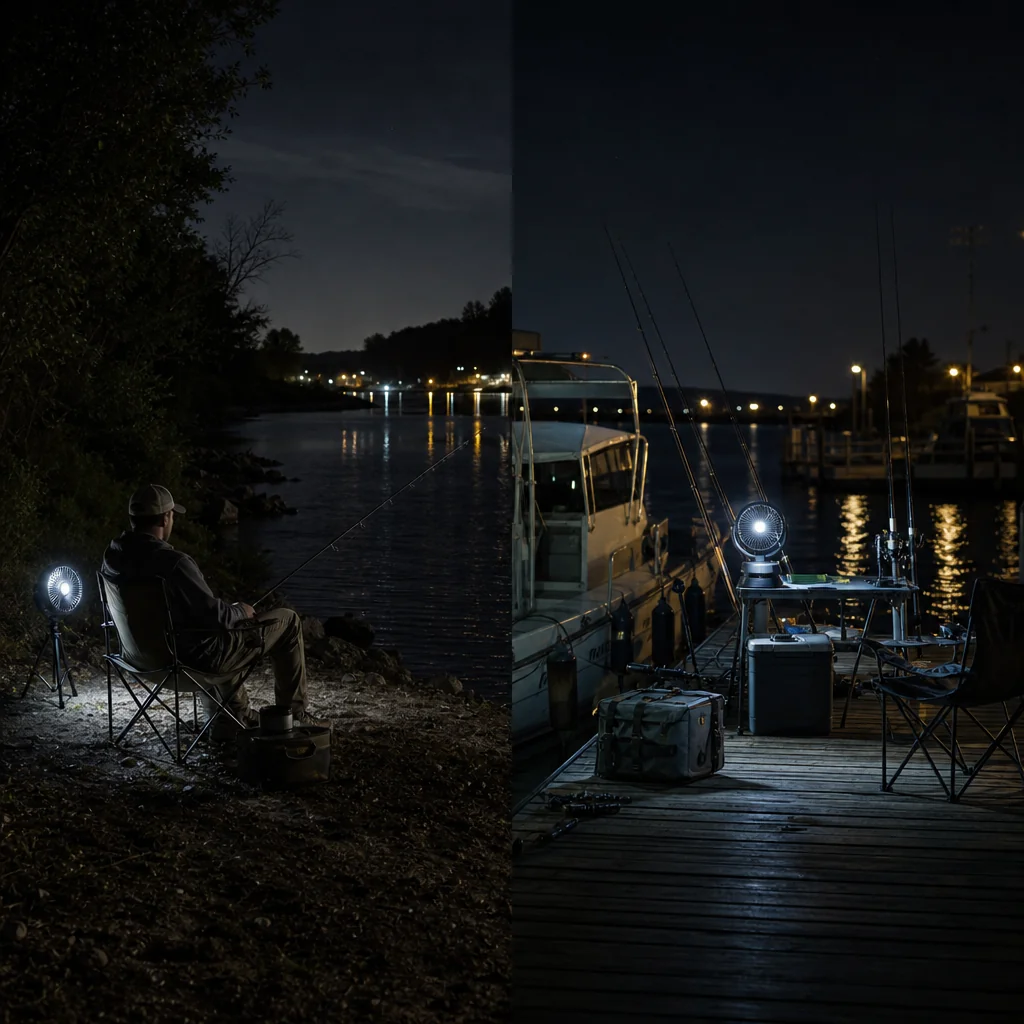
If you fish from shore or a dock, the simplest setup is a combo fan-light hung above shoulder height or clipped near your seat, with the light aimed down and away from the water. That gives you airflow where you feel it and keeps glare out of your eyes.
If you fish from a small boat, keep the unit stable and low enough that it will not become a hazard when landing fish or moving rods. In that situation, a separate small headlamp can still be worth carrying because it lets you keep the combo light dim while handling hooks and line.
If you stay out most of the night, think like an off-grid camper rather than a casual buyer. Bring the combo fully charged, let solar refill during the day, and keep a backup power bank or second light. Off-grid system guidance consistently assumes cloudy stretches and shortfalls happen, which is why even larger standalone systems often plan around storage first and backup second small remote off-grid solar system.
Pros and Cons Before You Buy
The strongest advantage is convenience. One unit can provide airflow, close-range light, and off-grid charging support without gasoline, extension cords, or a loud generator. Better models are also quieter, easier to move, and more pleasant to use in a tight fishing space.
The tradeoff is that small portable combos are limited systems. Their solar panels are usually too small to guarantee a full recharge in one day, their fan output is personal rather than powerful, and their advertised battery specs do not always tell you how long the unit will run with both features active. That is why smart buyers focus less on the word “solar” and more on real battery-backed runtime, low-speed efficiency, and charging options.
What to Look For in a Trustworthy Pick
A trustworthy combo for night fishing should have adjustable fan speeds, at least two useful light levels, USB charging, and a battery large enough for your normal trip length with some margin to spare. It should also be easy to position, whether that means a hook, stand, clamp, or stable base.
Panel quality still matters, but on small units, battery behavior matters more. In off-grid solar generally, bigger is not always better; the smarter choice is the system that matches your actual use rather than the one with the loudest spec sheet matched to actual lifestyle needs. That advice fits fishing well.
The right solar fan and light combo should disappear into the trip. If it keeps air moving, gives you clean light when a fish hits at 11:40 PM, and still has charge left when you pack up, it is doing the job. For night fishing, dependable modest output beats flashy claims every time.

Jordan Lee
Jordan Lee is part of the Farseen editorial team.