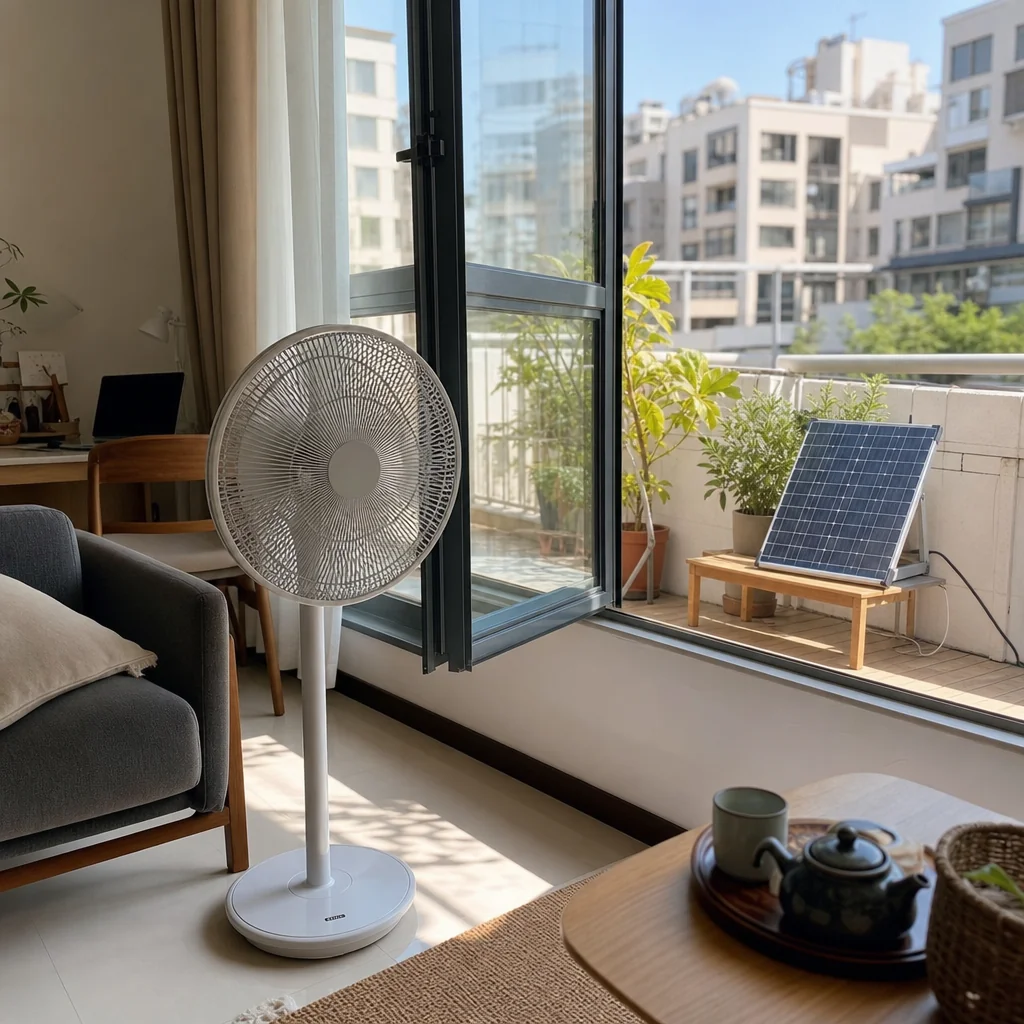
The best choice for most homes is a rechargeable solar stand fan with enough battery life for the evening, enough airflow for the room you actually use, and a charging setup that still works when the weather is not ideal.
When the power goes out on a hot night, or a back room never seems to cool down without running the AC harder, a weak portable fan quickly feels like wasted money. In real off-grid and backup setups, the difference usually comes down to stored runtime, not the word “solar” on the box. The simplest way to judge a fan is to look at battery life, airflow, charging options, and whether it will actually help in your bedroom, office, or small living area.
Start With the Right Type of Solar Fan
For home use, a rechargeable solar fan is usually a better buy than a direct-solar model. The reason is practical: a direct-solar fan only works when the panel is getting active sun, while a rechargeable model stores energy in a built-in battery so it can keep running after sunset, during outages, or when clouds roll in.
That sounds obvious, but it is a common buying mistake. A direct-solar fan can work well for a greenhouse, patio, shed, or daytime workspace. Inside a home, though, you often need airflow in the evening, during a storm, or during a blackout. Buyer guidance focused on real off-grid use generally reaches the same conclusion: battery-backed models are more flexible for bedrooms, desks, small living areas, and general outage comfort than solar-only fans.
There is also a scale issue that many listings blur. A solar-powered fan can mean anything from a small desktop unit to an attic ventilation fan to a hybrid fan tied into a larger home energy setup. If you want a stand fan for daily living, ignore broad “best solar fan” claims and focus on the narrower use case: personal or small-room cooling with battery backup.
Match the Fan to the Space, Not the Marketing
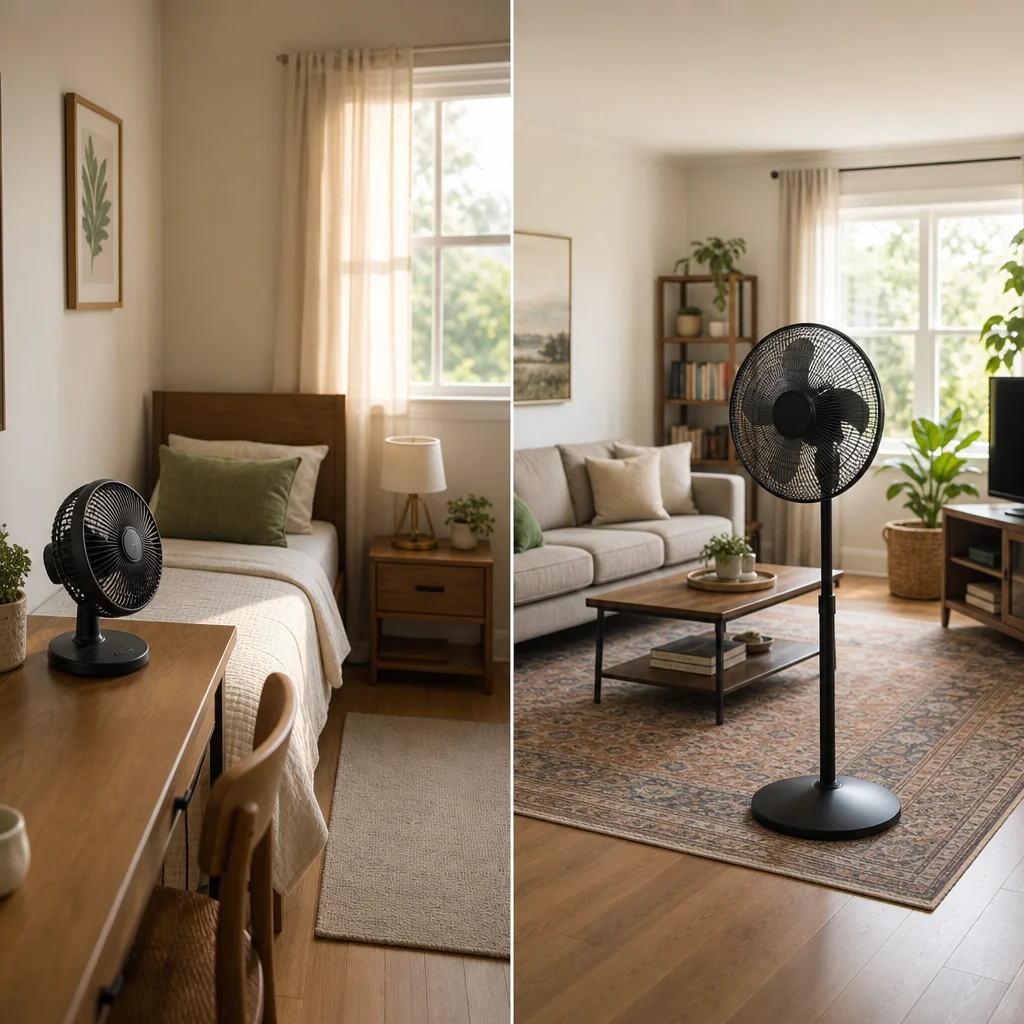
Most rechargeable solar fans are best for personal and small-space cooling, not for replacing central air conditioning or a full-size high-power floor fan. That matters because many buyers expect a 10-inch or 12-inch battery fan to cool a large open-plan room the way a corded stand fan can. In practice, these products work best when you aim airflow at people, not when you expect them to pull heat out of an entire large room.
A simple room test helps. In a small bedroom, home office, or kitchen nook, a rechargeable stand fan can make a clear comfort difference if it oscillates and has at least a couple of useful speed settings. In a large living room with high ceilings, it may still help, but mostly as spot cooling near a couch, bed, or desk. If your real problem is trapped attic heat or a hot upper floor, a solar attic or ventilation fan may solve more than a portable stand unit.
The market data points in the same direction. The residential segment is the largest part of the global solar fan market, and the leading power range is 10 W to 20 W. That suggests many household buyers are choosing modest, energy-conscious fans rather than heavy whole-room machines. It is a useful reality check: these are comfort tools, not miracle coolers.
Battery Capacity Matters More Than the Solar Label
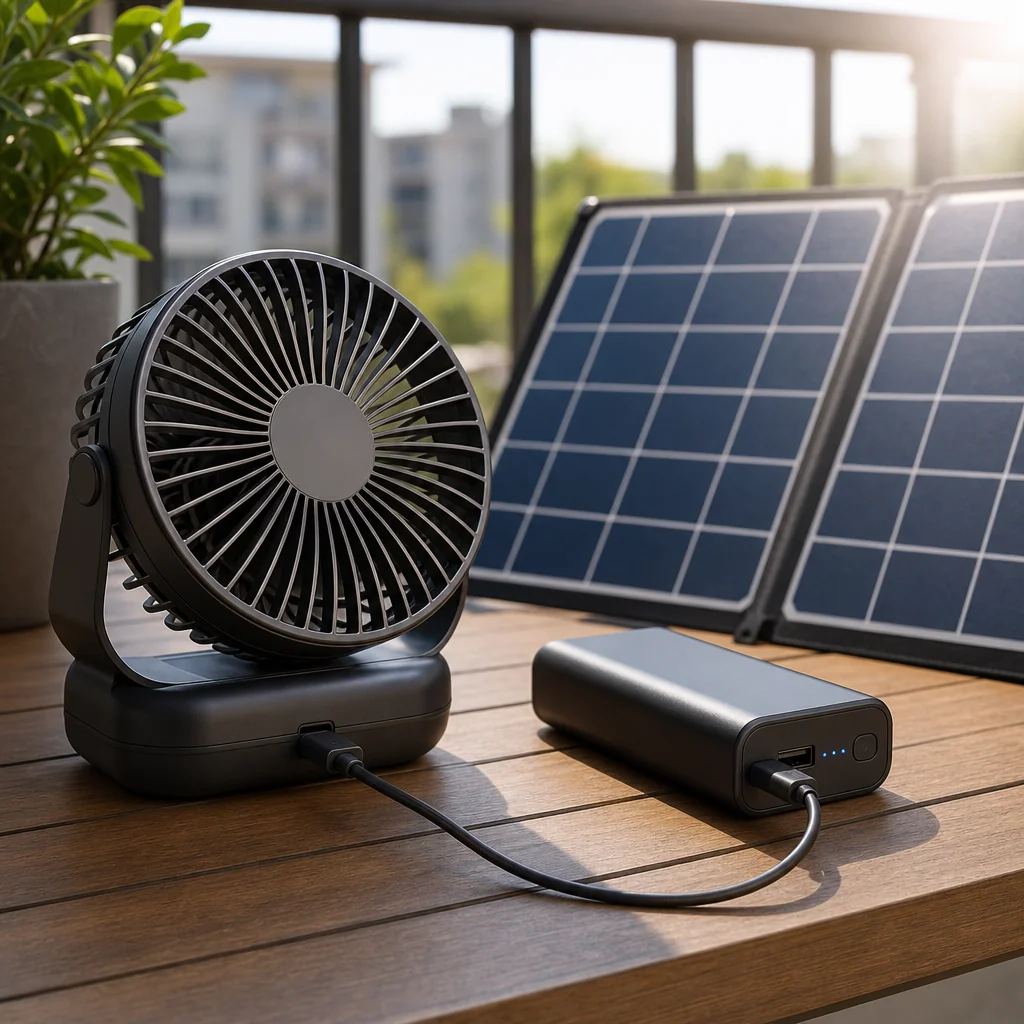
The most important spec for home use is battery capacity, because stored energy determines whether the fan will still be useful at 11:00 PM. Higher battery capacity usually means longer runtime, but only if the fan motor and extra features are not wasting that stored power.
This is where marketing gets slippery. Some product pages highlight battery size in mAh, such as 10,000 mAh or 14,400 mAh, but leave out runtime by speed setting, watt draw, or charging time. Without those details, you cannot compare two fans fairly. A published battery number is not useless, but it is incomplete. If one unit also powers an LED light or USB charging port, that added convenience may shorten actual fan runtime.
A good example is this 12-inch rechargeable fan, which pairs a rechargeable battery with solar and AC charging, offers three speeds, and notes that charging a cell phone from the USB port reduces fan runtime. That is exactly the kind of real-world caveat worth watching for. Multi-function gear is helpful, but backup cooling should come first if the fan is meant for home comfort.
Use Simple Runtime Math Before You Buy
A watt tells you how much power the fan is using at a given moment, while watt-hours tell you how much stored energy is in the battery. That distinction matters because runtime is really an energy question, not a branding question.
If a fan draws about 20 W and the battery stores about 240 Wh, you can expect roughly 12 hours of runtime under favorable conditions. Real runtime will usually be lower because speed changes, battery-management limits, and conversion losses reduce the ideal number. Even so, this quick estimate is far better than guessing from product photos or vague claims like “lasts all night.”
That same off-grid sizing logic is used in larger home systems. Portable power station guides and DIY solar sizing references both recommend calculating load first, then matching battery storage and charging input to that load. The method scales down well to a stand fan: estimate the fan’s draw, decide how many evening hours you need, and work backward to a battery size that covers it.
Check the Charging Setup Like You Would a Backup System
A hybrid charging setup is often the most practical choice for home use. In plain terms, that means the fan can charge from solar when the sun is available, but also from wall power or USB when you need a reliable top-up before bedtime or before a storm.
This matters more than many eco-minded buyers want to admit. If your fan depends on a tiny panel alone, recharging can be slow and inconsistent, especially if the panel is moved indoors, placed behind glass, or shaded for part of the day. A dual-input design gives you resilience without giving up the solar benefit. In an off-grid cabin, that might mean topping up from a portable power station. In a grid-connected home, it might mean pre-charging during the day and letting the fan carry you through an evening outage.
Panel quality still matters. Higher-efficiency panels capture more energy in less-than-perfect light, but even a good panel cannot fix a battery that is too small for your routine. If you regularly need overnight cooling, buy for battery first and solar second.
Pay Attention to the Features That Affect Daily Use
A brushless DC motor and solid battery-management features are worth favoring because they support efficiency and reliability, which matter more in off-grid living than flashy add-ons. Oscillation, tilt adjustment, and multiple speeds are not luxury extras, either. They let you spread airflow better and run the fan at a lower setting when you want to stretch battery life.
Noise level matters in bedrooms, but many listings do not state it clearly. Build quality matters too, especially if the fan may move between a porch, workshop, cabin, and bedroom. A sturdy base, protected charging ports, and simple controls usually age better than gimmicky features.
One distinction is worth keeping in mind. Some sources describe solar fans broadly as eco-friendly home cooling, while others are more careful and describe them mainly as small-area comfort tools. The difference is usually about product category, not disagreement. A fixed solar attic fan can meaningfully reduce heat buildup in a house, while a rechargeable stand fan mainly improves comfort around the people sitting near it. If you confuse those two jobs, you are likely to buy the wrong product.
A Practical Buying Standard for Most Homes
For a typical home user, the safest target is a medium-size rechargeable stand fan that offers AC and solar charging, oscillation, at least three speeds, and clearly stated runtime by setting. A built-in battery is essential, and trustworthy sellers will tell you how long the fan runs on low, medium, and high rather than hiding behind a large mAh number.
If your goal is emergency backup, choose longer runtime over maximum blast. If your goal is daily afternoon comfort in a sunny room, faster solar recharge and a decent panel become more important. If your space is large and hot, treat the fan as part of a cooling strategy that may also include shade, ventilation, insulation, or a larger fixed fan.
The best solar rechargeable stand fan is not the one with the loudest claim or the biggest panel in the photo. It is the one that still moves useful air where you sit, when you actually need it, without turning your backup plan into another thing that needs rescuing.

Ethan Parker
Ethan Parker is part of the Farseen editorial team.