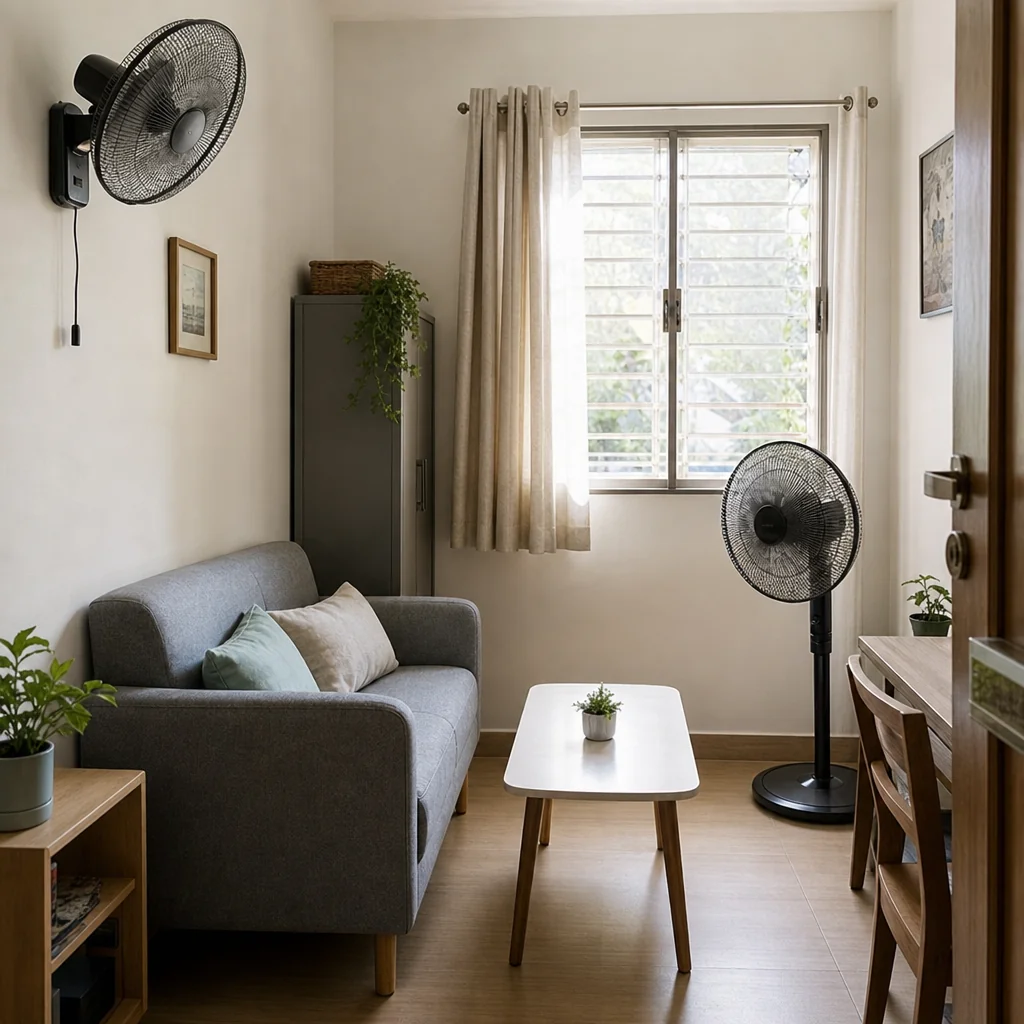
For most small rooms, a solar wall fan is the better fit when you want steady airflow without giving up floor space. A solar stand fan makes more sense when you need flexible placement, backup use during outages, or cooling you can move from room to room.
Does your bedroom, tiny cabin office, or shed room turn stuffy when the afternoon sun hits, but you do not want another cord stretched across the floor? In small off-grid and backup-power setups, the best comfort gains usually come from matching the fan style to the room layout, not just buying the biggest blades or the largest battery. This guide gives you a clear way to choose between wall-mounted and stand-style solar fans, plus the setup details that matter in real use.
What each fan type means in real life
A solar-powered fan uses a photovoltaic panel either to run the fan directly in sunshine or to charge a battery that runs it later. In practice, that difference matters more than the label on the box. Direct-solar models are simple and efficient in daytime sun, but battery-backed models are usually better for bedrooms, evening use, and outage planning.
A solar wall fan mounts high on a wall, usually aimed across the room or toward a window path. Its biggest practical benefit is keeping the floor clear, which matters in a small room with a bed, desk, or storage bins. A solar stand fan, sometimes sold as a pedestal or portable floor fan, sits on the floor and can be moved where you need it. That flexibility helps when you want airflow by the bed one day and near a workbench or kitchen corner the next.
Why small rooms change the decision
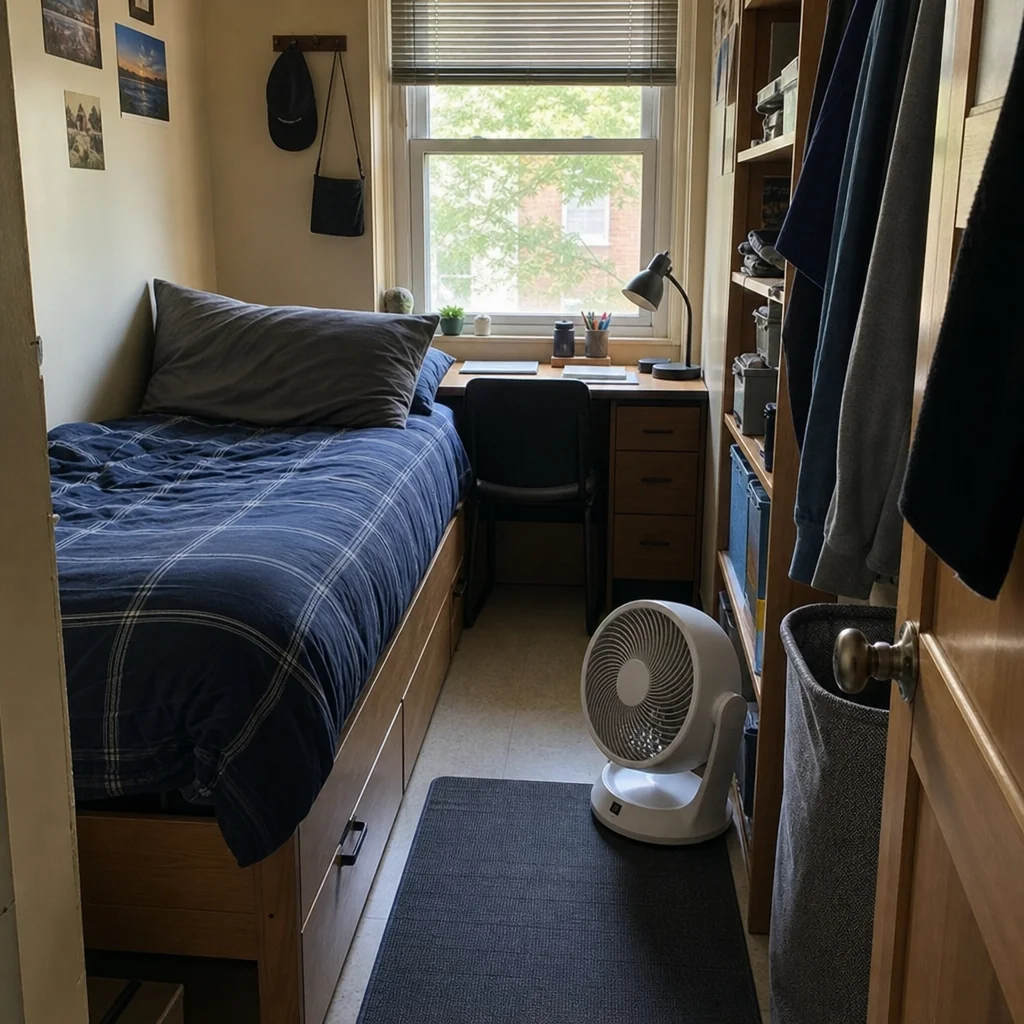
In off-grid homes, efficient appliance choices matter because every watt has to be produced and stored somewhere. That is why fan choice is not trivial in a 90 to 180 sq ft room. In a small room, comfort is often limited more by poor airflow paths and clutter than by raw fan power. A fan that moves air across your body and toward an open window can feel more useful than a stronger fan pointed into a corner.
This is where wall fans often win. Mounting the fan higher helps sweep air across the occupied zone and can improve cross-ventilation if you place it near a window or vent path. A stand fan can still work well, but it takes up floor area and is easier to block with furniture, laundry baskets, or the side of a bed. In a compact room, those obstacles are not minor; they can turn a decent fan into a noisy breeze that never reaches you.
Solar wall fan: where it works best
A wall-mounted solar fan for bedrooms and living rooms makes the most sense when the room layout is stable and you know where airflow should go. Think of a tiny bedroom where the bed stays in one place, or a garden office with one desk and one window. In those cases, a fixed fan is not a limitation; it is an advantage. Once installed, it stays out of the way, keeps cords and trip hazards off the floor, and can be aimed to support cross-breezes day after day.
The tradeoff is that installation matters. If you mount it too high, too low, or on the wrong wall, you may get plenty of noise and very little comfort. A wall fan also makes less sense in a rental, in a room that gets rearranged often, or when several people need airflow from different angles. If your room serves as a guest room, workout room, and storage room in the same week, a fixed fan can easily end up fixed in the wrong place.
Another advantage is energy discipline. A wall fan often becomes part of the room itself, so people tend to use it intentionally instead of dragging it around and running it at full speed everywhere. That may sound minor, but variable speed and targeted airflow are what keep off-grid systems manageable.
Solar stand fan: where it earns its keep
A portable solar fan is usually the better choice if your priority is flexibility rather than a permanent setup. For renters, campers, blackout prep, and multipurpose small rooms, stand fans solve a real problem: you can move the cooling to the person instead of forcing the room to fit the fan.
That matters more than many guides admit. Many small portable solar fans are positioned for personal airflow rather than full-room cooling, and one source places many portable models in the rough range of 50 to 200 CFM. In plain language, that is enough to make a bed corner, desk chair, or reading nook feel better, but it does not automatically mean the whole room will feel evenly ventilated.
A rechargeable stand fan also handles the evening better. Several sources make the same point from different angles: direct-solar-only products are fine in sun, but battery-backed designs are more practical for homes because they keep working after sunset and during outages. If your main use case is sleeping through a muggy night or getting through a utility outage, a stand fan with solar charging and battery storage is often the safer buy.
Side-by-side for a small room
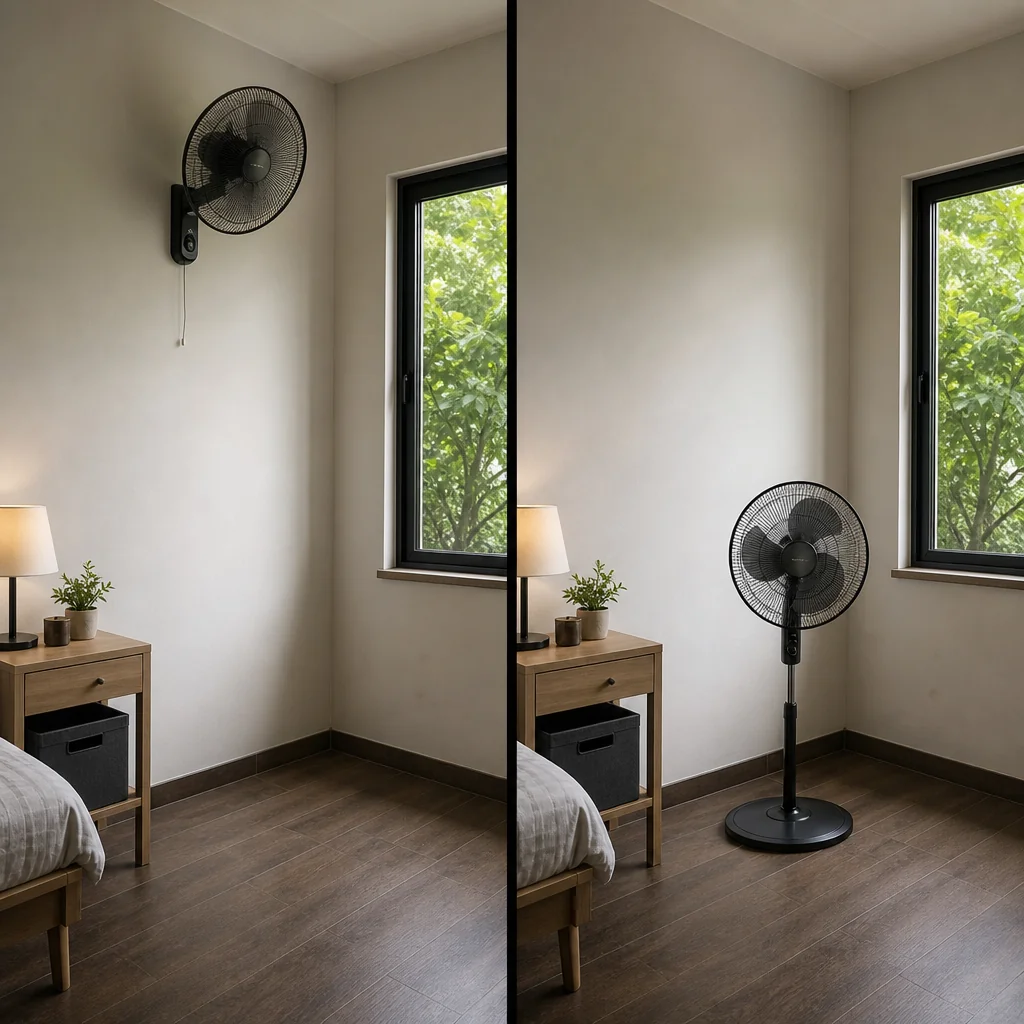
| Feature | Solar Wall Fan | Solar Stand Fan |
|---|---|---|
| Floor space | Excellent | Fair to poor |
| Flexibility | Low | High |
| Best for | Fixed bedrooms, offices, sheds | Renters, backup use, multipurpose rooms |
| Airflow direction | Stable, set once | Easy to re-aim anytime |
| Installation | More involved | Usually simple |
| Outage use | Good if battery-backed | Very good if rechargeable |
| Trip hazard | Low | Higher |
| Furniture interference | Lower when mounted well | Higher in crowded rooms |
Which one is more practical off-grid
A battery bank sizing approach should be based on the load and runtime you actually need, and that rule applies to fans just as much as lights or routers. For a small room, the smarter question is not “Which fan is strongest?” but “How many hours of useful airflow do I need, and when?” If you mostly need help from noon to 6:00 PM, a direct-solar or lightly battery-backed wall fan can work well. If you need airflow from 10:00 PM to 4:00 AM, battery storage matters more than mount style.
A simple example shows why. If a fan draws about 20 watts and you want 8 hours of overnight use, you need roughly 160 watt-hours of usable energy. That is still a modest load by off-grid standards, but only if the fan is actually solving the comfort problem. A badly placed stand fan blocked by furniture, or a wall fan aimed above your bed, can waste those watt-hours with little benefit.
This is also where battery-free solar systems deserve a reality check. A battery-free solar setup can be simple and cost-effective for daytime self-consumption, but it is a weak match for night cooling. If sleep comfort is your goal, do not let the word “solar” distract you from the plain fact that nighttime airflow needs stored power.
What makes sense in common real-world scenarios
In a tiny bedroom, a wall fan is usually the better choice if the bed location is fixed and the room is tight enough that floor space matters every day. Mounted to push air across the bed and toward the door or window, it tends to feel cleaner and less intrusive.
In a small rental apartment room, a rechargeable stand fan usually makes more sense. You avoid drilling, you can move it between the bedroom and a desk, and you still get value during outages or on a porch. That flexibility often outweighs the floor-space penalty.
In a shed office or workshop, the choice depends on whether the room is permanent or constantly changing. A fixed bench and fixed window usually point to a wall fan. A room that doubles as storage, hobby space, and an occasional guest area usually benefits more from a stand fan.
Buying mistakes that matter more than wall vs. stand
The solar fan market is growing quickly, and product variety is improving with brushless DC motors, battery features, and smarter controls. That is good news, but it also means marketing can make very different products sound equivalent. The biggest mistake is buying a direct-solar fan for a nighttime problem. The second is assuming any solar fan will cool a small room evenly just because the room is small.
Another common mistake is ignoring sun access. Panel placement still decides whether the system works well. Dust, shade, and weak window exposure reduce charging and output. A modest fan with a well-placed panel and realistic runtime expectations will usually outperform a fancier unit with poor solar access.
Final call
If your small room is permanent, crowded, and used the same way every day, a solar wall fan is usually the better long-term choice. If you need mobility, easy setup, and reliable comfort during outages or overnight use, a battery-backed solar stand fan is usually the smarter buy. In off-grid living, the best fan is the one that matches your room layout, your evening habits, and your actual sunlight, not the one with the most ambitious packaging.

Ethan Parker
Ethan Parker is part of the Farseen editorial team.