Choose between a tower fan and a pedestal fan by checking where the air comes out, whether the complete base fits your room, and how the manufacturer allows you to clean it. Neither shape guarantees stronger airflow, quieter operation or a lower electricity bill.
The choice becomes clearer when you picture the actual task: reaching someone behind a desk, sharing a breeze across a sofa, or fitting beside a bed without blocking a walkway. A slim-looking appliance can still be awkward in that particular position.
These are real buying questions. One home-worker discussion asks whether to replace an inadequate desk fan with a stand or tower model; another tower-versus-blade-fan discussion asks about efficiency and cleaning. Owners' preferences help identify what to check, but do not establish a winner across all models.
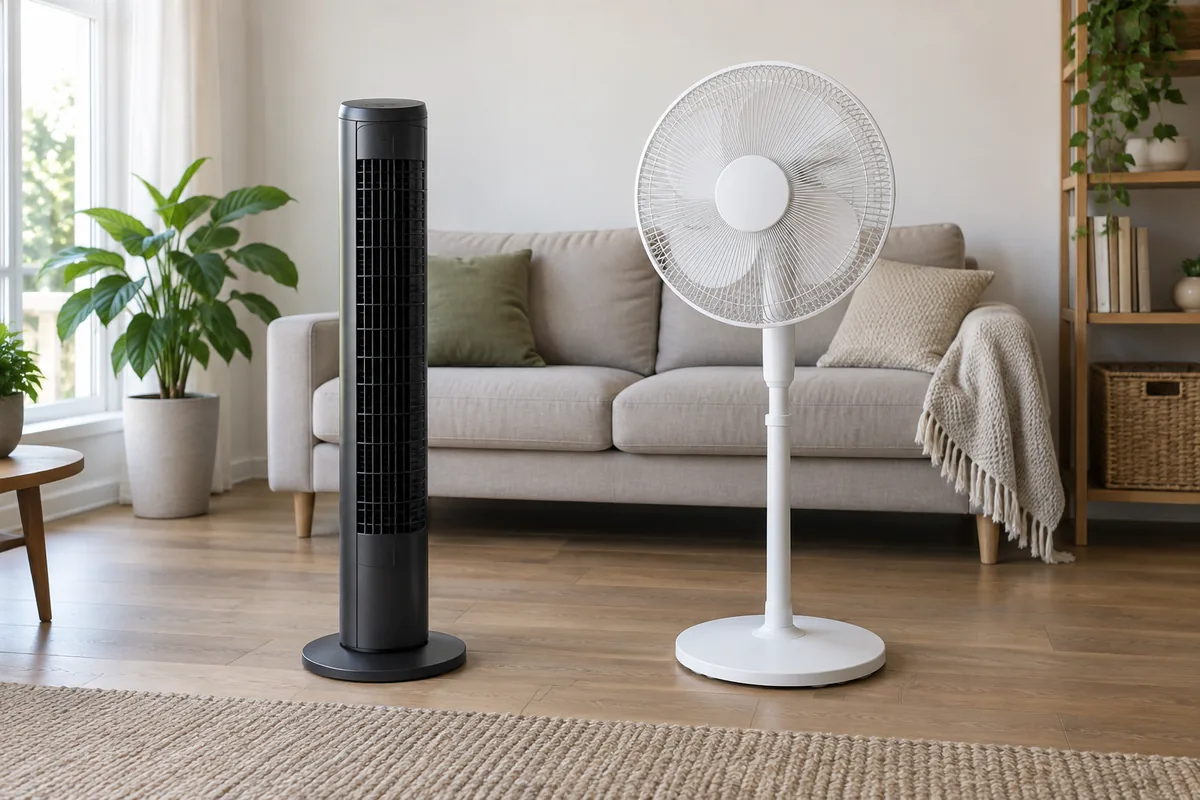
What is different about the two shapes?
A conventional pedestal fan has a guarded fan head on a stand, often with height adjustment. A conventional tower fan contains a cylindrical impeller inside a tall housing and delivers air through an elongated outlet. The UC Berkeley CBE guidebook describes these common designs, while noting that fan classifications are not standardized.
Treat those descriptions as a starting point. Check the actual outlet, adjustment range and instructions, particularly for unusual designs sold under similar names.
Both ordinary types move air. Changing the housing does not turn a fan into refrigeration; see why fans can feel cool without cooling the room if a lower room temperature is your main requirement.
| Question before buying | Pedestal model: inspect | Tower model: inspect |
|---|---|---|
| Will air reach my seat? | Head height and permitted tilt at your seated position | Outlet height and the clear path from it to your seat |
| Will it fit? | Base dimensions, head width and space for movement | Base dimensions, body depth and required clearance |
| Can two people share it? | Available oscillation and the seats it actually reaches | Available oscillation and the seats it actually reaches |
| What can I clean? | Whether the manual permits guard removal | Whether the manual permits access behind the housing |
Airflow: check furniture height before choosing more power
Start at the chair you use most. Look between that position and the proposed fan location: is there a solid desk panel, sofa arm or bed frame in the way?
For a desk, compare the fan's outlet with the tabletop and your upper body. A tower that fits neatly under the desk is not automatically useful there. Likewise, an adjustable pedestal deserves a check of its lowest and highest usable positions, rather than an assumption that it will reach any seat.
Beside a sofa, try each candidate from the position where its base can safely remain. Check both seats if sharing matters. A demonstration directly in front of the outlet does not tell you how the fan will feel from the other end of the sofa.
CBE explains that airflow depends on the complete design, and that strong airflow close to a person can be excessive even at the lowest setting. Its airflow and flexibility guidance also distinguishes a fixed breeze from the wider sweep produced by oscillation. Choose a usable low setting as well as an adequate high one.
Use only the placement and adjustments permitted by the manual. Do not solve an unsuitable outlet height by balancing a floor fan on furniture or propping it at an angle.
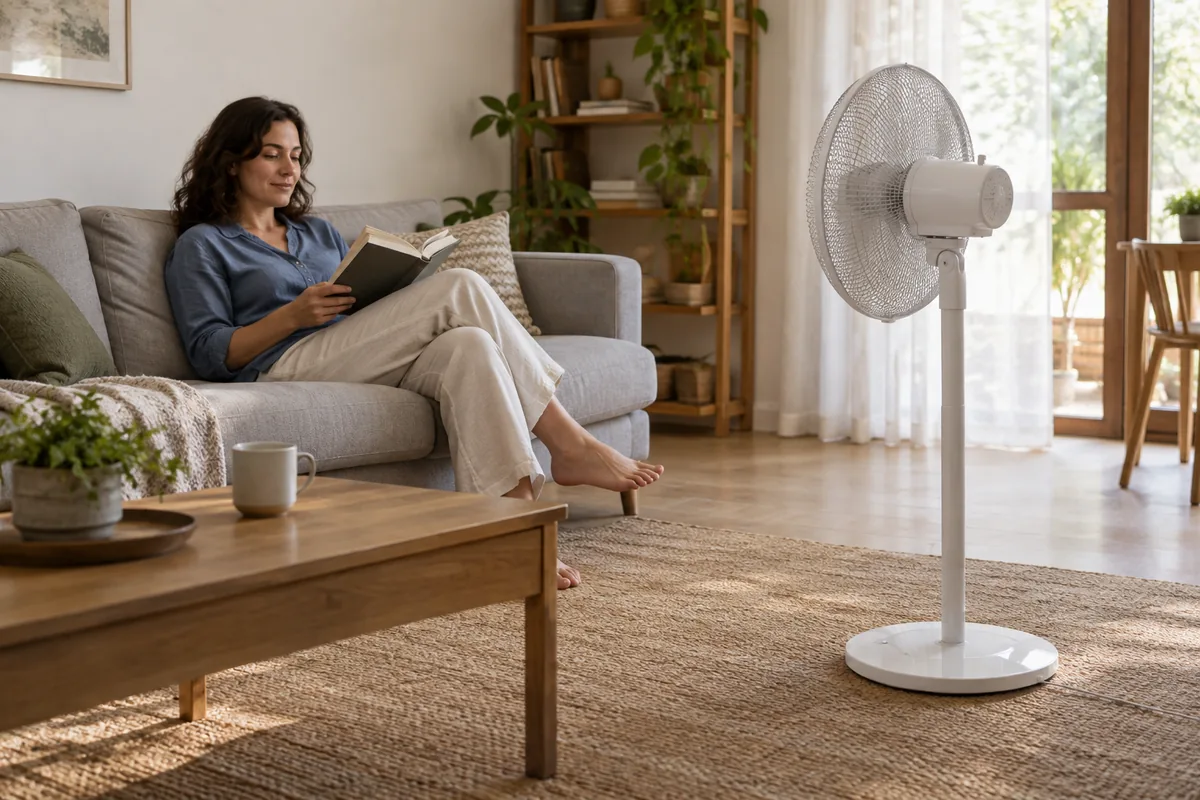
Space: measure the base, not just the column
Before ordering, mark the complete base dimensions on the floor with removable tape. Then consider the rest of the appliance: its widest point, permitted movement and the clearance specified in its instructions. A narrow tower body and a narrow floor footprint are different measurements.
Run through an ordinary day with that outline in place. Can you pull out the desk chair, open the wardrobe and walk past the bed? Can the cable reach a suitable outlet without crossing that route? Can you reach the controls without squeezing behind furniture?
Repeat the exercise for the pedestal candidate. Its head may extend beyond the base outline, so check that separately. This comparison can reveal that either design fits your room better than its catalogue photograph suggests.
Cleaning: read the maintenance instructions before buying
Do not assume every tower fan is difficult to clean or every pedestal grille comes off easily. The decisive detail is the access the manufacturer permits.
For example, Lasko's tower-fan guidance specifies external cleaning and advises against opening the unit. In contrast, Dreo's Nomad One/S instructions provide a model-specific procedure for removing the grille and impeller. These examples demonstrate variation within tower fans, not cleaning instructions for another model.
Ask the seller for the matching manual and check three things:
- Which areas can the owner clean without opening the appliance?
- Which parts, if any, are approved for removal and reassembly?
- What support is available when dirt remains somewhere the owner cannot access?
Choose a maintenance routine you are willing and able to follow. If you already own a fan with a guard that will not release, use the fan grille cleaning guide rather than treating this buying comparison as a teardown procedure.
Noise and electricity: compare the operating setting
A tower fan is not automatically quieter. CBE identifies both sound level and the character of the sound as relevant, with results depending on design and operation. Listen at the setting and position you would actually use; its noise discussion cautions against a universal ranking by type.
Electricity cost needs a separate comparison. Virginia Tech's energy guide calculates consumption from power and operating time, and notes that power can change with the selected setting. Use suitable input-wattage data and your daily hours in the fan electricity calculator, rather than assigning a fixed cost to either shape.
Which should you shortlist?
Shortlist a pedestal model when its documented height and direction adjustments help it fit your seating layout. Shortlist a tower when its actual base, outlet position and cleaning provisions suit the available space. Reject either candidate if its useful operating position blocks a route or leaves the breeze aimed at furniture.
If a standing solar rechargeable format is also on your list, Farseen's 198F standing fan and S600 standing fan provide two documented product references. Their format alone does not establish a performance advantage over a tower. Check the configuration, controls and support details needed for your household or retail assortment before selecting a model.

Farseen Editorial Team
The Farseen Editorial Team publishes practical guides and company updates about solar rechargeable fans, off-grid appliances, and product sourcing. Where an article discusses product-specific details, refer to its cited sources or contact Farseen for current information.