A five-blade pedestal fan is not automatically stronger, quieter or more efficient than a three-blade fan. Choose between the complete models by the airflow you need, the sound you can tolerate and the electricity or battery energy they use at a useful setting.
The question gets harder when both listings show the same diameter and watts. In a Reddit comparison of three- and five-blade stand fans, the buyer listed matching size and electrical ratings. Another stand-fan discussion asked why the two designs sounded different. These are reasonable questions; the comments are personal explanations, not controlled product tests.
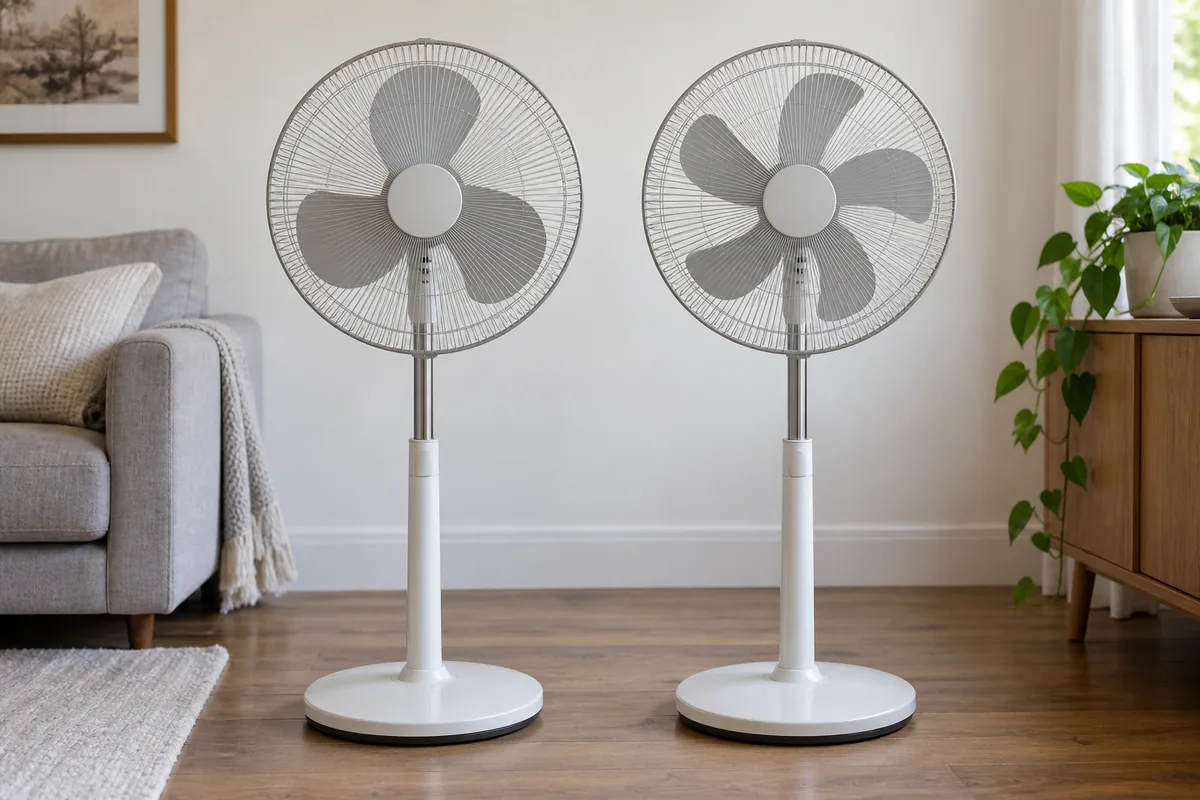
Why counting blades cannot settle the comparison
A blade count describes one visible feature. It does not describe the whole blade shape, fan diameter, rotational speed, motor or surrounding structure. Three broad blades and five narrower blades are visibly different arrangements; counting them does not measure their total area or useful airflow.
UC Berkeley's guide to pedestal and other household fans identifies fan size, blade type and structure as factors in airflow performance. That is a reason to compare complete designs, rather than treating two extra blades as a fixed performance upgrade.
Start by replacing these shortcuts with questions that a specification sheet or sample can answer:
| Tempting shortcut | Better question |
|---|---|
| Five blades must move more air | What airflow is reported for each complete fan, at which setting and under what test method? |
| Three blades must use less electricity | What is the input power at the setting that does the job? |
| Five blades must be quieter | How does each model sound when producing useful airflow at my position? |
| The same diameter and watts mean the same fan | What else differs in the design, controls and actual performance? |
These questions also help when a seller offers seven or nine blades. A higher count still needs supporting performance information.
Are five blades quieter?
There is no reliable winner from the count alone. The Berkeley guide describes sound from the motor and moving blades, with rotational speed and design affecting noise. It also distinguishes sound level from its frequency character. Two fans can therefore be differently irritating even when a simple loudness description sounds similar.
Try the setting you would actually use. Record whether you hear a steady rush, a hum, an intermittent tick or a rattle. Keep the room, listening position and background noise similar. If you can only watch an online video, treat it as a demonstration: the recording setup is not your room, and it does not provide a matched sound comparison.
For a fan you already own, a newly developed rattle is a separate question from blade-count preference. Use the guide to rattling during oscillation to describe the symptom and decide what to check without opening the motor housing.
What a “low-noise five-blade” claim actually tells you
Some manufacturers associate a particular blade design with quieter operation. For example, Anchor by Panasonic's Penta Turbo pedestal-fan listing describes five shaped blades intended for low-noise operation and separately lists speed, power and air delivery.
That is a claim about that manufacturer's complete product. It does not supply a controlled comparison showing that every five-blade fan is quieter than every three-blade fan. Ask what the claim is being compared with and whether the operating setting is stated. Apply the same questions to a three-blade product advertised as powerful or efficient.
Does blade count change the electricity bill or battery runtime?
Read the input-power information for the actual fan. Matching wattage labels do not establish equal power consumption at every setting. Virginia Tech's appliance energy guidance explains that actual power use can depend on the setting and that energy consumption combines power with operating time.
For two fans running from mains electricity, compare consumption for the same daily task. If both genuinely draw the same average watts for the same number of hours, their operating energy is the same regardless of blade count. That still does not tell you whether they deliver equally useful airflow. Our fan electricity calculator handles the energy and cost calculation once you have appropriate inputs.
For a rechargeable fan, keep the battery comparison separate. Request the operating setting and other loads behind a runtime claim. A five-blade photo cannot tell you whether the fan will cover an evening outage. See how fan speed changes battery life before treating the longest advertised runtime as the result at your preferred speed.
If you are choosing between a rechargeable fan and a plug-in fan on a backup supply, compare the complete DC and AC backup arrangements. The power connection and usable battery energy require a separate check from the blade design.

A practical comparison you can repeat
Use this short record when examining two complete fans. It is a personal comparison method, not a laboratory certification test.
- Name the task. Write down where you will sit or work and whether you want fixed airflow at one seat or a sweep across several positions.
- Record both models. Include the full model name, size label, blade count and the source of any power or airflow figures. Leave unavailable measurements blank.
- Use an appropriate position. Keep the fan assembled with its guard fitted, on a suitable stable surface, and follow its operating instructions. Note the distance and direction relative to your seat.
- Find a useful setting on each. Do not assume “speed two” represents equivalent performance across different models. Note the setting that you would choose for normal use.
- Record the tradeoff. Write down airflow impressions, sound and available power or runtime evidence for those settings. Keep personal observations separate from measured values.
If you are buying online and cannot try either fan, request comparable specifications or a sample. Missing data means the comparison remains open; it is not a reason to award the win to the larger blade count.
Which one should you choose?
Choose the three-blade model if its complete configuration meets your needs and the comparison supports it. Choose the five-blade model on the same basis. When both are acceptable, controls, placement, cleaning access, service arrangements and price can decide the purchase.
If the real difference is size, continue with the 16- versus 18-inch standing-fan comparison. It explains Farseen's documented configurations without turning size into an airflow guarantee. For a reseller evaluating samples, the solar-fan inspection checklist helps keep the selected sample and quoted configuration aligned.
The useful conclusion is the model and setting you would choose for your task, together with the observations that justify it. Blade count belongs in that record; it does not replace the comparison.

Farseen Editorial Team
The Farseen Editorial Team publishes practical guides and company updates about solar rechargeable fans, off-grid appliances, and product sourcing. Where an article discusses product-specific details, refer to its cited sources or contact Farseen for current information.