Yes—a fan can help clothes dry by moving air across the fabric, but it does not remove the released moisture from the room. The useful setup combines airflow around the laundry with a way to manage that moisture. A stronger breeze alone may accomplish little in an increasingly humid, closed room.
This guide concerns an ordinary room fan and a separate drying rack. It does not turn a fan into a heated dryer, dehumidifier or appliance approved for wet locations.
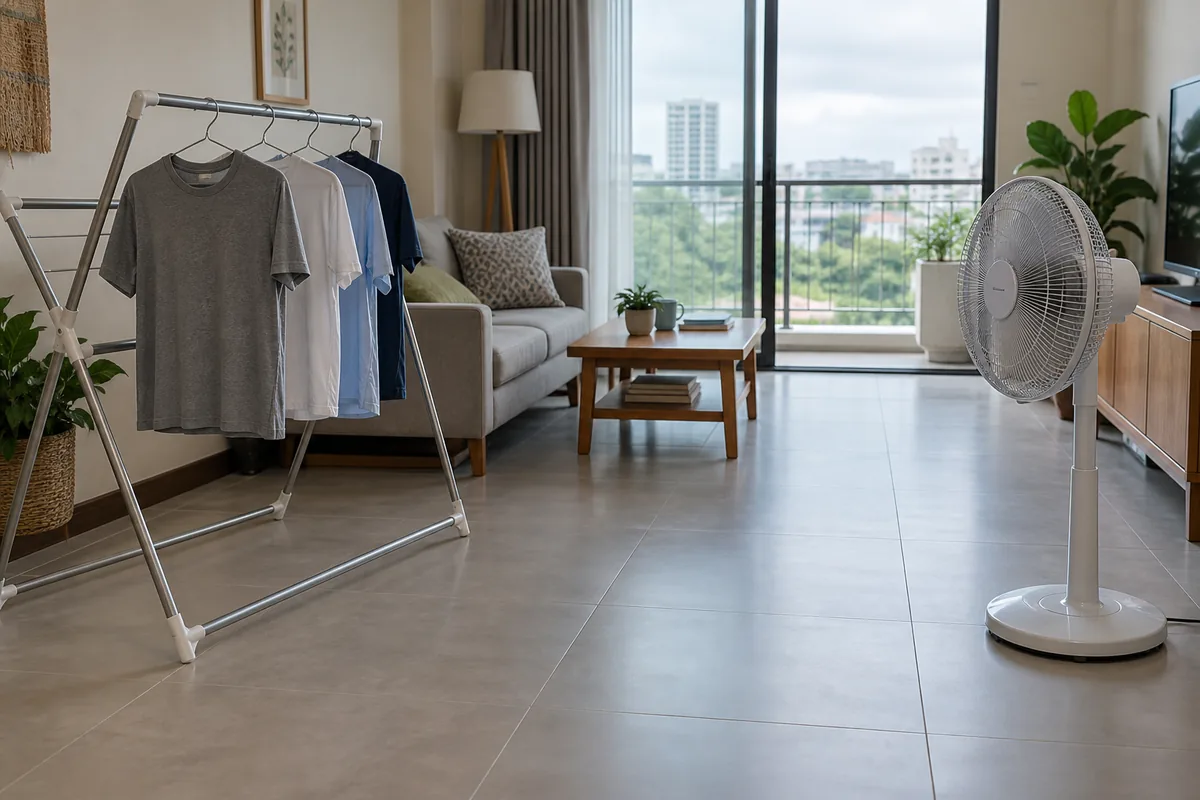
Why moving air helps wet clothes dry
Water in damp fabric evaporates into the surrounding air. Moving air can carry away the moist layer near the fabric and replace it with air that supports further evaporation. Temperature, moisture in the air and airflow all affect the result, as explained by West Texas A&M University physicist Christopher Baird.
That explains why a breeze can help without heating the clothes. It also explains the limitation: replacing humid air with more humid air is much less useful. Increasing speed cannot guarantee a particular drying time.
If you are interested in the related effect on people, read why fans feel cool without lowering room temperature. Here the task is removing water from fabric, so the state of the laundry and the room both matter.
Decide where the moisture will go
An ordinary circulating fan has no water-collection process. Moisture leaving the clothes enters the room air; circulating it around the rack does not make it disappear.
There are two distinct arrangements:
- Ventilation: moisture leaves through an appropriate air-exchange route, with replacement air entering. Whether this helps depends on outdoor conditions and the building's ventilation.
- Dehumidification: equipment removes moisture from indoor air. Follow the appliance instructions for room conditions, placement and collecting or draining water.
West Norfolk Council's indoor-air guidance identifies indoor clothes drying as a moisture source and advises improving ventilation when it cannot be avoided. It also recommends considering a dehumidifier and seeking help for inadequate ventilation or persistent damp.
An open window is not automatically the right solution during humid, rainy weather. Nor does a fan aimed through a doorway establish that moisture has left the home. If you use windows, consider weather, security and the available airflow route; our window-direction guide explains that layout decision separately.
Arrange the rack and fan before switching on
Start with the garment care labels and the instructions for your fan. Choose a permitted indoor location that stays dry, with room for the rack and safe access around it. Meaco's laundry setup guidance also emphasizes garment spacing and airflow across the rack. Its equipment-specific drying results are not predictions for another fan or room.
- Deal with excess water first. Follow the fabric's care instructions for spinning or otherwise removing excess water. Keep dripping items and water-handling tasks away from electrical equipment.
- Give garments space. Spread items across the rack so fabric layers do not form one dense curtain. Avoid filling every gap simply because another item fits.
- Keep the fan separate. Place it on the stable surface its instructions allow. Keep the fan, power supply, controls and cable out of the drip area and away from loose fabric. Never hang clothing on the grille or lay it over the fan.
- Aim through the available gaps. Use only the fan's intended direction and adjustment controls. Check that the breeze reaches the laundry without pulling an item toward the guard. There is no universal fan-to-rack distance: the appliance's clearances and the movement of the fabric determine a suitable position.
- Check the whole arrangement. Keep walkways clear, guards unobstructed and the chosen moisture-removal route working. Turn the fan off before moving it, following its disconnection instructions.
For example, the Vornado Z-Series DC manual warns against nearby fabrics being drawn into the appliance and against water contact. Those are instructions for its named models, not permission to use another fan beside laundry. Your model's instructions govern its placement.
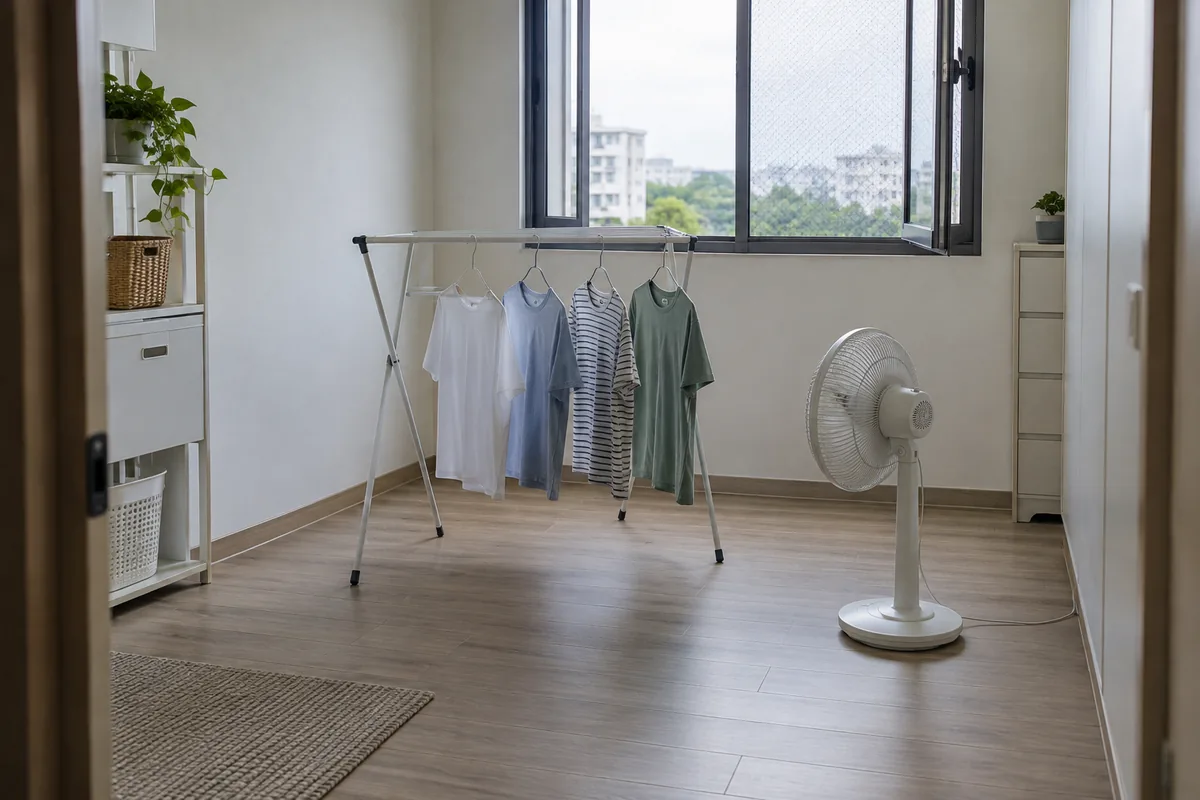
What if the clothes still take too long?
Check the pattern before buying a larger fan or turning everything to maximum.
| What you notice | Useful next check |
|---|---|
| The front items dry while covered layers stay damp | Open gaps, inspect folds and rearrange the rack with the fan off |
| A large part of the rack receives little airflow | Review direction and obstructions within the fan's permitted adjustments |
| The room becomes persistently damp or windows collect condensation | Review moisture removal and the room itself; more circulation alone does not resolve the cause |
| Drying varies between loads | Compare fabric, starting wetness, spacing and room conditions before blaming the fan |
These are observations to guide the next step, not a diagnosis of the building. Persistent condensation or damp deserves attention from the property owner or an appropriate professional. A fan is not a mould treatment.
Should a fan and dehumidifier run together?
They can perform different jobs: the fan supplies local air movement while the dehumidifier removes moisture. First check the dehumidifier's own airflow and placement; it may already circulate enough air around a sensibly arranged rack.
ENERGY STAR's dehumidifier guidance advises keeping the unit's airflow clear and closing doors and windows to the space while dehumidifying efficiently. It also keeps water drainage away from electrical equipment. Follow the specific model's instructions and the room's ventilation requirements rather than combining every possible arrangement.
A dehumidifier can warm the surrounding space. An evaporative air cooler, meanwhile, adds moisture as it operates; it is not a substitute for dehumidification. The fan, air cooler and air conditioner comparison explains these different processes.
Does high speed save time or electricity?
Judge the completed drying task, not the speed label. Record when you start, which setting you use and whether the garments are actually dry when you stop. Compare similar loads and conditions; do not copy another household's overnight result.
The fan electricity calculator can estimate energy from the fan's input watts and operating hours. If you also run a dehumidifier, count its consumption separately. Without comparable drying results and energy measurements, there is no basis for claiming that the highest setting or two appliances always cost less.
For a rechargeable fan, speed also affects battery runtime. Solar charging changes the energy source; it does not remove water from the room or establish a special drying mode. Farseen's published specifications do not provide a measured laundry-drying time or blanket permission for use in damp areas.
Choose a setup you can inspect and use within the equipment instructions. A timer or battery does not by itself establish unattended-use permission. Before putting clothes away, check the actual fabric rather than treating elapsed fan time as proof that the load is dry.

Farseen Editorial Team
The Farseen Editorial Team publishes practical guides and company updates about solar rechargeable fans, off-grid appliances, and product sourcing. Where an article discusses product-specific details, refer to its cited sources or contact Farseen for current information.