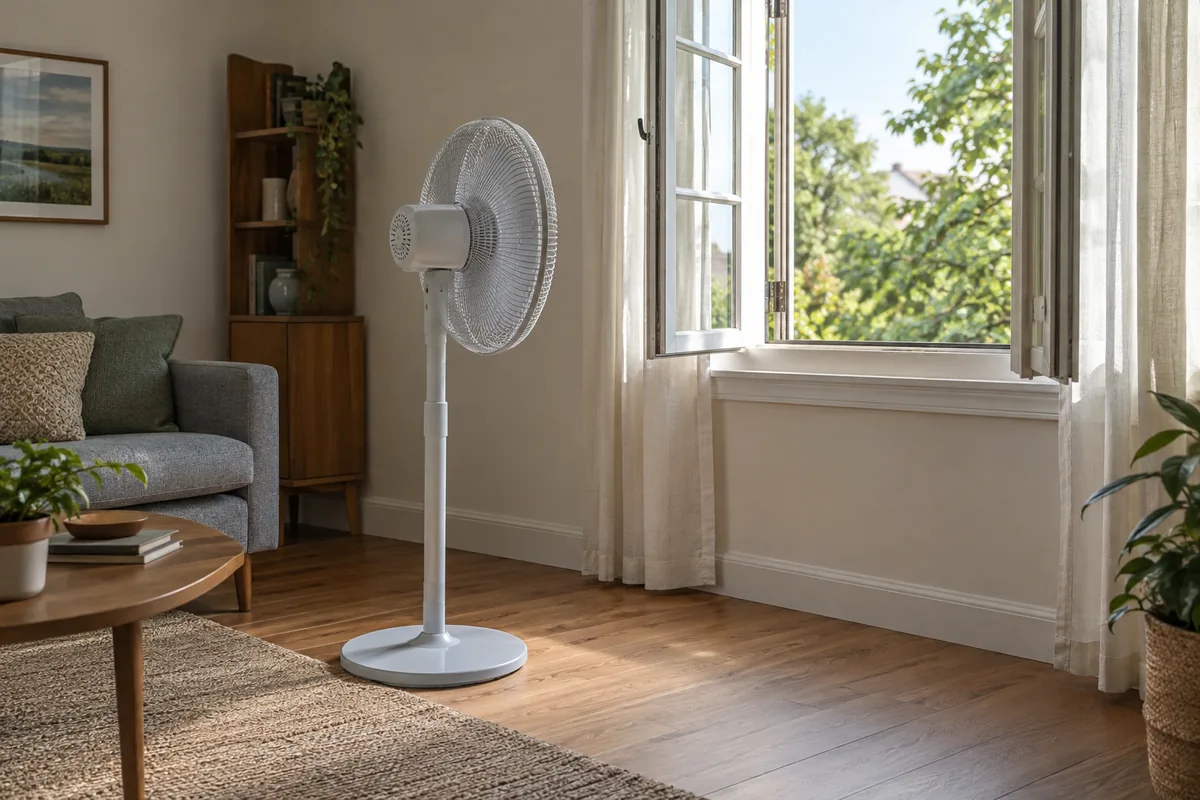
Either direction can be useful. To bring cooler outside air into a room, a suitable fan can assist incoming airflow. To move indoor air out, it can face an open window while another safe opening provides replacement air. Start with the direction air is already moving, the outdoor conditions and the path through your room. There is no single direction or distance that works best everywhere.
Only try a position that your fan's instructions permit. An ordinary household fan belongs on a stable indoor surface; being rechargeable or solar-powered does not make it a window-mounted or weatherproof appliance.
First decide what you want to cool
If you want a breeze at your desk, the useful question is whether air reaches you comfortably. You may get a better result by directing the fan toward your seat than by putting it near a window. Circulating fans primarily improve personal comfort; see why fans can feel cool without lowering room temperature.
If you want to lower indoor air temperature through ventilation, the incoming air needs to offer useful cooling. The U.S. Department of Energy's explanation of natural ventilation identifies cool nights and suitable breezes as favorable conditions. Pulling in hotter air does not become a cooling strategy merely because the fan feels strong.
Check outdoor air quality and weather before opening up. Smoke, pollution, excessive humidity, rain or an unsafe open window can rule out this approach. Follow local air-quality and heat advisories rather than relying on a fan arrangement to make unsuitable conditions safe.
Choose an airflow path, then a direction
Think of the room as a route between openings. Mark the window where air can enter, where it can leave, and any doors or furniture between them.
| What you find | A useful starting arrangement | What to check |
|---|---|---|
| Cooler air is already entering one window | An indoor fan may help carry that air farther into the occupied area | The fan's placement is permitted and its rear intake has space |
| Air naturally leaves through a window, with another opening available | A suitable fan facing outward can assist that route | Replacement air can travel through the room to the outlet |
| Two usable openings and two suitable fans | Consider one assisting intake and the other assisting exhaust | Both serve the same route rather than competing at adjacent positions |
| Only one opening or a closed internal door | Begin with a modest trial and observe the result | Do not assume strong air near the fan means the whole room is being ventilated |
| Outside is hotter, smoky or otherwise unsuitable | Reconsider bringing outside air in for cooling | Personal airflow and other cooling options serve different needs |
The EPA's guidance on improving natural ventilation allows fans facing inward or outward. For a single fan, it recommends following the existing airflow direction; it also describes using separate intake and exhaust fans. These are ventilation principles, not a guarantee for a particular room or appliance.
Before turning on the fan, you can look at the movement of an existing curtain from a safe distance. Secure loose fabric away from the fan before operation. Do not release paper or hold objects near its grille to trace airflow. Wind direction can change, so an arrangement that works one evening may need reconsidering later.
Is blowing out always better?
Blowing out makes sense when the window is a useful outlet and replacement air can enter elsewhere. South Carolina's Energy Saver guidance for purpose-built window fans describes exhausting on the side away from the prevailing wind and drawing intake air from other openings.
That does not establish “outward is always best” for a portable fan beside a single bedroom window. A different layout may already receive a useful incoming breeze. A door that must remain closed may also change the available route.
Describe your actual arrangement before copying one from a photograph: one window or two, doors open or closed, fan inside or mounted in an approved opening, and wind coming from which direction. Those details can explain why two people report different results.
How far should the fan be from the window?
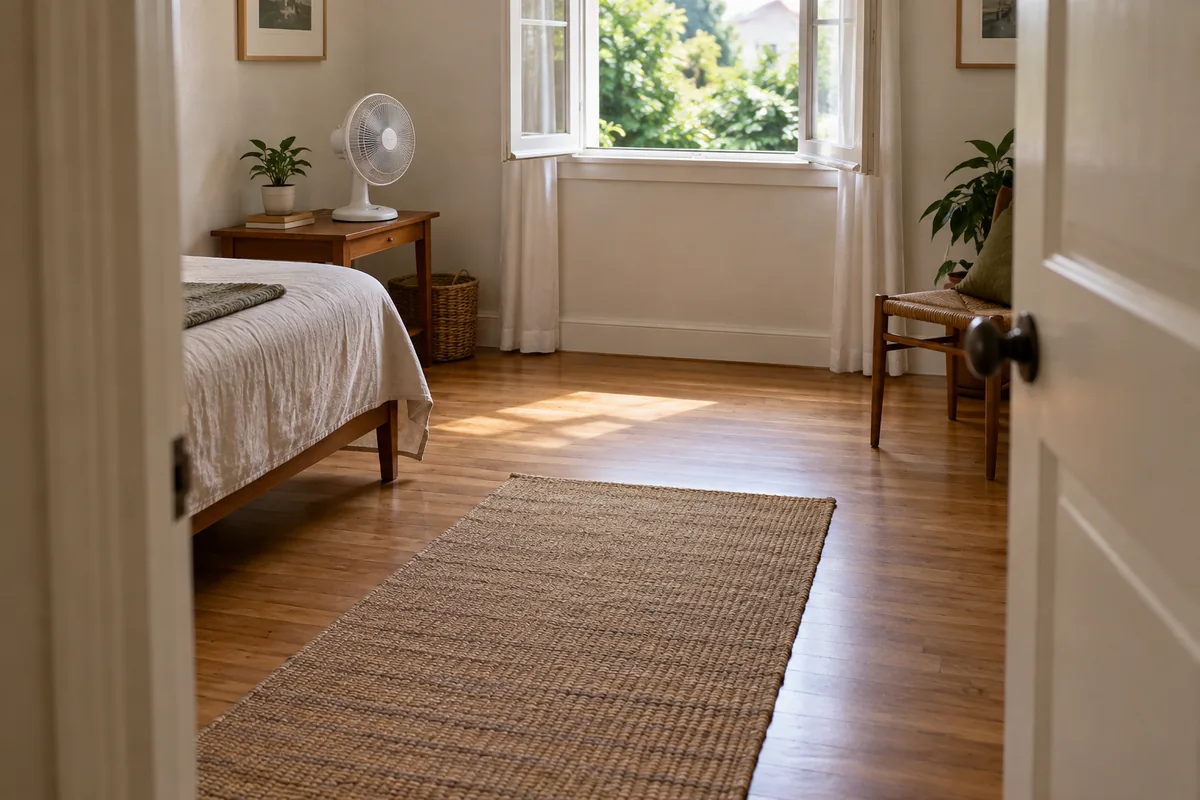
Use the model's required clearances first, then compare permitted positions. We do not have evidence for a universal “two feet,” “one metre” or other best distance for ordinary household fans.
The Building America ventilation-cooling guide identifies opening area, wind, the placement of openings and indoor–outdoor temperature differences as relevant factors. It does not provide a universal setback for your desk or standing fan.
A practical trial should keep the speed and window arrangement the same while changing one permitted fan position. Switch off and disconnect the fan before moving it. Record the distance you actually used, but treat it as a description of your room, not a rule to recommend to everyone else.
Avoid improvised stands, stacks of books and narrow windowsills. Never move the fan closer simply to follow a suggested distance if that makes it unstable, exposes it to water or puts fabric within reach of the grille.
Compare the result at the place you use
Make a short record with these entries:
- Conditions: time, indoor and outdoor temperature if available, wind and open doors/windows.
- Arrangement: fan position, direction and speed.
- Personal comfort: whether useful air reaches the actual chair or bed, including when the fan sweeps away.
- Room trend: temperature at the same indoor measuring position before and after the trial, away from direct sun and the immediate window opening.
- Practical problems: noise, obstructed access, a stretched cable or curtains moving toward the appliance.
This is a household comparison, not an airflow or air-change measurement. A cooler evening during your second trial can explain part of the improvement. Feeling a stronger breeze alone does not prove that the room temperature fell.
Keep the fan's permitted use in view
Some indoor fans expressly prohibit window use. For example, the Vornado Z-Series DC manual excludes placing those models in a window and warns against unstable surfaces, water exposure and nearby fabric. Follow your own model's restrictions even when a general ventilation diagram shows a fan at an opening.
Farseen's T02 is a desk format, 198F and S600 are standing formats, and W01 is wall-mounted. These formats do not establish window-exhaust performance or permission to expose the fan to weather. Use the desk versus standing fan guide when the main issue is finding a stable position with useful airflow.
Keep the inlet and outlet clear. If visible dust needs attention before a placement comparison, follow the guide to cleaning a fan with a difficult-to-remove grille. If your main question is directed personal airflow versus air mixing, the air circulator comparison explains that separate choice.

Farseen Editorial Team
The Farseen Editorial Team publishes practical guides and company updates about solar rechargeable fans, off-grid appliances, and product sourcing. Where an article discusses product-specific details, refer to its cited sources or contact Farseen for current information.