The battery chemistry affects weight, charging requirements and how a rechargeable fan's battery behaves over time. It does not, by itself, tell you how strong the breeze will be or how many hours the complete fan will run. Compare the battery specification together with the fan's power demand, charging system, controls and service arrangements.
For a fan used during power cuts, the practical question is whether it delivers useful airflow for the required time and can be recharged and maintained in your routine. The word “lithium” is a starting point for that comparison, not a complete specification.
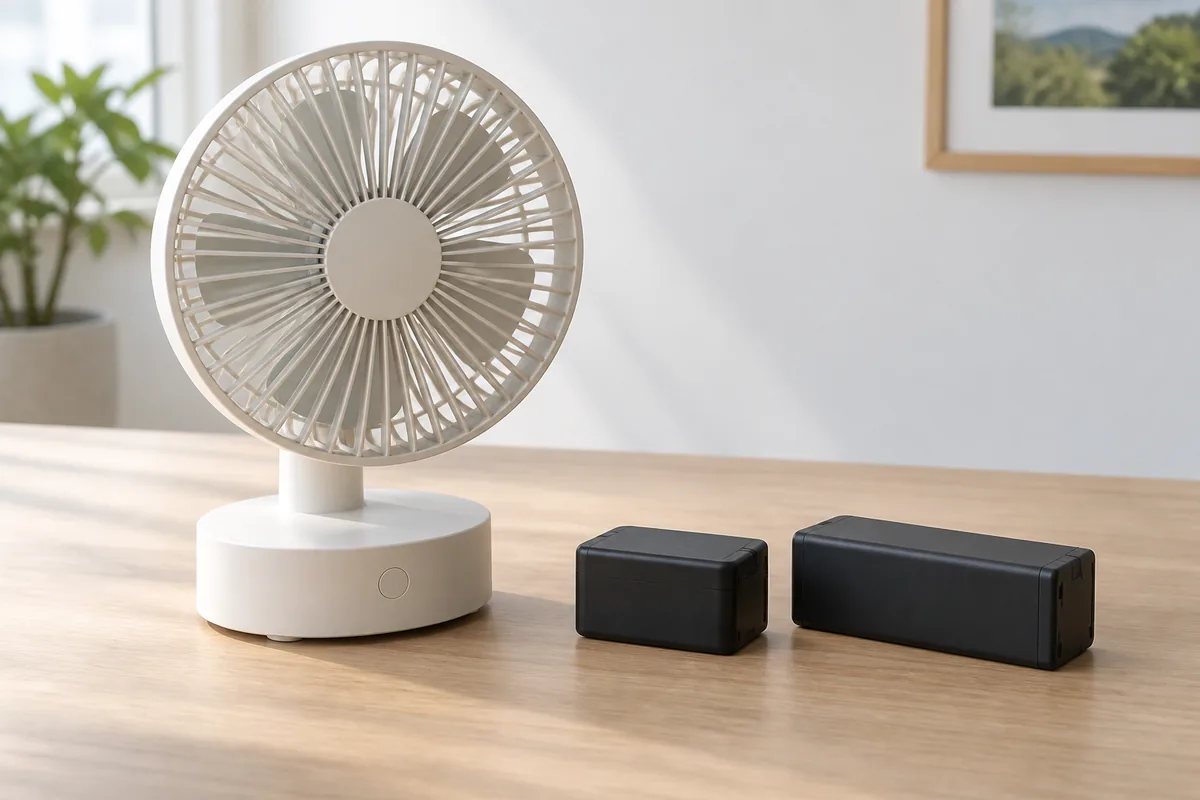
What do the battery names actually mean?
Lead-acid describes a battery chemistry. Within that family, sealed lead-acid designs include AGM, which uses an absorbent glass mat to hold the electrolyte. “Sealed” does not make charging conditions irrelevant: Power-Sonic's AGM guide explains the construction and the importance of the appropriate charging method.
Lithium-ion is a broader family that includes different chemistries. Lithium iron phosphate, usually written LiFePO4 or LFP, is one of them. A comparison about LFP should not silently be treated as a test of every lithium battery sold in a fan.
18650 identifies a cylindrical cell size format; it does not identify a complete pack's chemistry, capacity or protection system. Panasonic's catalogue lists size, cell technology, voltage and capacity as separate fields. You need the actual cell or pack specification to know what you are comparing.
For an assembled fan, ask for the complete battery-pack description. A cell-format label alone cannot establish that the product contains LiFePO4 cells or accepts a particular replacement pack.
Compare the differences that affect everyday use
| What matters to you | What to compare | What the chemistry label leaves unanswered |
|---|---|---|
| Moving the fan between rooms | Complete fan weight and ease of carrying | Battery size, stand weight and handle design |
| Getting through a power cut | Runtime at the speed you actually use | Starting charge, motor demand, controls and other loads |
| Being ready for the next outage | Documented charging time with the supplied equipment | Whether your available charging window is sufficient |
| Keeping a backup fan for occasional use | Storage and maintenance instructions | The correct charging routine for that exact product |
| Using the fan for several years | Battery specification, test conditions and service support | A guaranteed replacement date or lifespan |
Lithium batteries can offer less weight for a comparable energy requirement. Lead-acid capacity is also more sensitive to the discharge rate than the LFP batteries in Power-Sonic's comparison. These are useful reasons to investigate the specification, but they do not supply a weight saving or runtime multiplier for two finished fans.
For example, a lighter battery does not necessarily mean a lighter fan if the products have different stands and motors. Compare the total equipment you will use, not one component in isolation.
Which one runs longer on a charge?
You cannot settle that from the chemistry name or mAh number alone. First establish the energy rating of the complete battery pack. Then compare how the fan uses that energy at the required setting.
The Wh and mAh explanation shows why nominal voltage matters when comparing capacity. Even matching Wh figures do not guarantee identical runtime: the available energy, control cutoffs and operating load can differ.
Ask for runtime with the speed setting and test conditions stated. “Up to” runtime without a setting may not answer a need for strong airflow during an evening outage. Read how fan speed changes battery life before comparing the longest numbers on two listings.
Also distinguish runtime from service life. Runtime is how long one charge lasts. Service life concerns how the battery performs as it ages. A short first run does not prove rapid ageing, and a good first run does not establish several years of performance.
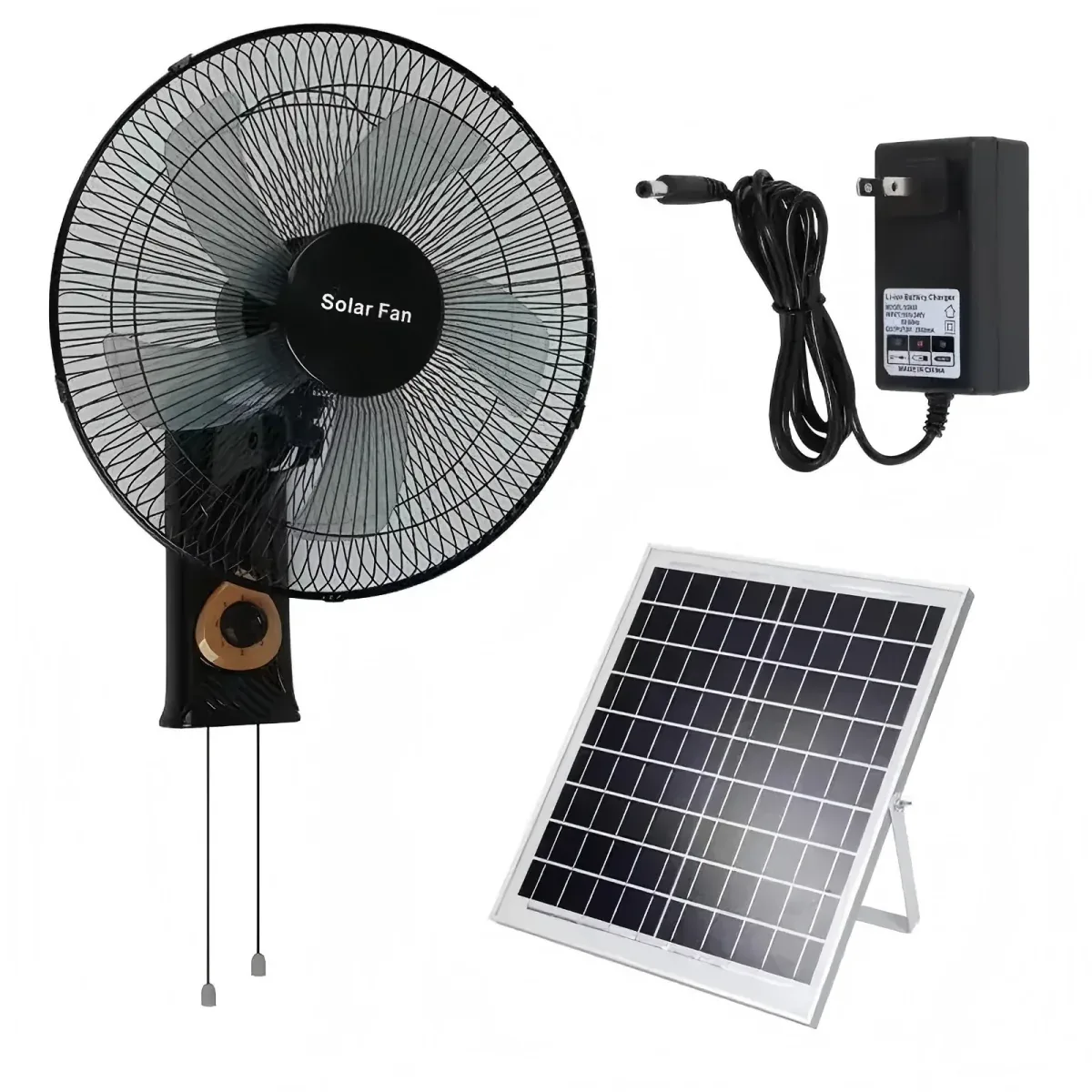
Why do the charger and protection circuit matter?
A rechargeable battery needs a charging process suited to its chemistry and configuration. In its LFP charging guide, Power-Sonic distinguishes the charging stages and standby treatment of sealed lead-acid and LFP batteries. It recommends choosing a charger designed for the battery chemistry. Its battery-level advice is not permission to use those chargers with an arbitrary fan.
For a finished fan, follow the fan manufacturer's instructions for the complete system. Read the charger-label guide if the battery voltage and adapter output differ. Matching the nominal battery voltage does not establish an acceptable charging source.
Protection electronics matter too. A battery-management or protection circuit can monitor conditions such as cell voltage and current and interrupt operation when its configured limits are reached. Texas Instruments' protection-device documentation illustrates these functions and their dependence on circuit configuration. A label saying “BMS” does not tell you which protections the finished product implements or replace a suitable charger.
For the same reason, a fan stopping with charge apparently remaining is not enough to diagnose battery failure. The charge indication, operating load and protection behavior all need to be considered for that model.
How should you care for an occasional-use fan?
Keep the original charging instructions with the fan and check the specified storage conditions. Lead-acid and lithium products can require different treatment during long periods without use. Avoid transferring a storage percentage or recharge interval from a different battery or an online comment to your own unit.
A useful personal record is simple: note when the fan was charged, which source was used, the selected speed and how long it ran. If performance changes, compare under similar conditions before blaming the chemistry. The guide to a rechargeable fan getting weaker explains the difference between weak airflow and shortened runtime.
Can you replace lead-acid with lithium later?
Only use a replacement approved for the exact fan. Similar size, a matching nominal voltage or a higher capacity label does not establish compatibility with the charging electronics, connectors and protection arrangement. Treat a chemistry change as a system-compatibility question, not a routine upgrade.
Also separate a battery that a service technician can replace from one designed for users to remove. The built-in versus external battery guide explains that distinction. Before buying a fan for long-term use, find out who handles battery service and how a matching replacement is identified.
Choose using the complete specification: useful airflow, documented runtime, a workable charging routine and clear service information. Chemistry helps explain the design; those practical checks tell you whether the fan suits the job.

Farseen Editorial Team
The Farseen Editorial Team publishes practical guides and company updates about solar rechargeable fans, off-grid appliances, and product sourcing. Where an article discusses product-specific details, refer to its cited sources or contact Farseen for current information.